LECTURE 1
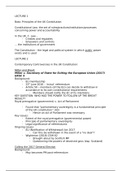
Basic Principles of the UK Constitution:
Constitutional Law: the set of rules/practices/institutions/processes
concerning power and accountability
In the UK, C. Law…
- Creates and regulates
- Empowers and controls
… the institutions of government
The Constitution – the legal and political system in which public power
exists and is used
LECTURE 2
Contemporary Controversies in the UK Constitution:
Miller and Brexit
Miller v. Secretary of State for Exiting the European Union (2017)
UKSC 5
Background:
- EU membership
- 23rd June 2016 – ‘in/out’ referendum
- Article 50 – members (of the EU) can decide to withdraw in
accordance to its own constitutional requirements
- Members should notify the EC of its intentions
KEY QUESTION: WHO HAD THE POWER TO FOLLOW UP THE BREXIT
RESULT?
Royal prerogative (government) v. Act of Parliament
- Found that “parliamentary sovereignty is a fundamental principle
of the UK constitution” (43)
- Hence an act of Parliament was necessary
Key issues:
- Extent of the royal prerogative (governmental power)
- Principle of parliamentary sovereignty
- Legal significance of referendums
Ongoing issues:
- EU (Notification of Withdrawal) Act 2017
- Can this be withdrawn in the event of a “no deal”?
- Wightman (2018) CSIH 62
- Brought about by Scottish MP
- Questioning the powers of devolved govs (esp. Scotland)
Calling the 2017 General Election
Background:
- May becomes PM post-referendum
, - Wants opportunity to establish legitimacy and clear
mandate for strong Brexit
- Fixed Term Parliaments Act 2011
- “I’m not going to be calling a snap election” (May)
- Pre-2011 position: Queen has power to dissolve parliament
by PM’s advice
- Post-2011 position: Early elections can be called on the
conditions that:
- Vote of no confidence in government
- 2/3 majority vote in Commons
Legal Issues:
- Relationship between statute and royal prerogative
- Idea of constitutional conventions
- Role of politics
Key Issues:
- Failure of the 2011 Act
- Aimed to limit the power of the PM but failed
- Irresistibility of politics
- Repeal, replace, reform, retain?
- Could have simply inserted an amendment specific to that
election as Constitutional law is not superior to other law
EU (Withdrawal) Act 2018 and the Scottish Continuity Bill
Background:
- Referendum and Article 50 notice given
- Part of the domestic preparation for leaving
- Making EU law automatically domestic law
WOULD MAKE ALL EU LAW UK LAW – too many laws to begin from scratch
Legal Issues:
- Broad secondary law-making powers delegated to the
government
- Gov can change old EU laws rather than having to go
through Parliament
- Limiting the competence of the devolved institutions in
Scotland/Wales/NI
- Powers of changing “EU law” restricted to Westminster
- Marginalising devolved powers e.g Scottish
parliament
Key Issues:
- Scotland refuses to consent to the 2018 Act
- Marginalises devolved institutions
- May lead to another Scottish independence referendum?
- However, still lawfully enacted by UK Parliament
- Sovereign power but usually limits itself to acting with the
consent of all devolved institutions
Ongoing Issues:
- Scotland enacting its own law
, - Contradicts parts of UK law
- UK withdrawal from the European Union (legal continuity)
(Scotland) Bill (March 2018)
- Attempts to retain powers so that the Scottish government
can have more say in the decisions of the UK Parliament
- Getting power back; demarginalization
- UK SC challenge July 2018
- Potential implications for Scotland
- Feel they have been “constitutionally isolated” from Brexit
process
- Another independence referendum?
Recurring debate – the role of the courts in deciding major political
debates
- Centre for legal and political disputes
LECTURE 3
- In Public Law, there cannot merely be a focus on law:
- “public law is applied politics” – W.I. Jennings
- Constitutional law also does not exist solely to limit government
- “the constitution is not a ‘suicide pact’” – Justice Robert
Jackson
- Not just something to defeat government and
prevent things from happening
A constitution is:
- A set of rules and practices
- Both legal and non-legal
- Providing a basis for gov in a state (or society/community etc)
Functions of a constitution:
- Constitutes and distributes public power
- Creating mechanisms of reliability
- Gives a government the appearance of legitimacy
Legitimacy: having the right to exercise power/ to rule
- The constitution doesn’t make the government legitimate; it acts
to persuade the people that the gov’s power is legitimate
- Acts as a legitimacy claim, e.g “We the people” in the US
Constitution
A constitution is always subject to revolution as it cannot protect itself
The challenge of UK ‘exceptionalism’
- Argued that the UK has no constitution
- Dangerous – open to elective dictatorship since all
legislation has equal power/ no sovereign laws
Basic Principles of the UK Constitution:
Constitutional Law: the set of rules/practices/institutions/processes
concerning power and accountability
In the UK, C. Law…
- Creates and regulates
- Empowers and controls
… the institutions of government
The Constitution – the legal and political system in which public power
exists and is used
LECTURE 2
Contemporary Controversies in the UK Constitution:
Miller and Brexit
Miller v. Secretary of State for Exiting the European Union (2017)
UKSC 5
Background:
- EU membership
- 23rd June 2016 – ‘in/out’ referendum
- Article 50 – members (of the EU) can decide to withdraw in
accordance to its own constitutional requirements
- Members should notify the EC of its intentions
KEY QUESTION: WHO HAD THE POWER TO FOLLOW UP THE BREXIT
RESULT?
Royal prerogative (government) v. Act of Parliament
- Found that “parliamentary sovereignty is a fundamental principle
of the UK constitution” (43)
- Hence an act of Parliament was necessary
Key issues:
- Extent of the royal prerogative (governmental power)
- Principle of parliamentary sovereignty
- Legal significance of referendums
Ongoing issues:
- EU (Notification of Withdrawal) Act 2017
- Can this be withdrawn in the event of a “no deal”?
- Wightman (2018) CSIH 62
- Brought about by Scottish MP
- Questioning the powers of devolved govs (esp. Scotland)
Calling the 2017 General Election
Background:
- May becomes PM post-referendum
, - Wants opportunity to establish legitimacy and clear
mandate for strong Brexit
- Fixed Term Parliaments Act 2011
- “I’m not going to be calling a snap election” (May)
- Pre-2011 position: Queen has power to dissolve parliament
by PM’s advice
- Post-2011 position: Early elections can be called on the
conditions that:
- Vote of no confidence in government
- 2/3 majority vote in Commons
Legal Issues:
- Relationship between statute and royal prerogative
- Idea of constitutional conventions
- Role of politics
Key Issues:
- Failure of the 2011 Act
- Aimed to limit the power of the PM but failed
- Irresistibility of politics
- Repeal, replace, reform, retain?
- Could have simply inserted an amendment specific to that
election as Constitutional law is not superior to other law
EU (Withdrawal) Act 2018 and the Scottish Continuity Bill
Background:
- Referendum and Article 50 notice given
- Part of the domestic preparation for leaving
- Making EU law automatically domestic law
WOULD MAKE ALL EU LAW UK LAW – too many laws to begin from scratch
Legal Issues:
- Broad secondary law-making powers delegated to the
government
- Gov can change old EU laws rather than having to go
through Parliament
- Limiting the competence of the devolved institutions in
Scotland/Wales/NI
- Powers of changing “EU law” restricted to Westminster
- Marginalising devolved powers e.g Scottish
parliament
Key Issues:
- Scotland refuses to consent to the 2018 Act
- Marginalises devolved institutions
- May lead to another Scottish independence referendum?
- However, still lawfully enacted by UK Parliament
- Sovereign power but usually limits itself to acting with the
consent of all devolved institutions
Ongoing Issues:
- Scotland enacting its own law
, - Contradicts parts of UK law
- UK withdrawal from the European Union (legal continuity)
(Scotland) Bill (March 2018)
- Attempts to retain powers so that the Scottish government
can have more say in the decisions of the UK Parliament
- Getting power back; demarginalization
- UK SC challenge July 2018
- Potential implications for Scotland
- Feel they have been “constitutionally isolated” from Brexit
process
- Another independence referendum?
Recurring debate – the role of the courts in deciding major political
debates
- Centre for legal and political disputes
LECTURE 3
- In Public Law, there cannot merely be a focus on law:
- “public law is applied politics” – W.I. Jennings
- Constitutional law also does not exist solely to limit government
- “the constitution is not a ‘suicide pact’” – Justice Robert
Jackson
- Not just something to defeat government and
prevent things from happening
A constitution is:
- A set of rules and practices
- Both legal and non-legal
- Providing a basis for gov in a state (or society/community etc)
Functions of a constitution:
- Constitutes and distributes public power
- Creating mechanisms of reliability
- Gives a government the appearance of legitimacy
Legitimacy: having the right to exercise power/ to rule
- The constitution doesn’t make the government legitimate; it acts
to persuade the people that the gov’s power is legitimate
- Acts as a legitimacy claim, e.g “We the people” in the US
Constitution
A constitution is always subject to revolution as it cannot protect itself
The challenge of UK ‘exceptionalism’
- Argued that the UK has no constitution
- Dangerous – open to elective dictatorship since all
legislation has equal power/ no sovereign laws