Nur 256 Exam #1 UPDATED ACTUAL
Questions and CORRECT Answers
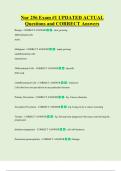
Benign - CORRECT ANSWER - slow growing
differentiated cells
stasis
Malignant - CORRECT ANSWER - rapid growing
undifferentiated cells
metastasizes
Differentiated Cells - CORRECT ANSWER - Specific
Still work
Undifferentiated Cells - CORRECT ANSWER - Unknown
Cells that have not specialized in any particular function
Primary Prevention - CORRECT ANSWER - Eg: Cancer education
Secondary Prevention - CORRECT ANSWER - Eg: Going in for a cancer screening
Tertiary - CORRECT ANSWER - Eg: Having been diagnosed with cancer and slowing the
progression
Initiation (apoptosis) - CORRECT ANSWER - cell self-destructs
Promotion (preneoplastic) - CORRECT ANSWER - Benign
, Progression (angiogenesis) - CORRECT ANSWER - New blood vessels
How does cancer spread? - CORRECT ANSWER - Travel through blood stream,
lymphatic system (lymph nodes)
TNM (Tumor, Node, Metastasis) - CORRECT ANSWER - Staging 1-4; 1 being
differentiated and 4 being non-differentiated
Developmental Disability - CORRECT ANSWER - -Genetic
-Born with it
Acquired Disability - CORRECT ANSWER - conditions caused after birth by illness or
accident
Disability due to Age - CORRECT ANSWER - Body is unable to function properly due to
the aging processes
Hypovolemic Shock - CORRECT ANSWER - shock resulting from blood or fluid loss
s/sx of hypovolemic shock - CORRECT ANSWER - •Pallor
•Cool, moist skin
•Rapid respirations
•Cyanosis
•Rapid, weak, thready pulse (tachycardia)
•Decreasing pulse pressure
•Low blood pressure (hypotension)
•Concentrated urine
*Place pt in Trendelenburg postion
Questions and CORRECT Answers
Benign - CORRECT ANSWER - slow growing
differentiated cells
stasis
Malignant - CORRECT ANSWER - rapid growing
undifferentiated cells
metastasizes
Differentiated Cells - CORRECT ANSWER - Specific
Still work
Undifferentiated Cells - CORRECT ANSWER - Unknown
Cells that have not specialized in any particular function
Primary Prevention - CORRECT ANSWER - Eg: Cancer education
Secondary Prevention - CORRECT ANSWER - Eg: Going in for a cancer screening
Tertiary - CORRECT ANSWER - Eg: Having been diagnosed with cancer and slowing the
progression
Initiation (apoptosis) - CORRECT ANSWER - cell self-destructs
Promotion (preneoplastic) - CORRECT ANSWER - Benign
, Progression (angiogenesis) - CORRECT ANSWER - New blood vessels
How does cancer spread? - CORRECT ANSWER - Travel through blood stream,
lymphatic system (lymph nodes)
TNM (Tumor, Node, Metastasis) - CORRECT ANSWER - Staging 1-4; 1 being
differentiated and 4 being non-differentiated
Developmental Disability - CORRECT ANSWER - -Genetic
-Born with it
Acquired Disability - CORRECT ANSWER - conditions caused after birth by illness or
accident
Disability due to Age - CORRECT ANSWER - Body is unable to function properly due to
the aging processes
Hypovolemic Shock - CORRECT ANSWER - shock resulting from blood or fluid loss
s/sx of hypovolemic shock - CORRECT ANSWER - •Pallor
•Cool, moist skin
•Rapid respirations
•Cyanosis
•Rapid, weak, thready pulse (tachycardia)
•Decreasing pulse pressure
•Low blood pressure (hypotension)
•Concentrated urine
*Place pt in Trendelenburg postion