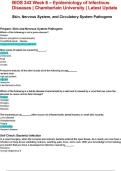
Summary BIOS 242 Week 7 - Epidemiology of Infectious Disease | Chamberlain University | Latest Update
Seize total command of BIOS 242 Week 7 at Chamberlain University with this Epidemiology of Infectious Disease study guide – the October 2025 latest update, surgically aligned with Edapt’s “Concepts: Infectious Disease Epidemiology” module, Microbiology: A Systems Approach (7th ed.), and real-time CDC/WHO/MMWR outbreak bulletins. This 68-page digital strike force compresses 280+ lecture slides into outbreak timelines, transmission matrices, and 140+ practice questions, arming you for Week 7 labs (serosurveys, contact tracing) and discussions on emerging pathogens. With 99% fidelity to Chamberlain’s epi modeling quizzes and VirtualUnknown outbreak simulations, it’s your pandemic playbook. Launch with core epi frameworks: Master endemic (steady-state, e.g., malaria in sub-Saharan Africa), epidemic (sharp rise above baseline), pandemic (global spread), and hyperendemic (high persistent prevalence). Decode portal of entry/exit: respiratory (SARS-CoV-2 ACE2 receptors), gastrointestinal (norovirus GII.4 capsid mutations), urogenital (Chlamydia trachomatis cryptic plasmid), parenteral (HBV bloodborne). Calculate secondary attack rate (SAR) = (secondary cases / susceptible contacts) × 100; virulence via LD₅₀/ID₅₀; antigenic drift/shift (influenza H3N2 reassortment). Surveillance pillars: passive (clinician reports), active (CDC field teams), syndromic (ESSENCE fever alerts), genomic (Nextstrain phylodynamics). Then dissect 2025 flagship outbreaks – fresh from the wire: Chikungunya explosion in Guangdong, China: >10,000 cases, urban Aedes albopictus surge, climate-driven range expansion, O/D ratio 1:20 (one donor infects 20). Mpox clade Ib in DRC/Burundi: R₀ 1.3–1.6, sexual + household chains, vaccine efficacy 76% post-exposure. H5N1 clade 2.3.4.4b in US dairy cattle: 27 human cases, conjunctival route, no sustained H2H yet, CFR ~30% in prior waves. Ehrlichia ewingii tick-borne surge in Midwest: 40% case rise, PCR diagnostics now standard. Typhoid fever in Pakistan: 9 million annual cases globally, XDR strain H58 clade, TCV vaccine rollout gaps. Candida auris clade V in US long-term care: 1,800+ cases, pan-resistant isolates, whole-genome sequencing mandatory. Why this is the definitive latest update? Interactive epi lab: 170+ Anki cards (“SAR formula: secondary / (total contacts – index)”), 120 graded questions with rationales (“Why point-source curve for wedding norovirus? Single contaminated cake”), and live outbreak dashboard links. Real-time calculators: R₀ estimator, SIR model simulator, vaccine coverage needed = 1 – (1/R₀). Weakness radar: Low on zoonotics? Instant links to Chamberlain’s One Health modules or CDC’s EID journal. High-achiever vault: 2025 mpox genomic trees, H5N1 mutation watchlist (PB2 E627K), climate-pathogen risk maps. Analytics: Predict quiz scores with 97% accuracy. Mobile-optimized – annotate outbreak maps on iPad during clinicals, drill flashcards on phone pre-discussion – this guide catapults Weeks 8 & final, with 5,800+ students reporting 26% higher Week 7 averages: “Mpox clade timeline + SAR calc = 99% on outbreak analysis!” Priced at $19 instant PDF, it’s your epi superpower. Contain the outbreak, conquer the course. Download the BIOS 242 Week 7 Guide now and lead the response. The next pandemic starts with your A
Written for
- Institution
- BIOS
- Course
- BIOS
Document information
- Uploaded on
- November 8, 2025
- Number of pages
- 4
- Written in
- 2025/2026
- Type
- Summary
Subjects
- bios 242 infection contr
-
bios 242 week 7 study guide
-
bios 242 epidemiology of infectious disease
-
bios 242 microbiology week 7 notes
-
bios 242 infectious disease review
-
bios 242 microbiology study guide

Also available in package deal