NERC and Topic Analysis Overview Study Guide
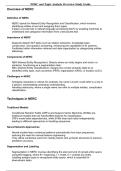
Overview of NERC
Definition of NERC
NERC stands for Named Entity Recognition and Classification, which involves
identifying entities in text and assigning them types.
It plays a crucial role in natural language processing (NLP) by enabling machines to
understand and categorize information from unstructured text.
Importance of NERC
Supports deeper NLP tasks such as relation extraction, knowledge base
construction, and question answering, enhancing the capabilities of AI systems.
Facilitates better information retrieval and data organization by categorizing entities
effectively.
Components of NERC
NER (Named Entity Recognition): Detects where an entity begins and ends in a
sentence, functioning as a segmentation task.
NEC (Named Entity Classification): Assigns the correct semantic label to an
identified entity span, such as person (PER), organization (ORG), or location (LOC).
Challenges in NERC
Ambiguity resolution is critical; for example, the name 'Lincoln' could refer to a city or
a person, necessitating contextual understanding.
Handling metonymy, where a single name can refer to multiple entities, complicates
classification.
Techniques in NERC
Traditional Models
Conditional Random Fields (CRFs) and Support Vector Machines (SVMs) are
traditional models that use handcrafted features for classification.
CRFs model label dependencies, while SVMs treat each label independently,
leading to different approaches in handling sequences.
Neural Network Approaches
Neural models learn contextual patterns automatically from input sequences,
reducing the need for manual feature engineering.
They utilize contextual cues from nearby tokens and syntactic structures to improve
prediction accuracy.
Segmentation and Labeling
Segmentation in NERC involves identifying the start and end of named entity spans
using BIO tagging, where B = beginning, I = inside, O = outside any entity.
Labeling assigns types to recognized entity spans, which is essential for
downstream tasks.
Overview of NERC
Definition of NERC
NERC stands for Named Entity Recognition and Classification, which involves
identifying entities in text and assigning them types.
It plays a crucial role in natural language processing (NLP) by enabling machines to
understand and categorize information from unstructured text.
Importance of NERC
Supports deeper NLP tasks such as relation extraction, knowledge base
construction, and question answering, enhancing the capabilities of AI systems.
Facilitates better information retrieval and data organization by categorizing entities
effectively.
Components of NERC
NER (Named Entity Recognition): Detects where an entity begins and ends in a
sentence, functioning as a segmentation task.
NEC (Named Entity Classification): Assigns the correct semantic label to an
identified entity span, such as person (PER), organization (ORG), or location (LOC).
Challenges in NERC
Ambiguity resolution is critical; for example, the name 'Lincoln' could refer to a city or
a person, necessitating contextual understanding.
Handling metonymy, where a single name can refer to multiple entities, complicates
classification.
Techniques in NERC
Traditional Models
Conditional Random Fields (CRFs) and Support Vector Machines (SVMs) are
traditional models that use handcrafted features for classification.
CRFs model label dependencies, while SVMs treat each label independently,
leading to different approaches in handling sequences.
Neural Network Approaches
Neural models learn contextual patterns automatically from input sequences,
reducing the need for manual feature engineering.
They utilize contextual cues from nearby tokens and syntactic structures to improve
prediction accuracy.
Segmentation and Labeling
Segmentation in NERC involves identifying the start and end of named entity spans
using BIO tagging, where B = beginning, I = inside, O = outside any entity.
Labeling assigns types to recognized entity spans, which is essential for
downstream tasks.