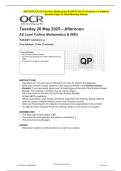
2025 OCR AS Level Further Mathematics B (MEI) Y412/01 Statistics a Combined
Question Paper & Final Marking Scheme
Oxford Cambridge and RSA
Tuesday 20 May 2025 – Afternoon
AS Level Further Mathematics B (MEI)
Y412/01 Statistics a
Time allowed: 1 hour 15 minutes
You must have:
• the Printed Answer Booklet
• the Formulae Booklet for Further Mathematics B
QP
(MEI)
• a scientific or graphical calculator
INSTRUCTIONS
• Use black ink. You can use an HB pencil, but only for graphs and diagrams.
• Write your answer to each question in the space provided in the Printed Answer
Booklet. If you need extra space use the lined pages at the end of the Printed Answer
Booklet. The question numbers must be clearly shown.
• Fill in the boxes on the front of the Printed Answer Booklet.
• Answer all the questions.
• Where appropriate, your answer should be supported with working. Marks might be
given for using a correct method, even if your answer is wrong.
• Give your final answers to a degree of accuracy that is appropriate to the context.
• Do not send this Question Paper for marking. Keep it in the centre or recycle it.
INFORMATION
• The total mark for this paper is 60.
• The marks for each question are shown in brackets [ ].
• This document has 8 pages.
ADVICE
• Read each question carefully before you start your answer.
DC (DE/SG) 351792/4
© OCR 2025 [F/508/5554] OCR is an
, exempt Charity
Turn over
*1868923285*
, 2
1 A student is investigating what level of exercise is given to dogs in the UK by their owners.
(a) When trying to collect suitable information, give two reasons why it might be advantageous
to use a sample of dog owners, rather than a census of dog owners. [2]
(b) Explain why it is preferable that the size of the sample is large. [1]
2 The probability distribution of a discrete random variable X is given in the table.
x 0 1 2 3
1 1 1
P(X = x) 6 3 a 10
(a) Find the value of a. [1]
The probability function of another discrete random variable, Y, is defined below.
y
P(Y = y) = 595 for y = 1, 2, ..., n,
where n is a positive integer.
(b) Determine the value of n. [3]
(c) Find P(Y 1 n) . [1]
(d) Given that X and Y are independent, determine P(X + Y G 2). [2]
3 The discrete random variable Q has the distribution Geo(0.3).
(a) Find P(Q = 2). [1]
(b) Determine P(Q G 5) . [2]
The discrete random variable R has a uniform distribution on {4, 5, ..., 8}.
The discrete random variable S has the distribution B(10, 0.1).
Q, R and S are mutually independent of each other.
(c) Find P(Q + R + S = 5) [3]
The discrete random variable T is defined by T = R - Q + 2S
(d) Determine the value of E(T). [4]
© OCR 2025 Y412/01 Jun25
Question Paper & Final Marking Scheme
Oxford Cambridge and RSA
Tuesday 20 May 2025 – Afternoon
AS Level Further Mathematics B (MEI)
Y412/01 Statistics a
Time allowed: 1 hour 15 minutes
You must have:
• the Printed Answer Booklet
• the Formulae Booklet for Further Mathematics B
QP
(MEI)
• a scientific or graphical calculator
INSTRUCTIONS
• Use black ink. You can use an HB pencil, but only for graphs and diagrams.
• Write your answer to each question in the space provided in the Printed Answer
Booklet. If you need extra space use the lined pages at the end of the Printed Answer
Booklet. The question numbers must be clearly shown.
• Fill in the boxes on the front of the Printed Answer Booklet.
• Answer all the questions.
• Where appropriate, your answer should be supported with working. Marks might be
given for using a correct method, even if your answer is wrong.
• Give your final answers to a degree of accuracy that is appropriate to the context.
• Do not send this Question Paper for marking. Keep it in the centre or recycle it.
INFORMATION
• The total mark for this paper is 60.
• The marks for each question are shown in brackets [ ].
• This document has 8 pages.
ADVICE
• Read each question carefully before you start your answer.
DC (DE/SG) 351792/4
© OCR 2025 [F/508/5554] OCR is an
, exempt Charity
Turn over
*1868923285*
, 2
1 A student is investigating what level of exercise is given to dogs in the UK by their owners.
(a) When trying to collect suitable information, give two reasons why it might be advantageous
to use a sample of dog owners, rather than a census of dog owners. [2]
(b) Explain why it is preferable that the size of the sample is large. [1]
2 The probability distribution of a discrete random variable X is given in the table.
x 0 1 2 3
1 1 1
P(X = x) 6 3 a 10
(a) Find the value of a. [1]
The probability function of another discrete random variable, Y, is defined below.
y
P(Y = y) = 595 for y = 1, 2, ..., n,
where n is a positive integer.
(b) Determine the value of n. [3]
(c) Find P(Y 1 n) . [1]
(d) Given that X and Y are independent, determine P(X + Y G 2). [2]
3 The discrete random variable Q has the distribution Geo(0.3).
(a) Find P(Q = 2). [1]
(b) Determine P(Q G 5) . [2]
The discrete random variable R has a uniform distribution on {4, 5, ..., 8}.
The discrete random variable S has the distribution B(10, 0.1).
Q, R and S are mutually independent of each other.
(c) Find P(Q + R + S = 5) [3]
The discrete random variable T is defined by T = R - Q + 2S
(d) Determine the value of E(T). [4]
© OCR 2025 Y412/01 Jun25