Yoder-Wise's Leading and Managing in Canadian Nursing 3rd Edition Yoder-
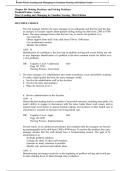
Chapter 08: Making Decisions and Solving Problems
Waddell/Walton: Yoder-
Wise’s Leading and Managing in Canadian Nursing, Third Edition
MULTIPLE CHOICE
The risk manager informs the nurse manager of an orthopedic unit that her unit has had
an increase in incident reports about patients falling during the shift from 2300 to 0700
hours. The nurse manager knows that the best way to resolve the problem is to:
Use creativity.
Obtain support from staff of the shift from 0700 to 1500 hours.
Use institutional research.
Identify the problem.
ANS: D
Identification of a problem is the first step in problem solving and occurs before any oth
er step. Improper identification of a problem is the most common reason for failure to re
s olve problems.
DIF: Cognitive Level: Understand REF:
Page 151 TOP:
Nursing Process: Assessment
2. The nurse manager of a rehabilitation unit wants to purchase a new antiembolic stocking.
To make a high-quality decision, the nurse manager would:
a. Involve the rehabilitation staff in the decision.
b. Involve the sales representative.
N RIGB.CM
c. Make the decision al on e .
U S N
vbHHHvbHHHvb vb
O
vb vb vbT
d. Involve administration in the decision.
ANS: A
Shared decision making leads to a number of successful outcomes, including team pride, t he
team‘s ability to engage in discussions with the nurse leader about work issues, and co
ntinued team involvement in shared decision making. Involvement of other health care pr
ofessionals is essential in decisions involving patient care.
DIF: Cognitive Level: Apply REF:
Page 158 TOP:
Nursing Process: Implementation
Several nurses on an adolescent psychiatric unit complain that the teenagers are becomi
ng unmanageable on the shift from 2300 to 0700 hours. To resolve this problem, the n urse
manager decides that the staff should have a brainstorming session. The goal of br
ainstorming is to:
Evaluate problem solutions.
Critique the ideas of other staff members.
Generate as many solutions as possible.
Identify only practical and realistic ideas.
ANS: C
Brainstorming encourages creativity in the beginning of problem solving and avoids pre
m ature shutting down of ideas through early evaluation.
,NURSINGTB.COM
, Yoder-Wise's Leading and Managing in Canadian Nursing 3rd Edition Yoder-
DIF: Cognitive Level: Apply REF:
Page 160 TOP:
Nursing Process: Planning
During a fire drill several psychiatric patients become agitated. The nurse manager quick
ly assigns a staff member to each patient. This decision style is most appropriate for:
Routine problems.
Crisis situations.
Managers who prefer an authoritarian style.
Followers who cannot agree on a solution.
ANS: B
Some problems, such as the crisis situation depicted in this example, necessitate immedi
a te decision making to ensure patient safety.
DIF: Cognitive Level: Understand REF:
Page 150 TOP:
Nursing Process: Implementation
After the nurses who work on an adolescent psychiatric unit have had a brainstorming s
ession, they are ready to resolve the problem of teenagers who are unmanageable. To m
aximize group effectiveness in decision making and problem solving, the nurse manag
er has:
Prevented conflict.
Formed highly cohesive groups.
Used majority rule to arrive at decisions.
Encouraged equal participation among members.
NURSINGTB.COM
ANS: D
The nurse leader or manager needs to provide a nonthreatening and positive environment, in
which group members actively participate, by controlling aggressive individuals and encourag
ing passive individuals to participate actively. Diversity, managed conflict, and moderate coh
esiveness are effective in reaching quality decisions.
DIF: Cognitive Level: Apply REF: Pages 159–
160 TOP:
Nursing Process: Implementation
To solve a problem, the nurse manager understands that the most important problem
-solving step is:
The implementation phase.
Identification of numerous solutions.
Accurate identification of the problem.
Evaluation of the effectiveness of problem resolution.
ANS: C
To proceed effectively, it is important to determine whether a problem exists and to acc
urately identify a problem. Failure to resolve problems is most often linked to improper i
dentification of the problem.
DIF: Cognitive Level: Understand REF:
Page 151 TOP:
Nursing Process: Assessment
NURSINGTB.COM
Chapter 08: Making Decisions and Solving Problems
Waddell/Walton: Yoder-
Wise’s Leading and Managing in Canadian Nursing, Third Edition
MULTIPLE CHOICE
The risk manager informs the nurse manager of an orthopedic unit that her unit has had
an increase in incident reports about patients falling during the shift from 2300 to 0700
hours. The nurse manager knows that the best way to resolve the problem is to:
Use creativity.
Obtain support from staff of the shift from 0700 to 1500 hours.
Use institutional research.
Identify the problem.
ANS: D
Identification of a problem is the first step in problem solving and occurs before any oth
er step. Improper identification of a problem is the most common reason for failure to re
s olve problems.
DIF: Cognitive Level: Understand REF:
Page 151 TOP:
Nursing Process: Assessment
2. The nurse manager of a rehabilitation unit wants to purchase a new antiembolic stocking.
To make a high-quality decision, the nurse manager would:
a. Involve the rehabilitation staff in the decision.
b. Involve the sales representative.
N RIGB.CM
c. Make the decision al on e .
U S N
vbHHHvbHHHvb vb
O
vb vb vbT
d. Involve administration in the decision.
ANS: A
Shared decision making leads to a number of successful outcomes, including team pride, t he
team‘s ability to engage in discussions with the nurse leader about work issues, and co
ntinued team involvement in shared decision making. Involvement of other health care pr
ofessionals is essential in decisions involving patient care.
DIF: Cognitive Level: Apply REF:
Page 158 TOP:
Nursing Process: Implementation
Several nurses on an adolescent psychiatric unit complain that the teenagers are becomi
ng unmanageable on the shift from 2300 to 0700 hours. To resolve this problem, the n urse
manager decides that the staff should have a brainstorming session. The goal of br
ainstorming is to:
Evaluate problem solutions.
Critique the ideas of other staff members.
Generate as many solutions as possible.
Identify only practical and realistic ideas.
ANS: C
Brainstorming encourages creativity in the beginning of problem solving and avoids pre
m ature shutting down of ideas through early evaluation.
,NURSINGTB.COM
, Yoder-Wise's Leading and Managing in Canadian Nursing 3rd Edition Yoder-
DIF: Cognitive Level: Apply REF:
Page 160 TOP:
Nursing Process: Planning
During a fire drill several psychiatric patients become agitated. The nurse manager quick
ly assigns a staff member to each patient. This decision style is most appropriate for:
Routine problems.
Crisis situations.
Managers who prefer an authoritarian style.
Followers who cannot agree on a solution.
ANS: B
Some problems, such as the crisis situation depicted in this example, necessitate immedi
a te decision making to ensure patient safety.
DIF: Cognitive Level: Understand REF:
Page 150 TOP:
Nursing Process: Implementation
After the nurses who work on an adolescent psychiatric unit have had a brainstorming s
ession, they are ready to resolve the problem of teenagers who are unmanageable. To m
aximize group effectiveness in decision making and problem solving, the nurse manag
er has:
Prevented conflict.
Formed highly cohesive groups.
Used majority rule to arrive at decisions.
Encouraged equal participation among members.
NURSINGTB.COM
ANS: D
The nurse leader or manager needs to provide a nonthreatening and positive environment, in
which group members actively participate, by controlling aggressive individuals and encourag
ing passive individuals to participate actively. Diversity, managed conflict, and moderate coh
esiveness are effective in reaching quality decisions.
DIF: Cognitive Level: Apply REF: Pages 159–
160 TOP:
Nursing Process: Implementation
To solve a problem, the nurse manager understands that the most important problem
-solving step is:
The implementation phase.
Identification of numerous solutions.
Accurate identification of the problem.
Evaluation of the effectiveness of problem resolution.
ANS: C
To proceed effectively, it is important to determine whether a problem exists and to acc
urately identify a problem. Failure to resolve problems is most often linked to improper i
dentification of the problem.
DIF: Cognitive Level: Understand REF:
Page 151 TOP:
Nursing Process: Assessment
NURSINGTB.COM