Summary Advanced Molecular Gastronomy – Chemistry
1. Taste perception
Flavour = odour (volatiles/aromas) + taste (non-volatiles/tastants)
Taste receptors
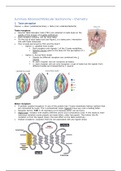
• Several Taste Receptor Cells (TRC) are collected in taste buds on the
papilla of the tongue and palate epithelium.
• Each receptor contains TRC for each taste
• On the top of each taste bud (see figure), is a taste pore: interaction
site with taste molecules
• How is taste perceived by TRC and the brain?
o Option 1: Labelled lines model
▪ Each receptor only signals 1 of the 5 taste modalities.
▪ Specific neuron goes to the brain for the perception of 1
taste
o Option 2: Across-fibre model
▪ Signals by different receptors are combined into 1
neuron
▪ B: each receptor cell can recognize all tastes
▪ C: each receptor cell can only recognize 1 type of taste but the signals from
different tastes are transported by 1 neuron.
Bitter receptors
• G-protein coupled receptors → core of the protein has 7 trans-membrane helices (yellow) that
are connected by loops. The 3 extracellular loops (ligands) have key role in tasting bitter.
• Receptor family: T2R → 25 members (a lot because bitter can be toxic)
• Haplo type: receptor with slightly different amino acid composition (red) → this leads to inter-
individual variation (some people can taste bitter, other less good). The further the AA
mutation is from the ligand (loop), the less effect on the taste sensitivity.
• Orphan receptors: receptors that are not associated with any ligand (loop)
,Sweet and umami receptors
• Also G-protein coupled receptors
• Receptors are heterodimeric proteins: T1R1 and T1R3 for umami, T1R2 and T1R3 for sweet
• T1R receptors consist of Venus Fly Trap Domain and transmembrane domain. Upper and lower
lope of VFTD are connected by hinge region.
• VFTD is open when no tastants is bound, VFTD is closed when tastants is bound.
• Differences sweet/umami and bitter:
o Sweet/umami is heterodimeric protein
o Sweet/umami receptor has VFTD and transmembrane domain
• One taste bud contains both receptor for sweet, umami and bitter. However, they are in
different cells and thus the signals are separated.
Signal transduction and assaying the potency of tastants
• Signal transduction: tastant is bound by receptor → different conformation of receptor →
receptor adopts the G-protein → beta-gamma unit of G-protein is cleaved of → beta-gamma
unit triggers influx of Ca into the cell → neurotransmitter release → neurotransmitter goes to
brain → perception
• Cell-based receptor assay: to determine the intrinsic bitterness or scanning a lot of compounds.
Yeast cells are modified with for instance a bitter receptor on their membrane. Intracellular
increases when you add the bitter tastant → this gives a fluorescent colour because Ca binds to
the dye. If colour stays long → lingering effect of the taste molecule
o Threshold value: concentration of tastant that gives a measurable signal
o EC50 value: amount of tastant required for 50% of the maximal response.
o Mock transfected cell: negative control, yeast cell that is not modified with receptor.
You don’t want that this gives a fluorescence response → otherwise choose new type
Docking of tastants in receptors
• Docking study: understand the interaction of the tastant with the receptor protein and to
predict the taste activity of compounds
• You need a 3D receptor for the study → metabotropic glutamate receptor (mGluR) → looks like
a taste receptor (amino acid sequence) but is not one
2. Bitterness in beer
Brewing process of beer
• Malting → barley seeds germinate and amylases are activated.
• Kilning process → drying of germinated barley = malt. Results in Maillard reaction = flavour
and colour of beer.
• Milling of malt
• Mashing process → starch is degraded into oligosaccharides
• Lautering → sieving water-insoluble materials out
• Brewing → wort is boiled with hop flowers → preservation and flavour
• Cooling and removal of precipitated proteins
• Fermentation → determines final alcohol percentage
• Removal of excess yeast and maturation
Beer flavour → hop
• Hop flowers contain antimicrobial compounds (bitter acids) which have a flavour
• Hop has bitter, floral, citrusy notes.
• Adding hop during brewing step: bitter acids are released into the beer but volatile citrus
aromas are lost upon heating
• Dry hopping: adding hop after fermentation (in IPA beer), no heating. More citrus notes and
less bitterness.
Bitter acids
• Alpha acids = humulones = 6 carbon ring with 2 prenyl chains and R group
o Water soluble, largest part of the bitter acids
o Under influence of heat → iso-alpha-acids (very bitter)
• Beta acids = lupulones = 6 carbon ring with 3 prenyl chains and R group
o Additional prenyl group makes it more hydrophobic = not water soluble
o Only small amount in hop and not much extracted into beer
o Upon heating, colupulone disappears and tricycle-colupulones is formed → more bitter
, Iso alpha acids
• Conversion of alpha acid to iso alpha acids by Oktoberfest Umlagerung
• During heating, 6 membered ring with double bond is converted/saturated into 5 membered
ring without 1 double bond less. The 6 membered ring was flat because of its double bonds,
the 5 membered ring is less flat.
• Trans-iso-alpha-acid: hydroxyl group (OH) points forwards
• Cis-iso-alpha-acid: hydroxyl group (OH) points backwards
Functional redundancy: one bitter acid can activate multiple bitter receptors (T2R). This is
probably because the binding pockets of the receptors are similarly.
Cell based and sensory panel assays compared for bitterness
• Sensory panel indicates iso-alpha acid as most bitter, cell based assay says alpha acid..
• The sensory panel perceives a lower bitterness of alpha acids because they bind to salivary
proteins or they adsorb to the oral epithelium. Alpha acids bind more than iso-alpha acids
because they are more apolar. If polar, more in saliva and to receptors..
• The longer the R group (alkyl), the higher the bitterness potency.
• Cell based assay: for determining intrinsic bitterness of compounds, to know which bitter
compound binds to which receptor, when you want to screen a lot of bitter blockers.
Disadvantage: does not give information about actual perceived bitterness.
• Sensory test: interindividual variation and cross-modal interactions can easily be studied.
Disadvantage: difficult to recruit panellists for bitterness.
Bitter acid composition of various beers
• Iso-alpha-acids > alpha acids > beta acids
• Beta acids are hydrophobic and interact with barley proteins → insoluble complexes.
• Amount of iso-alpha-acids depends on Oktoberfest Umlagerung = brewing process
• Trans/cis ratio = 0.4 because equilibrium for wort boiling temperature.
Compositional changes in various bitter acids upon storage of beer
• Beer flavour changes because alpha-acids decrease more than iso-alpha-acids. Trans/cis ratio
decreases as well. Beta acids increase…
• Bitter acids are sensitive towards UV-light → decompose → Skunky flavour
• UV light results in cleavage of prenyl group from the bitter acid. Prenyl radical reacts with
sulphur containing compounds → prenyl mercaptan is formed → very low threshold!
Strategies for preventing deterioration of hop bitter acids during storage
• Hydrogenate iso-alpha-acids (isos) into ‘tetras’ (double bond of prenyl becomes saturated) by
adding 4 hydrogen atoms.
• Or reduce iso-alpha-acids (isos) into ‘rhos’ by sodium borohydride. Unsaturated side chain is
reduced to corresponding alcohol.
• Both hydrogenation (by 6 hydrogen atoms) and reduction of unsaturated side chain → hexas
are formed
• Rhos are less bitter (higher threshold), tetras and hexas as more bitter (lower threshold)
• However, tetras and hexas have a lower foam stability…
3. Umami and taste enhancement
Detection of monosodium glutamate (MSG), only nice taste when combined with savory flavours
Adding MSG, can increase the perception of saltiness or savory taste.
Tasting umami
• Less receptors for sweet and umami
• Sense umami: dimeric protein of R1R1 and R1R3 receptor
Umami perception: synergy of L-Glu with IMP
• L-glutamate induces umami perception in the T1R1/T1R3 heterodimer.
• EC50 value becomes lower when IMP is also added = synergy. See graph below.
o EC50 value = amount of tastants required to reach 50% of the maximal fluorescence
response.
• (1) L-Glu binds deep in the Venus Fly Trap Domain close to the hinge regions (=docking).
Forms H-bonds with amino acids there so the Venus Fly Trap Domain closes. Not a stable
situation so can open again.
1. Taste perception
Flavour = odour (volatiles/aromas) + taste (non-volatiles/tastants)
Taste receptors
• Several Taste Receptor Cells (TRC) are collected in taste buds on the
papilla of the tongue and palate epithelium.
• Each receptor contains TRC for each taste
• On the top of each taste bud (see figure), is a taste pore: interaction
site with taste molecules
• How is taste perceived by TRC and the brain?
o Option 1: Labelled lines model
▪ Each receptor only signals 1 of the 5 taste modalities.
▪ Specific neuron goes to the brain for the perception of 1
taste
o Option 2: Across-fibre model
▪ Signals by different receptors are combined into 1
neuron
▪ B: each receptor cell can recognize all tastes
▪ C: each receptor cell can only recognize 1 type of taste but the signals from
different tastes are transported by 1 neuron.
Bitter receptors
• G-protein coupled receptors → core of the protein has 7 trans-membrane helices (yellow) that
are connected by loops. The 3 extracellular loops (ligands) have key role in tasting bitter.
• Receptor family: T2R → 25 members (a lot because bitter can be toxic)
• Haplo type: receptor with slightly different amino acid composition (red) → this leads to inter-
individual variation (some people can taste bitter, other less good). The further the AA
mutation is from the ligand (loop), the less effect on the taste sensitivity.
• Orphan receptors: receptors that are not associated with any ligand (loop)
,Sweet and umami receptors
• Also G-protein coupled receptors
• Receptors are heterodimeric proteins: T1R1 and T1R3 for umami, T1R2 and T1R3 for sweet
• T1R receptors consist of Venus Fly Trap Domain and transmembrane domain. Upper and lower
lope of VFTD are connected by hinge region.
• VFTD is open when no tastants is bound, VFTD is closed when tastants is bound.
• Differences sweet/umami and bitter:
o Sweet/umami is heterodimeric protein
o Sweet/umami receptor has VFTD and transmembrane domain
• One taste bud contains both receptor for sweet, umami and bitter. However, they are in
different cells and thus the signals are separated.
Signal transduction and assaying the potency of tastants
• Signal transduction: tastant is bound by receptor → different conformation of receptor →
receptor adopts the G-protein → beta-gamma unit of G-protein is cleaved of → beta-gamma
unit triggers influx of Ca into the cell → neurotransmitter release → neurotransmitter goes to
brain → perception
• Cell-based receptor assay: to determine the intrinsic bitterness or scanning a lot of compounds.
Yeast cells are modified with for instance a bitter receptor on their membrane. Intracellular
increases when you add the bitter tastant → this gives a fluorescent colour because Ca binds to
the dye. If colour stays long → lingering effect of the taste molecule
o Threshold value: concentration of tastant that gives a measurable signal
o EC50 value: amount of tastant required for 50% of the maximal response.
o Mock transfected cell: negative control, yeast cell that is not modified with receptor.
You don’t want that this gives a fluorescence response → otherwise choose new type
Docking of tastants in receptors
• Docking study: understand the interaction of the tastant with the receptor protein and to
predict the taste activity of compounds
• You need a 3D receptor for the study → metabotropic glutamate receptor (mGluR) → looks like
a taste receptor (amino acid sequence) but is not one
2. Bitterness in beer
Brewing process of beer
• Malting → barley seeds germinate and amylases are activated.
• Kilning process → drying of germinated barley = malt. Results in Maillard reaction = flavour
and colour of beer.
• Milling of malt
• Mashing process → starch is degraded into oligosaccharides
• Lautering → sieving water-insoluble materials out
• Brewing → wort is boiled with hop flowers → preservation and flavour
• Cooling and removal of precipitated proteins
• Fermentation → determines final alcohol percentage
• Removal of excess yeast and maturation
Beer flavour → hop
• Hop flowers contain antimicrobial compounds (bitter acids) which have a flavour
• Hop has bitter, floral, citrusy notes.
• Adding hop during brewing step: bitter acids are released into the beer but volatile citrus
aromas are lost upon heating
• Dry hopping: adding hop after fermentation (in IPA beer), no heating. More citrus notes and
less bitterness.
Bitter acids
• Alpha acids = humulones = 6 carbon ring with 2 prenyl chains and R group
o Water soluble, largest part of the bitter acids
o Under influence of heat → iso-alpha-acids (very bitter)
• Beta acids = lupulones = 6 carbon ring with 3 prenyl chains and R group
o Additional prenyl group makes it more hydrophobic = not water soluble
o Only small amount in hop and not much extracted into beer
o Upon heating, colupulone disappears and tricycle-colupulones is formed → more bitter
, Iso alpha acids
• Conversion of alpha acid to iso alpha acids by Oktoberfest Umlagerung
• During heating, 6 membered ring with double bond is converted/saturated into 5 membered
ring without 1 double bond less. The 6 membered ring was flat because of its double bonds,
the 5 membered ring is less flat.
• Trans-iso-alpha-acid: hydroxyl group (OH) points forwards
• Cis-iso-alpha-acid: hydroxyl group (OH) points backwards
Functional redundancy: one bitter acid can activate multiple bitter receptors (T2R). This is
probably because the binding pockets of the receptors are similarly.
Cell based and sensory panel assays compared for bitterness
• Sensory panel indicates iso-alpha acid as most bitter, cell based assay says alpha acid..
• The sensory panel perceives a lower bitterness of alpha acids because they bind to salivary
proteins or they adsorb to the oral epithelium. Alpha acids bind more than iso-alpha acids
because they are more apolar. If polar, more in saliva and to receptors..
• The longer the R group (alkyl), the higher the bitterness potency.
• Cell based assay: for determining intrinsic bitterness of compounds, to know which bitter
compound binds to which receptor, when you want to screen a lot of bitter blockers.
Disadvantage: does not give information about actual perceived bitterness.
• Sensory test: interindividual variation and cross-modal interactions can easily be studied.
Disadvantage: difficult to recruit panellists for bitterness.
Bitter acid composition of various beers
• Iso-alpha-acids > alpha acids > beta acids
• Beta acids are hydrophobic and interact with barley proteins → insoluble complexes.
• Amount of iso-alpha-acids depends on Oktoberfest Umlagerung = brewing process
• Trans/cis ratio = 0.4 because equilibrium for wort boiling temperature.
Compositional changes in various bitter acids upon storage of beer
• Beer flavour changes because alpha-acids decrease more than iso-alpha-acids. Trans/cis ratio
decreases as well. Beta acids increase…
• Bitter acids are sensitive towards UV-light → decompose → Skunky flavour
• UV light results in cleavage of prenyl group from the bitter acid. Prenyl radical reacts with
sulphur containing compounds → prenyl mercaptan is formed → very low threshold!
Strategies for preventing deterioration of hop bitter acids during storage
• Hydrogenate iso-alpha-acids (isos) into ‘tetras’ (double bond of prenyl becomes saturated) by
adding 4 hydrogen atoms.
• Or reduce iso-alpha-acids (isos) into ‘rhos’ by sodium borohydride. Unsaturated side chain is
reduced to corresponding alcohol.
• Both hydrogenation (by 6 hydrogen atoms) and reduction of unsaturated side chain → hexas
are formed
• Rhos are less bitter (higher threshold), tetras and hexas as more bitter (lower threshold)
• However, tetras and hexas have a lower foam stability…
3. Umami and taste enhancement
Detection of monosodium glutamate (MSG), only nice taste when combined with savory flavours
Adding MSG, can increase the perception of saltiness or savory taste.
Tasting umami
• Less receptors for sweet and umami
• Sense umami: dimeric protein of R1R1 and R1R3 receptor
Umami perception: synergy of L-Glu with IMP
• L-glutamate induces umami perception in the T1R1/T1R3 heterodimer.
• EC50 value becomes lower when IMP is also added = synergy. See graph below.
o EC50 value = amount of tastants required to reach 50% of the maximal fluorescence
response.
• (1) L-Glu binds deep in the Venus Fly Trap Domain close to the hinge regions (=docking).
Forms H-bonds with amino acids there so the Venus Fly Trap Domain closes. Not a stable
situation so can open again.