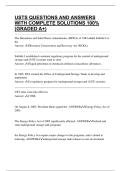
USTS QUESTIONS AND ANSWERS
WITH COMPLETE SOLUTIONS 100%
(GRADED A+)
The Hazardous and Solid Waste Amendments (HSWA) of 1984 added Subtitle I to
the
Answer: ✔✔Resource Conservation and Recovery Act (RCRA).
Subtitle I established a national regulatory program for the control of underground
storage tank (UST) systems used to store
Answer: ✔✔liquid petroleum or chemicals defined as hazardous substances.
In 1985, EPA created the Office of Underground Storage Tanks to develop and
implement
Answer: ✔✔a regulatory program for underground storage tank (UST) systems.
UST rules went into effect in
Answer: ✔✔1988.
On August 8, 2005, President Bush signed the -ANSWER✔✔Energy Policy Act of
2005.
The Energy Policy Act of 2005 significantly affected -ANSWER✔✔federal and
state underground storage tank programs
the Energy Policy Act require major changes to the programs, and is aimed at
reducing -ANSWER✔✔underground storage tank releases to our environment
,The UST provisions of the Energy Policy Act focus on -ANSWER✔✔preventing
releases.
The UST provisions of the Energy Policy Act expanded eligible uses of the -
ANSWER✔✔Leaking Underground Storage Tank (LUST) Trust Fund.
The UST provisions of the Energy Policy Act included provisions regarding -
ANSWER✔✔inspections, operator training, delivery prohibition, secondary
containment and financial responsibility, and cleanup of releases that contain
oxygenated fuel additives.
There are approximately 575,000 underground storage tanks (USTs) nationwide
that -ANSWER✔✔store petroleum or hazardous substances.
The greatest potential threat from a leaking UST is contamination of groundwater,
the source of drinking water for -ANSWER✔✔nearly half of all Americans.
The underground storage tank program is primarily implemented by -
ANSWER✔✔states and territories.
First point of contact is the state regulatory agency that has jurisdiction where the
USTs are -ANSWER✔✔physically located.
In Ohio, petroleum UST program is administered by -ANSWER✔✔the State Fire
Marshal - Bureau of Underground Storage Tank Regulations (SFM-BUSTR)
USTs containing hazardous substances other than petroleum are regulated under -
ANSWER✔✔the Ohio EPA.
, An underground storage tank system is a tank and any underground piping
connected to the tank that has at -ANSWER✔✔least 10 percent of its combined
volume underground.
The federal UST regulations apply to only underground tanks and piping storing
either -ANSWER✔✔petroleum or certain hazardous substances.
The U.S. EPA designed part of the technical regulations for underground storage
tank (UST) systems to prevent -ANSWER✔✔releases from USTs.
The regulations require owners and operators to properly install UST systems and
protect their USTs from -ANSWER✔✔spills, overfills, and corrosion and require
correct filling practices to be followed.
In addition, owners and operators must report the existence of -ANSWER✔✔new
UST systems, suspected releases, UST system closures, and keep records of
operation and maintenance.
What is Spill Protection? -ANSWER✔✔Containment around the fill pipe that
catches small drips or spills that occur when the delivery hose is disconnected from
the fill pipe.
This containment is typically called a -ANSWER✔✔spill bucket or catchment
basin.
The spill bucket should be large enough to contain what -ANSWER✔✔may spill
when the delivery hose is uncoupled from the fill pipe.
WITH COMPLETE SOLUTIONS 100%
(GRADED A+)
The Hazardous and Solid Waste Amendments (HSWA) of 1984 added Subtitle I to
the
Answer: ✔✔Resource Conservation and Recovery Act (RCRA).
Subtitle I established a national regulatory program for the control of underground
storage tank (UST) systems used to store
Answer: ✔✔liquid petroleum or chemicals defined as hazardous substances.
In 1985, EPA created the Office of Underground Storage Tanks to develop and
implement
Answer: ✔✔a regulatory program for underground storage tank (UST) systems.
UST rules went into effect in
Answer: ✔✔1988.
On August 8, 2005, President Bush signed the -ANSWER✔✔Energy Policy Act of
2005.
The Energy Policy Act of 2005 significantly affected -ANSWER✔✔federal and
state underground storage tank programs
the Energy Policy Act require major changes to the programs, and is aimed at
reducing -ANSWER✔✔underground storage tank releases to our environment
,The UST provisions of the Energy Policy Act focus on -ANSWER✔✔preventing
releases.
The UST provisions of the Energy Policy Act expanded eligible uses of the -
ANSWER✔✔Leaking Underground Storage Tank (LUST) Trust Fund.
The UST provisions of the Energy Policy Act included provisions regarding -
ANSWER✔✔inspections, operator training, delivery prohibition, secondary
containment and financial responsibility, and cleanup of releases that contain
oxygenated fuel additives.
There are approximately 575,000 underground storage tanks (USTs) nationwide
that -ANSWER✔✔store petroleum or hazardous substances.
The greatest potential threat from a leaking UST is contamination of groundwater,
the source of drinking water for -ANSWER✔✔nearly half of all Americans.
The underground storage tank program is primarily implemented by -
ANSWER✔✔states and territories.
First point of contact is the state regulatory agency that has jurisdiction where the
USTs are -ANSWER✔✔physically located.
In Ohio, petroleum UST program is administered by -ANSWER✔✔the State Fire
Marshal - Bureau of Underground Storage Tank Regulations (SFM-BUSTR)
USTs containing hazardous substances other than petroleum are regulated under -
ANSWER✔✔the Ohio EPA.
, An underground storage tank system is a tank and any underground piping
connected to the tank that has at -ANSWER✔✔least 10 percent of its combined
volume underground.
The federal UST regulations apply to only underground tanks and piping storing
either -ANSWER✔✔petroleum or certain hazardous substances.
The U.S. EPA designed part of the technical regulations for underground storage
tank (UST) systems to prevent -ANSWER✔✔releases from USTs.
The regulations require owners and operators to properly install UST systems and
protect their USTs from -ANSWER✔✔spills, overfills, and corrosion and require
correct filling practices to be followed.
In addition, owners and operators must report the existence of -ANSWER✔✔new
UST systems, suspected releases, UST system closures, and keep records of
operation and maintenance.
What is Spill Protection? -ANSWER✔✔Containment around the fill pipe that
catches small drips or spills that occur when the delivery hose is disconnected from
the fill pipe.
This containment is typically called a -ANSWER✔✔spill bucket or catchment
basin.
The spill bucket should be large enough to contain what -ANSWER✔✔may spill
when the delivery hose is uncoupled from the fill pipe.