
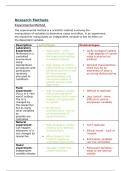
Research Methods
Experimental Method
The experimental method is a scientific method involving the
manipulation of variables to determine cause and effect. In an experiment
the researcher manipulates an independent variable to see its effect on
the dependant variable.
Description Advantages Disadvantages
Laboratory
Experiment - Replication – other Lacks ecological validity
Performed in a researchers can repeat – high degrees of control
controlled the experiment leading make scenarios too
environment to reliable findings. artificial.
using
standardised High degree of control - Demand characteristics –
procedures with experimenters control all there may be an
participants variables and the IV and awareness of what is
randomly DV are precisely occurring during testing
allocated to operationalised and
conditions. measured leading to
greater accuracy and
objectivity.
Field
experiment - High ecological validity – Difficult to replicate
Occur in a ‘real due to the real-world
world’ setting. environment this is more Less control – more
The IV is realistic and applicable difficult to control
changed by to real life. extraneous variables
the researcher,
but as many No demand
other variables characteristics - due to
as an unawareness of
possible are experimentation
controlled.
Natural
experiment – High ecological validity – Can’t replicate
Can happen Leading to no demand
whenever. IV is characteristics Ethical issues – Lack of
not changed by consent
researcher. Allow research that
couldn’t happen in Extraneous variables
controlled experiments. can’t be controlled.
Quasi
experiment – Valuable insight into Participant Variables –
Independent certain behaviour leads to low internal
variable already validity
, exists in High controlled
participants environment Demand characteristics
Observational Techniques
Observation Advantages Disadvantages
Type
Controlled
Observation – Less chance of Demand characteristics
Watching and extraneous variables – lead to low external
recording making observation of validity
behaviour in a behaviour patterns easier
controlled to observe
setting
Easy to replicate to gain
more results for more
detailed research
Naturalistic
Observation - Less chance of demand Uncontrolled
Watching and characteristics – high extraneous variables
recording external validity make it difficult to
behaviour in real judge behaviour
world places High ecological validity patterns
Lack of replicability
Overt
observation - No ethical issues – Demand characteristics
Participants informed consent
behaviour is Bias from observer
watched and
recorded with
their knowledge
and consent
Covert
observation - Less demand Ethical issues due to no
Participants characteristics due to informed consent
behaviour is observation of natural
watched and behaviour
recorded without
their knowledge
or consent
Participant
observation – First hand data Researcher bias
Researcher joins
group and takes
part of the
observation
Non-
Experimental Method
The experimental method is a scientific method involving the
manipulation of variables to determine cause and effect. In an experiment
the researcher manipulates an independent variable to see its effect on
the dependant variable.
Description Advantages Disadvantages
Laboratory
Experiment - Replication – other Lacks ecological validity
Performed in a researchers can repeat – high degrees of control
controlled the experiment leading make scenarios too
environment to reliable findings. artificial.
using
standardised High degree of control - Demand characteristics –
procedures with experimenters control all there may be an
participants variables and the IV and awareness of what is
randomly DV are precisely occurring during testing
allocated to operationalised and
conditions. measured leading to
greater accuracy and
objectivity.
Field
experiment - High ecological validity – Difficult to replicate
Occur in a ‘real due to the real-world
world’ setting. environment this is more Less control – more
The IV is realistic and applicable difficult to control
changed by to real life. extraneous variables
the researcher,
but as many No demand
other variables characteristics - due to
as an unawareness of
possible are experimentation
controlled.
Natural
experiment – High ecological validity – Can’t replicate
Can happen Leading to no demand
whenever. IV is characteristics Ethical issues – Lack of
not changed by consent
researcher. Allow research that
couldn’t happen in Extraneous variables
controlled experiments. can’t be controlled.
Quasi
experiment – Valuable insight into Participant Variables –
Independent certain behaviour leads to low internal
variable already validity
, exists in High controlled
participants environment Demand characteristics
Observational Techniques
Observation Advantages Disadvantages
Type
Controlled
Observation – Less chance of Demand characteristics
Watching and extraneous variables – lead to low external
recording making observation of validity
behaviour in a behaviour patterns easier
controlled to observe
setting
Easy to replicate to gain
more results for more
detailed research
Naturalistic
Observation - Less chance of demand Uncontrolled
Watching and characteristics – high extraneous variables
recording external validity make it difficult to
behaviour in real judge behaviour
world places High ecological validity patterns
Lack of replicability
Overt
observation - No ethical issues – Demand characteristics
Participants informed consent
behaviour is Bias from observer
watched and
recorded with
their knowledge
and consent
Covert
observation - Less demand Ethical issues due to no
Participants characteristics due to informed consent
behaviour is observation of natural
watched and behaviour
recorded without
their knowledge
or consent
Participant
observation – First hand data Researcher bias
Researcher joins
group and takes
part of the
observation
Non-


