7
ment
PLET
WERS)
r2
DUE 8
ber [School]
[Course title]
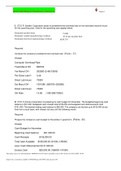
, ECS3707 Assignment 7(COMPLETE ANSWERS) Semester 2 2025 - DUE 8 November 2025
Institution
University Of South Africa (Unisa)
Course
Development Economics (ECS3707)
ECS3707 Assignment 7(COMPLETE ANSWERS) Semester 2 2025 - DUE 8 November 2025; 100%
TRUSTED Complete, trusted solutions and explanations.
ASSESSMENT 7 ECS307-S2-2025 ECS 3707 ASSESSMENT 7 S2-2025 Year 2025 Semester S2
Module ECS 3707 Assessment 7 Assessment unique number Opens: Monday, 3 November 2025, 1:00
PM Due: Saturday, 8 November 2025, 4:00 PM Number of questions 2 Number of pages 8 Assessment
total marks 100 Type of assessment Elective grouped assessment Elective group Summative Assessment
date Duration 24 hours First Examiner Dr. R Lӧtter (nee Bezuidenhout) Second Examiner Dr. NW
Gamede Third Examiner Dr. I Maloma Overview and general information Assessment content This
assessment includes all lesson units, with main emphasis is on lesson 7 and lesson 8. The assessment
focuses on a cross-country comparative analysis of South Africa and Argentina, examining institutional,
economic, corruption, and socio-economic indicators. Students are expected to apply institutional
economic theories, interpret FSI, CPI, and Freedom House data, and critically evaluate the impact of
governance and institutions on development outcomes. Assessment format This is a short essay-type
assessment consisting of four structured questions. Responses should be written in essay format, with
students providing evidence-based analysis, theoretical application, and comparative discussion.
Assessment overview The assessment requires students to demonstrate their ability to analyse institutional
and governance factors alongside economic and socio-economic indicators in a cross-country context. It
evaluates students’ capacity to integrate theory and empirical evidence, critically assess development
outcomes, and present structured, coherent arguments. Assessment objectives In completing this
assessment this assessment, students should be able to: Compare institutional and economic indicators
across countries. • Apply institutional economic theory to real-world development challenges. • Critically
assess the impact of corruption and governance on socio-economic outcomes. • Portray analytical and
evidence-based essay writing skills. Assessment structure Summative (Weight: 25%) Applied short essay
questions Submission guidelines Electronic submission via myUnisa in PDF format 2 Include your name,
student number, and assessment title on the cover page. ASSESSMENT SOURCES AND ECONOMIC
DATA Data requirements The data required to complete this assessment is accessible through the links
provided below, or students may consult additional resources uploaded to the module website. Links and
resources to answer this assessment Chapter 11 and 14 Todaro, Michael Paul, and Stephen C Smith.
Economic Development. Thirteenth Edition. Hoboken, NJ: Pearson, 2020. APA: Todaro, M. Paul, &
Smith, S. C. (2020). United Nations SDG goals Fragile state index South Africa: Argentina: Corruption
perception index (social indicator CPI – not monetary) Corruption Watch global and South Africa –
UNISA huge participant and contributor to research Failed state index - Political freedom – Freedom
ment
PLET
WERS)
r2
DUE 8
ber [School]
[Course title]
, ECS3707 Assignment 7(COMPLETE ANSWERS) Semester 2 2025 - DUE 8 November 2025
Institution
University Of South Africa (Unisa)
Course
Development Economics (ECS3707)
ECS3707 Assignment 7(COMPLETE ANSWERS) Semester 2 2025 - DUE 8 November 2025; 100%
TRUSTED Complete, trusted solutions and explanations.
ASSESSMENT 7 ECS307-S2-2025 ECS 3707 ASSESSMENT 7 S2-2025 Year 2025 Semester S2
Module ECS 3707 Assessment 7 Assessment unique number Opens: Monday, 3 November 2025, 1:00
PM Due: Saturday, 8 November 2025, 4:00 PM Number of questions 2 Number of pages 8 Assessment
total marks 100 Type of assessment Elective grouped assessment Elective group Summative Assessment
date Duration 24 hours First Examiner Dr. R Lӧtter (nee Bezuidenhout) Second Examiner Dr. NW
Gamede Third Examiner Dr. I Maloma Overview and general information Assessment content This
assessment includes all lesson units, with main emphasis is on lesson 7 and lesson 8. The assessment
focuses on a cross-country comparative analysis of South Africa and Argentina, examining institutional,
economic, corruption, and socio-economic indicators. Students are expected to apply institutional
economic theories, interpret FSI, CPI, and Freedom House data, and critically evaluate the impact of
governance and institutions on development outcomes. Assessment format This is a short essay-type
assessment consisting of four structured questions. Responses should be written in essay format, with
students providing evidence-based analysis, theoretical application, and comparative discussion.
Assessment overview The assessment requires students to demonstrate their ability to analyse institutional
and governance factors alongside economic and socio-economic indicators in a cross-country context. It
evaluates students’ capacity to integrate theory and empirical evidence, critically assess development
outcomes, and present structured, coherent arguments. Assessment objectives In completing this
assessment this assessment, students should be able to: Compare institutional and economic indicators
across countries. • Apply institutional economic theory to real-world development challenges. • Critically
assess the impact of corruption and governance on socio-economic outcomes. • Portray analytical and
evidence-based essay writing skills. Assessment structure Summative (Weight: 25%) Applied short essay
questions Submission guidelines Electronic submission via myUnisa in PDF format 2 Include your name,
student number, and assessment title on the cover page. ASSESSMENT SOURCES AND ECONOMIC
DATA Data requirements The data required to complete this assessment is accessible through the links
provided below, or students may consult additional resources uploaded to the module website. Links and
resources to answer this assessment Chapter 11 and 14 Todaro, Michael Paul, and Stephen C Smith.
Economic Development. Thirteenth Edition. Hoboken, NJ: Pearson, 2020. APA: Todaro, M. Paul, &
Smith, S. C. (2020). United Nations SDG goals Fragile state index South Africa: Argentina: Corruption
perception index (social indicator CPI – not monetary) Corruption Watch global and South Africa –
UNISA huge participant and contributor to research Failed state index - Political freedom – Freedom