Week 1
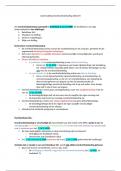
Lecture 1.1 Introduction value based healthcare
Redefining health care (2006) -> Michael Porter & Elizabeth Teisberg
The roots of VBHC
Michael Porter = founding father, Harvard Business School Professor. Famous for his work on
competition.
• Value chain = All the activities an organization performs, which together create a
valuable product or service.
• Central premise = In any industry, a successful and sustainable enterprise needs to
create value for its clients – particularly in a competitive market.
Porter’s vision for health care systems
• Overarching goal for all system stakeholders: to improve value.
• Patient value = the health-related outcomes that matter to patients, divided by what
it costs to achieve those outcomes.
“This goal is what matters for patients and unites the interests of all actors in the system. If
value improves, patients, payers, providers, and suppliers can all benefit while the economic
sustainability of the health care system increases.” (Porter 2010)
Outcomes -> what do patients want? What matters most to patients?
• To get better. AKA to achieve the best possible treatment outcomes.
• Outcomes = the effects of care on the health status of patients.
• Most cases: multiple relevant outcomes.
Costs
Treatments come at a price; we pay our health care professionals.
• Some treatments are more expensive than others
• Some providers charge higher prices
If two providers/treatments have the exact same outcome, we should go for the less costly
one.
Value for patients = the health status they achieve (outcomes) and the price they have to pay
for it (costs). Optimizing this equation becomes the central goal: the best outcomes, as
efficiently as possible
• Value = outcomes / costs
Key principle = Value in health care is created at the level of medical conditions, over the full
cycle of care.
A) Value is created at the level of medical conditions.
• Patients seek health care to address health related issues/disturbances.
• Those issues (complaints, symptoms) are usually directly related to a particular
medical condition.
• Ergo: professionals create value by addressing specific conditions!
,“Value in health care can only be understood by focusing on the level at which it is actually
created, which is in addressing particular medical conditions” (Porter & Teisberg 2006: 99)
B) Value is created over the full cycle of care.
• Value is generated through the full set of activities (i.e. value chain)
• Full care cycle: from start to end (diagnosis to rehabilitation).
• Surgery for example, is only one element of the full cycle.
Remember
• Value should be the goal
• Value is created at the level of medical conditions over full care cycles
1. Measurement & Reporting
Providers should systematically measure the outcomes and costs of their care cycles. Results
should be reported and publicly disclosed (transparency). This will enable effective
comparisons and allow all parties to make more value based decisions.
2. Organizing
Organizational structures based on value creation: at the level of care cycles (value chains)
for medical conditions.
Radically different from the traditional structure of hospitals based on medical specialties.
Integrated Practise Unit (IPU) = multidisciplinary team, coordinating all the specialized
knowledge and skills that are needed to address a medical condition.
3. Payment
Payment aligned with value creation: reimbursing care cycles at the level of medical
condition.
Bundled payment instead of multiple separate bills within the same care cycle (i.e. fee-for-
service).
Incentivizing value (not volume).
Value-based payment
• Removing adverse incentives (e.g. for overtreatment)
• Alternative to fee-for-service (Providers are rewarded for volume)
• Instead: rewarding good outcomes & efficiency
1) Rewarding with more patients (Porter)
2) Financial bonus (pay-for-performance)
Value-based competition
• Systematic outcome measurement.
• Excellent providers rewarded with more patients = more patients receiving excellent
care.
• Providers who cannot keep up should restructure or go out of business (which would
be good for patient value!)
The right kind of competition will unleash “dramatic improvements in value” (Porter &
Teisberg 2006: 143).
, Lecture 1.2 – Integrated Practise Units
Integrated Practise Units (IPUs)
• Hospitals and other health care providers are typically organized along the lines of
medical specialties (e.g. neurology, oncology, radiology).
• Porter and colleagues propose a radical reorganization aligned with care cycles for
medical conditions (and the creation of value).
• IPUs are organizational units in which a multidisciplinary team of (dedicated)
professionals and supporting staff are grouped together (and co-located) to
coordinate their interdependent tasks with the overarching goal to improve value for
a particular group of patients.
Confusion about IPUs
• Some miss the crucial point that the concept refers to organizational units.
• Multidisciplinary collaboration is common; IPUs are rare (and maybe even non-
existent in Dutch hospitals).
• Part B: clarifying the meaning of IPUs through Porter (VBHC) and Mintzberg
(organization)
Organizational structures -> Henry Mintzber (1979)
Organizational structure = the way an organization designs its task allocation and
coordination. Organizations have various design ‘knobs’ to turn.
Unit grouping:
• Lines of authority (coordination via supervision)
• Close contact (coordination via informal communication).
Unit grouping
• Function-based grouping = Each line/unit represent a group of people with a
particular set of knowledge and/or skills. -> Units are grouped based on the means
(the functions) of a production process.
• Market-based grouping = Each line/unit represents a group of people that serve a
particular market (e.g. a group of patients) -> units are grouped based on the ends of
a production process (e.g. costumer needs, product charachteristics).
The structure of hospitals
• Hospitals typically have a “functional design”: the organizational structure is based on
specialized skills. Hospitals group their units based on separate functions (means).
Long tradition:
à History of medical specialization
à Increasingly specialized professionals with complex knowledge and skills
à Grouped into specialty-based units (e.g. neurology, oncology).
Critique
Lecture 1.1 Introduction value based healthcare
Redefining health care (2006) -> Michael Porter & Elizabeth Teisberg
The roots of VBHC
Michael Porter = founding father, Harvard Business School Professor. Famous for his work on
competition.
• Value chain = All the activities an organization performs, which together create a
valuable product or service.
• Central premise = In any industry, a successful and sustainable enterprise needs to
create value for its clients – particularly in a competitive market.
Porter’s vision for health care systems
• Overarching goal for all system stakeholders: to improve value.
• Patient value = the health-related outcomes that matter to patients, divided by what
it costs to achieve those outcomes.
“This goal is what matters for patients and unites the interests of all actors in the system. If
value improves, patients, payers, providers, and suppliers can all benefit while the economic
sustainability of the health care system increases.” (Porter 2010)
Outcomes -> what do patients want? What matters most to patients?
• To get better. AKA to achieve the best possible treatment outcomes.
• Outcomes = the effects of care on the health status of patients.
• Most cases: multiple relevant outcomes.
Costs
Treatments come at a price; we pay our health care professionals.
• Some treatments are more expensive than others
• Some providers charge higher prices
If two providers/treatments have the exact same outcome, we should go for the less costly
one.
Value for patients = the health status they achieve (outcomes) and the price they have to pay
for it (costs). Optimizing this equation becomes the central goal: the best outcomes, as
efficiently as possible
• Value = outcomes / costs
Key principle = Value in health care is created at the level of medical conditions, over the full
cycle of care.
A) Value is created at the level of medical conditions.
• Patients seek health care to address health related issues/disturbances.
• Those issues (complaints, symptoms) are usually directly related to a particular
medical condition.
• Ergo: professionals create value by addressing specific conditions!
,“Value in health care can only be understood by focusing on the level at which it is actually
created, which is in addressing particular medical conditions” (Porter & Teisberg 2006: 99)
B) Value is created over the full cycle of care.
• Value is generated through the full set of activities (i.e. value chain)
• Full care cycle: from start to end (diagnosis to rehabilitation).
• Surgery for example, is only one element of the full cycle.
Remember
• Value should be the goal
• Value is created at the level of medical conditions over full care cycles
1. Measurement & Reporting
Providers should systematically measure the outcomes and costs of their care cycles. Results
should be reported and publicly disclosed (transparency). This will enable effective
comparisons and allow all parties to make more value based decisions.
2. Organizing
Organizational structures based on value creation: at the level of care cycles (value chains)
for medical conditions.
Radically different from the traditional structure of hospitals based on medical specialties.
Integrated Practise Unit (IPU) = multidisciplinary team, coordinating all the specialized
knowledge and skills that are needed to address a medical condition.
3. Payment
Payment aligned with value creation: reimbursing care cycles at the level of medical
condition.
Bundled payment instead of multiple separate bills within the same care cycle (i.e. fee-for-
service).
Incentivizing value (not volume).
Value-based payment
• Removing adverse incentives (e.g. for overtreatment)
• Alternative to fee-for-service (Providers are rewarded for volume)
• Instead: rewarding good outcomes & efficiency
1) Rewarding with more patients (Porter)
2) Financial bonus (pay-for-performance)
Value-based competition
• Systematic outcome measurement.
• Excellent providers rewarded with more patients = more patients receiving excellent
care.
• Providers who cannot keep up should restructure or go out of business (which would
be good for patient value!)
The right kind of competition will unleash “dramatic improvements in value” (Porter &
Teisberg 2006: 143).
, Lecture 1.2 – Integrated Practise Units
Integrated Practise Units (IPUs)
• Hospitals and other health care providers are typically organized along the lines of
medical specialties (e.g. neurology, oncology, radiology).
• Porter and colleagues propose a radical reorganization aligned with care cycles for
medical conditions (and the creation of value).
• IPUs are organizational units in which a multidisciplinary team of (dedicated)
professionals and supporting staff are grouped together (and co-located) to
coordinate their interdependent tasks with the overarching goal to improve value for
a particular group of patients.
Confusion about IPUs
• Some miss the crucial point that the concept refers to organizational units.
• Multidisciplinary collaboration is common; IPUs are rare (and maybe even non-
existent in Dutch hospitals).
• Part B: clarifying the meaning of IPUs through Porter (VBHC) and Mintzberg
(organization)
Organizational structures -> Henry Mintzber (1979)
Organizational structure = the way an organization designs its task allocation and
coordination. Organizations have various design ‘knobs’ to turn.
Unit grouping:
• Lines of authority (coordination via supervision)
• Close contact (coordination via informal communication).
Unit grouping
• Function-based grouping = Each line/unit represent a group of people with a
particular set of knowledge and/or skills. -> Units are grouped based on the means
(the functions) of a production process.
• Market-based grouping = Each line/unit represents a group of people that serve a
particular market (e.g. a group of patients) -> units are grouped based on the ends of
a production process (e.g. costumer needs, product charachteristics).
The structure of hospitals
• Hospitals typically have a “functional design”: the organizational structure is based on
specialized skills. Hospitals group their units based on separate functions (means).
Long tradition:
à History of medical specialization
à Increasingly specialized professionals with complex knowledge and skills
à Grouped into specialty-based units (e.g. neurology, oncology).
Critique