1 | Page
D265 - WGU - Critical Thinking - Reason
and Evidence Questions and Correct Answers
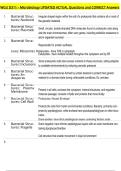
PROPOSITIONS Ans: — Are statements that can be true or false
NON-PROPOSITONS Ans: — Are sentences that are not statements
about matters of fact or fiction. They do not make a claim that can
be true or false.
SIMPLE PROPOSITIONS Ans: — Have no internal logic structure,
meaning whether they are true or false does not depend on
whether a part of them is true or false. They are simply true or
false on their own. (Example: Harry Potter wears glasses. The sky is
blue.)
COMPLEX PROPOSITIONS Ans: — Have internal logic structure,
meaning they are composed of simple propositions. Whether they
are true or false depends on whether their parts are true or false.
(Example: The sky is blue, but it does not look blue to me right
now. The cat ate the food, but he did not like it. The GDP of
Canada is either $3 trillion or $12 trillion.)
Words used to identify Independent Propositions Ans: — AND, OR,
EITHER, BUT, IF, THEN.
CONCLUSION INDICATORS Ans: — THEREFORE, SO, IT FOLLOWS
THAT, HENCE, THUS, ENTAILS THAT, WE MAY CONCLUDE THAT,
IMPLIES THAT, WHEREFORE, AND AS A RESULT.
PREMISE INDICATORS Ans: — BECAUSE, FOR, GIVEN THAT, AS,
SINCE, AS INDICATED BY.
DEDUCTIVE ARGUMENTS Ans: — Arguments where the premises
guarantee or necessitate the conclusion.
-mathematical arguments, logical arguments, arguments from
definition.
INDUCTION ARGUMENTS Ans: — Arguments where the premises
make the conclusion probable.
-analogies, authority, causal inferences, extrapolations, etc.
© 2025 All rights reserved
, 2 | Page
INFERENCE TO THE BEST EXPLANATION OR ABDUCTION Ans: —
Arguments where the best available explanation is chosen as the
correct explanation.
FORMAL FALLACY Ans: — Concerns the structure of an argument
INFORMAL FALLACY Ans: — Concerns the informational content
of an argument
A FORMAL FALLACY IS A TYPE OF Ans: — Bad Argument Structure
Which piece of information would be the most helpful to know in
assessing the credibility of a news story? Ans: — Whether the
name of the author and the publication are identified
Which questions are most appropriate for evaluating the
credibility of an information source? Ans: — Who funded it? &
Does it try to get you to distrust other sources?
While researching a topic on the internet, a student encounters
two different websites, one of that looks more official than the
other and includes tables, charts, and statistics, while the other
does not.
What is the line of reasoning this student should employ to
determine which site is more credible? Ans: — It is not feasible to
determine which site is more credible from the information
provided.
In which way should an information source be approached if it is
stating that it is the only source of real information and that other
sources cannot be trusted? Ans: — Skeptically, because the source
may lack credibility.
PRINCIPLE OF CHARITY Ans: — The principle of charity suggests
we should try to understand ideas before criticizing them.
Which of the following are reasons for applying the principle of
charity? Ans: — It is morally right to give others the benefit of the
doubt.
It allows for a clearer understanding of the issue.
© 2025 All rights reserved
D265 - WGU - Critical Thinking - Reason
and Evidence Questions and Correct Answers
PROPOSITIONS Ans: — Are statements that can be true or false
NON-PROPOSITONS Ans: — Are sentences that are not statements
about matters of fact or fiction. They do not make a claim that can
be true or false.
SIMPLE PROPOSITIONS Ans: — Have no internal logic structure,
meaning whether they are true or false does not depend on
whether a part of them is true or false. They are simply true or
false on their own. (Example: Harry Potter wears glasses. The sky is
blue.)
COMPLEX PROPOSITIONS Ans: — Have internal logic structure,
meaning they are composed of simple propositions. Whether they
are true or false depends on whether their parts are true or false.
(Example: The sky is blue, but it does not look blue to me right
now. The cat ate the food, but he did not like it. The GDP of
Canada is either $3 trillion or $12 trillion.)
Words used to identify Independent Propositions Ans: — AND, OR,
EITHER, BUT, IF, THEN.
CONCLUSION INDICATORS Ans: — THEREFORE, SO, IT FOLLOWS
THAT, HENCE, THUS, ENTAILS THAT, WE MAY CONCLUDE THAT,
IMPLIES THAT, WHEREFORE, AND AS A RESULT.
PREMISE INDICATORS Ans: — BECAUSE, FOR, GIVEN THAT, AS,
SINCE, AS INDICATED BY.
DEDUCTIVE ARGUMENTS Ans: — Arguments where the premises
guarantee or necessitate the conclusion.
-mathematical arguments, logical arguments, arguments from
definition.
INDUCTION ARGUMENTS Ans: — Arguments where the premises
make the conclusion probable.
-analogies, authority, causal inferences, extrapolations, etc.
© 2025 All rights reserved
, 2 | Page
INFERENCE TO THE BEST EXPLANATION OR ABDUCTION Ans: —
Arguments where the best available explanation is chosen as the
correct explanation.
FORMAL FALLACY Ans: — Concerns the structure of an argument
INFORMAL FALLACY Ans: — Concerns the informational content
of an argument
A FORMAL FALLACY IS A TYPE OF Ans: — Bad Argument Structure
Which piece of information would be the most helpful to know in
assessing the credibility of a news story? Ans: — Whether the
name of the author and the publication are identified
Which questions are most appropriate for evaluating the
credibility of an information source? Ans: — Who funded it? &
Does it try to get you to distrust other sources?
While researching a topic on the internet, a student encounters
two different websites, one of that looks more official than the
other and includes tables, charts, and statistics, while the other
does not.
What is the line of reasoning this student should employ to
determine which site is more credible? Ans: — It is not feasible to
determine which site is more credible from the information
provided.
In which way should an information source be approached if it is
stating that it is the only source of real information and that other
sources cannot be trusted? Ans: — Skeptically, because the source
may lack credibility.
PRINCIPLE OF CHARITY Ans: — The principle of charity suggests
we should try to understand ideas before criticizing them.
Which of the following are reasons for applying the principle of
charity? Ans: — It is morally right to give others the benefit of the
doubt.
It allows for a clearer understanding of the issue.
© 2025 All rights reserved