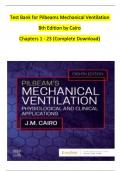
BURNS' PEDIATRIC PRIMARY CARE
8TH EDITION
• AUTHOR(S)DAWN LEE GARZON, MARY
DIRKS, MARTHA DRIESSNACK, KAREN
G. DUDERSTADT, NAN M. GAYLORD
TEST BANK
Q1
Reference: Ch. 1 — Pediatric Primary Care — Primary Care
Versus Primary Prevention
Question Stem: A 14-month-old attends well-child care; the
parent asks whether the visit is "primary care" or "primary
prevention." Which best explains the difference to emphasize
anticipatory guidance and population-level interventions?
Options:
A. Primary care focuses on acute illness; primary prevention is
only immunizations.
B. Primary care is the ongoing clinical relationship; primary
prevention targets interventions to stop disease before it
occurs.
,C. Primary care is provided only by pediatricians; primary
prevention is provided by public health.
D. Primary care and primary prevention are interchangeable
terms in pediatrics.
Correct Answer: B
Rationales:
• Correct (B): Primary care describes the continuous
clinician–family relationship for health promotion, while
primary prevention comprises actions (e.g.,
immunizations, safety counseling) to prevent disease
onset. This distinction supports both individualized
anticipatory guidance and broader preventive efforts.
• Incorrect (A): Primary care includes acute and chronic care
as well as prevention; primary prevention is broader than
just immunizations.
• Incorrect (C): Both primary care and primary prevention
involve multiple providers and sectors; they are not
exclusive to pediatricians or public health.
• Incorrect (D): The terms are related but not
interchangeable; primary prevention is a component of
primary care but has a distinct public-health focus.
Teaching Point: Primary care is the continuous
relationship; primary prevention prevents disease before it
begins.
Citation: Garzon et al. (2023). Burns’ Pediatric Primary
Care (8th Ed.). Ch. 1.
,Q2
Reference: Ch. 1 — Pediatric Primary Care — Pediatric Primary
Care Providers
Question Stem: An NP and a newly graduated RN discuss roles
in a pediatric clinic. Which assignment best reflects the scope of
practice and interprofessional team-based primary care?
Options:
A. RN performs well-child histories and independent diagnosis
without NP oversight.
B. NP independently manages acute visits and prescribes per
state scope; RN focuses on assessment, education, and care
coordination.
C. RN functions as the primary prescriber; NP provides
administrative support only.
D. Both RN and NP perform identical roles; titles do not affect
responsibilities.
Correct Answer: B
Rationales:
• Correct (B): NPs typically provide diagnosis and
prescriptive management within their licensure; RNs
emphasize assessment, education, nursing interventions,
and coordination—reflecting team-based pediatric primary
care.
, • Incorrect (A): RNs do important assessments and
education but do not independently diagnose or prescribe
beyond their scope.
• Incorrect (C): This reverses typical responsibilities; RNs are
not primary prescribers.
• Incorrect (D): Professional titles and licensure define
different scopes and responsibilities in pediatric primary
care.
Teaching Point: Team-based primary care assigns
assessment/education to RNs and diagnostic/prescriptive
duties to advanced clinicians.
Citation: Garzon et al. (2023). Burns’ Pediatric Primary
Care (8th Ed.). Ch. 1.
Q3
Reference: Ch. 1 — Pediatric Primary Care — Unique Issues in
Pediatrics
Question Stem: A 6-week-old presents with poor weight gain.
Which pediatric-specific factor must be prioritized when
formulating the plan of care?
Options:
A. Family health literacy and feeding dynamics affecting intake.
B. Adult BMI as primary determinant of infant growth.
C. Insurance status only, since it dictates access to formula.
D. Sibling vaccination status as the main contributor to poor
8TH EDITION
• AUTHOR(S)DAWN LEE GARZON, MARY
DIRKS, MARTHA DRIESSNACK, KAREN
G. DUDERSTADT, NAN M. GAYLORD
TEST BANK
Q1
Reference: Ch. 1 — Pediatric Primary Care — Primary Care
Versus Primary Prevention
Question Stem: A 14-month-old attends well-child care; the
parent asks whether the visit is "primary care" or "primary
prevention." Which best explains the difference to emphasize
anticipatory guidance and population-level interventions?
Options:
A. Primary care focuses on acute illness; primary prevention is
only immunizations.
B. Primary care is the ongoing clinical relationship; primary
prevention targets interventions to stop disease before it
occurs.
,C. Primary care is provided only by pediatricians; primary
prevention is provided by public health.
D. Primary care and primary prevention are interchangeable
terms in pediatrics.
Correct Answer: B
Rationales:
• Correct (B): Primary care describes the continuous
clinician–family relationship for health promotion, while
primary prevention comprises actions (e.g.,
immunizations, safety counseling) to prevent disease
onset. This distinction supports both individualized
anticipatory guidance and broader preventive efforts.
• Incorrect (A): Primary care includes acute and chronic care
as well as prevention; primary prevention is broader than
just immunizations.
• Incorrect (C): Both primary care and primary prevention
involve multiple providers and sectors; they are not
exclusive to pediatricians or public health.
• Incorrect (D): The terms are related but not
interchangeable; primary prevention is a component of
primary care but has a distinct public-health focus.
Teaching Point: Primary care is the continuous
relationship; primary prevention prevents disease before it
begins.
Citation: Garzon et al. (2023). Burns’ Pediatric Primary
Care (8th Ed.). Ch. 1.
,Q2
Reference: Ch. 1 — Pediatric Primary Care — Pediatric Primary
Care Providers
Question Stem: An NP and a newly graduated RN discuss roles
in a pediatric clinic. Which assignment best reflects the scope of
practice and interprofessional team-based primary care?
Options:
A. RN performs well-child histories and independent diagnosis
without NP oversight.
B. NP independently manages acute visits and prescribes per
state scope; RN focuses on assessment, education, and care
coordination.
C. RN functions as the primary prescriber; NP provides
administrative support only.
D. Both RN and NP perform identical roles; titles do not affect
responsibilities.
Correct Answer: B
Rationales:
• Correct (B): NPs typically provide diagnosis and
prescriptive management within their licensure; RNs
emphasize assessment, education, nursing interventions,
and coordination—reflecting team-based pediatric primary
care.
, • Incorrect (A): RNs do important assessments and
education but do not independently diagnose or prescribe
beyond their scope.
• Incorrect (C): This reverses typical responsibilities; RNs are
not primary prescribers.
• Incorrect (D): Professional titles and licensure define
different scopes and responsibilities in pediatric primary
care.
Teaching Point: Team-based primary care assigns
assessment/education to RNs and diagnostic/prescriptive
duties to advanced clinicians.
Citation: Garzon et al. (2023). Burns’ Pediatric Primary
Care (8th Ed.). Ch. 1.
Q3
Reference: Ch. 1 — Pediatric Primary Care — Unique Issues in
Pediatrics
Question Stem: A 6-week-old presents with poor weight gain.
Which pediatric-specific factor must be prioritized when
formulating the plan of care?
Options:
A. Family health literacy and feeding dynamics affecting intake.
B. Adult BMI as primary determinant of infant growth.
C. Insurance status only, since it dictates access to formula.
D. Sibling vaccination status as the main contributor to poor