March 21, 2018
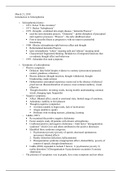
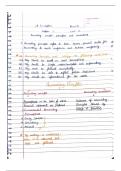
Introduction to Schizophrenia
≈ Schizophrenia history:
– 1851- Falvet “Folie circulaire”
– 1871- Hecker “hebephrenia”
– 1878 - Kraeplin –combined into single disease- “dementia Praecox”
used the term dementia praecox. “Dementia” - global disruption of perceptual
and cognitive processes. “Praecox” - the early adulthood onset
First to describe illness as progressive with no return to premorbid
functioning
– 1908 - Bleuler schizophrenia-split between affect and thought
Reformulated dementia Praecox
term schizophrenia “schizo” meaning split and “phrene” meaning mind
Characterised fragmented thinking. Breakdown of integrated functions that
co-ordinate thought affect and behaviour
– 1959 - Schneider-first rank symptoms
≈ Symptoms of schizophrenia:
– Positive symptoms:
Delusion: false belief despite evidence to contrary (persecutory/paranoid,
control, grandiose, reference)
Bizarre delusion (thought insertion, thought withdrawal, thought
broadcasting, made actions)
Hallucination: perceptual experience seems real in the absence of physical
proof (not an illusion/distortion of senses)- most common auditory, visual,
olfactory
Thought disorders: inventing words, having trouble understanding common
words, changing topic frequently)
– Negative symptoms:
Affect: Blunted affect, mood or emotional state, limited range of emotions,
Anhedonia: inability to feel pleasure
Thought (cognitive symptoms):
Avolition (unable to begin tasks, lack of motivation)
Alogia (unable to speak)
Problems with working memory, planning, learning
– Liddle (1987):
Re-examined the positive negative dichotomy
Factor analytic study 40 patients with chronic schizophrenia
Confirmed positive and negative dichotomy + third factor “disorganisation
syndrome” which Crow and others attributed to the positive dimension
Identified three syndrome categories:
1. Psychomotor poverty (poverty of speech, decreased spontaneous
movement, blunted affect)
2. Reality distortion (delusions, hallucinations)
3. Disorganisation syndrome (inappropriate affect, distractibility, poverty of
content of speech, thought disturbances)
Liddle (2002) expanded to include 5 factors: 1) psychomotor poverty 2)
reality distortion 3) Disorganisation 4) psychomotor excitation 5) anxiety
/depression
– The presence of symptoms vary in people; have some symptoms and not others
Introduction to Schizophrenia
≈ Schizophrenia history:
– 1851- Falvet “Folie circulaire”
– 1871- Hecker “hebephrenia”
– 1878 - Kraeplin –combined into single disease- “dementia Praecox”
used the term dementia praecox. “Dementia” - global disruption of perceptual
and cognitive processes. “Praecox” - the early adulthood onset
First to describe illness as progressive with no return to premorbid
functioning
– 1908 - Bleuler schizophrenia-split between affect and thought
Reformulated dementia Praecox
term schizophrenia “schizo” meaning split and “phrene” meaning mind
Characterised fragmented thinking. Breakdown of integrated functions that
co-ordinate thought affect and behaviour
– 1959 - Schneider-first rank symptoms
≈ Symptoms of schizophrenia:
– Positive symptoms:
Delusion: false belief despite evidence to contrary (persecutory/paranoid,
control, grandiose, reference)
Bizarre delusion (thought insertion, thought withdrawal, thought
broadcasting, made actions)
Hallucination: perceptual experience seems real in the absence of physical
proof (not an illusion/distortion of senses)- most common auditory, visual,
olfactory
Thought disorders: inventing words, having trouble understanding common
words, changing topic frequently)
– Negative symptoms:
Affect: Blunted affect, mood or emotional state, limited range of emotions,
Anhedonia: inability to feel pleasure
Thought (cognitive symptoms):
Avolition (unable to begin tasks, lack of motivation)
Alogia (unable to speak)
Problems with working memory, planning, learning
– Liddle (1987):
Re-examined the positive negative dichotomy
Factor analytic study 40 patients with chronic schizophrenia
Confirmed positive and negative dichotomy + third factor “disorganisation
syndrome” which Crow and others attributed to the positive dimension
Identified three syndrome categories:
1. Psychomotor poverty (poverty of speech, decreased spontaneous
movement, blunted affect)
2. Reality distortion (delusions, hallucinations)
3. Disorganisation syndrome (inappropriate affect, distractibility, poverty of
content of speech, thought disturbances)
Liddle (2002) expanded to include 5 factors: 1) psychomotor poverty 2)
reality distortion 3) Disorganisation 4) psychomotor excitation 5) anxiety
/depression
– The presence of symptoms vary in people; have some symptoms and not others