April 25, 2018
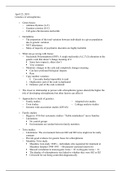
Genetics of schizophrenia
≈ Genes basics:
– Adenine-thymine (A-T)
– Guanine-cytosine (G-C)
– Cell-gene-chromosome-nucleotide
≈ Heritability:
– The proportion of the total variation between individuals in a given population
due to genetic variation
– NOT inheritance
– Many of majority of psychiatric disorders are highly heritable
≈ What can go wrong with Genes:
– Nucleotide Polymorphism (SNP): A single nucleotide (A,C,T,G) alteration in the
genetic code that doesn’t change meaning of it
Some have impacts, others don’t
Very common
– Mutation: changes in the code and completely changes meaning
Can have profound biological impacts
Rare
– Copy number variation:
Can make harder/impossible to read
1. Duplication: part of the code is duplicated
2. Deletion: part of the code is deleted
≈ The closer to relationship to person with schizophrenia (genes shared) the higher the
risk of developing schizophrenia but other factors can affect it
≈ Approaches to study of genetics:
– Family studies – Adopted twin studies
– Twin studies – Linkage analysis studies
– Genome wide-association studies (GWAS)
≈ Family studies:
– Began in 1916 first systematic studies- “feeble mindedness” ran in families
– Limitations:
No control groups
Environments are similar between family members
≈ Twin studies:
– Limitations: The environment between MZ and DZ twins might not be really
constant
– Provide good evidence for genetic bases for schizophrenia
– Maudsley Twin study:
Maudsley twin study 1940’s - individuals who registered for treatment at
Maudsley hospital 1948-1993 – 106 patients- personal interviews
Showed correlation in monozygotic twins = .81 in dizygotic twins = .31
The display of schizophrenia was linked to whether they were MZ or DZ
Criticized for not being controlled diagnostically
Genetics of schizophrenia
≈ Genes basics:
– Adenine-thymine (A-T)
– Guanine-cytosine (G-C)
– Cell-gene-chromosome-nucleotide
≈ Heritability:
– The proportion of the total variation between individuals in a given population
due to genetic variation
– NOT inheritance
– Many of majority of psychiatric disorders are highly heritable
≈ What can go wrong with Genes:
– Nucleotide Polymorphism (SNP): A single nucleotide (A,C,T,G) alteration in the
genetic code that doesn’t change meaning of it
Some have impacts, others don’t
Very common
– Mutation: changes in the code and completely changes meaning
Can have profound biological impacts
Rare
– Copy number variation:
Can make harder/impossible to read
1. Duplication: part of the code is duplicated
2. Deletion: part of the code is deleted
≈ The closer to relationship to person with schizophrenia (genes shared) the higher the
risk of developing schizophrenia but other factors can affect it
≈ Approaches to study of genetics:
– Family studies – Adopted twin studies
– Twin studies – Linkage analysis studies
– Genome wide-association studies (GWAS)
≈ Family studies:
– Began in 1916 first systematic studies- “feeble mindedness” ran in families
– Limitations:
No control groups
Environments are similar between family members
≈ Twin studies:
– Limitations: The environment between MZ and DZ twins might not be really
constant
– Provide good evidence for genetic bases for schizophrenia
– Maudsley Twin study:
Maudsley twin study 1940’s - individuals who registered for treatment at
Maudsley hospital 1948-1993 – 106 patients- personal interviews
Showed correlation in monozygotic twins = .81 in dizygotic twins = .31
The display of schizophrenia was linked to whether they were MZ or DZ
Criticized for not being controlled diagnostically