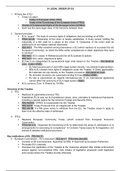
01 LEGAL ORDER OF EU
1. Primary law of EU
Treaty of Lisbon
Treaty on European Union (TEU)
Treaty of the Functioning of the European Union (TFEU)
Charter of Fundamental Rights of the European Union (CFREU)
Each has the same legal value No hierarchy between them
2. General principles
EU's “acquis”: The body of common rights & obligations that are binding on all MSs
TFEU Art 20: “Citizenship of the Union is hereby established Every person holding the
nationality of a MS shall be a citizen of the Union Citizenship of the Union shall be
additional to & not replace national citizenship”
TEU Art 1: “The MSs establish among themselves a EU (which replaces & succeeds the old
European Community), on which the MSs confer competences to attain objectives they have
in common”
TEU Art 2: EU’s values Reference point for all EU policies & actions
TEU Art 3: EU’s aims, objectives & tasks
EU law is an independent & supranational legal order based on the Treaties (Van Gend en
Loos; Costa v ENEL)
EU laws become part of each MS’s legal system directly / via national implementation
MSs & EU citizens have rights & obligations under the Treaties Direct applicability:
EU nationals can rely directly on the Treaties’ provisions (Van Gend en Loos)
No domestic provision can supersede binding EU law (Costa v ENEL)
EU law is autonomous as regards international law An international agreement
cannot affect the autonomy of EU’s legal system (Kadi I)
EU’s currency: Euro Shared by 19 MSs
Overview of the Treaties
3. TEU
Replaces & supersedes previous TEU
Establishes EU & sets out its foundational values, aims, principles & institutional framework,
including a special regime for the Common Foreign and Security Policy
TEU Art 6(1): CFREU is incorporated into the Treaties
TEU Art 51: Treaty Protocols form an integral part of the Treaties
TEU Art 50: If a MS gives notice to withdraw from the EU, the Treaties cease to apply to
them from the effective date of withdrawal
4. TFEU
Replaces European Community Treaty (which evolved from European Economic
Community)
TFEU Art 1(1): “Organises the functioning of EU & determines the areas of, delimitation of, &
arrangements for exercising its competence” Contains Treaty bases for EU legislation, EU
policies & detailed institutional provisions
Key institutions of EU (TEU Art 13)
5. European Commission – EU’s executive (TEU Art 17; TFEU Arts 244-250)
Consists of 28 commissioners: Appointed by MSs Approved by European Parliament
Promotes EU’s interests
Oversees the application of the Treaties & the measures adopted; May initiate enforcement
actions against non-compliant MSs; Sole initiator of legislative proposals (draft legislative
acts) except where the Treaties provide otherwise
, 6. Council (“Council of Ministers”) (TEU Art 16; TFEU Arts 237-243)
Consists of ministerial-level representatives of the governments of MSs Represents MSs
Promotes national interests
Exercises legislative & budgetary powers jointly with European Parliament
7. European Council (TEU Arts 15 & 18; TFEU Art 235)
Consists of heads of state / government of 28 MSs
Determines EU’s strategic direction; Eercises leadership
8. European Parliament (TEU Arts 14 & 17; TFEU Arts 223-234)
Consists of 751 members: Directly elected by European citizens Represents EU’s citizens
Exercises legislative & budgetary powers jointly with Council; Holds European Commission
to account (can pass a no-confidence vote on motions proposed by European Commission)
9. EU courts (CJEU) – EU’s judiciary (TEU Art 19; TFEU Arts 251-281)
Consists of:
Court of Justice (ECJ)
Consists of:
o 28 judges: Chosen from each MS
o 11 Advocates-Generals
Make reasoned submissions on cases in open court
Act with complete impartiality & independence
Issue his opinion in advance of the judgment with detailed legal
analysis of the issues Advisory: Not binding on the court
Deals with preliminary references from national courts, direct actions brought
by EU institutions & appeals from GC on points of law
General Court (GC)
Consists of 47 judges
Deals with actions brought by private parties
Bound by appeal judgments of ECJ
Ensures the uniform application & interpretation of EU law; May review the legality of the acts
of EU institutions
Law-making & democracy in EU
10. Institutional balance in law-making
TEU Art 17(2): With limited exceptions, EU legislative acts may only be adopted based on a
Commission proposal / draft legislative act
TEU Arts 14(1) & 16(1): Legislative functions are exercised jointly by European Parliament &
Council
Voting procedures
Qualified Majority Voting in Council
TEU Art 16(3): QMV is the norm, unless the Treaties provide otherwise
TFEU Art 238(3)(a): 2 conditions must be satisfied
o 55% of MSs vote in favour
o The proposal is supported by MSs representing at least 65% of the
total EU population
o A blocking minority may defeat the proposal The blocking minority
must have at least 4 Council members representing at least 35% of the
total EU population
Proportional system: Weighted votes for each MS based on population
Adjusted depending on the number of MS participating in the policy area
Voting in European Parliament
1. Primary law of EU
Treaty of Lisbon
Treaty on European Union (TEU)
Treaty of the Functioning of the European Union (TFEU)
Charter of Fundamental Rights of the European Union (CFREU)
Each has the same legal value No hierarchy between them
2. General principles
EU's “acquis”: The body of common rights & obligations that are binding on all MSs
TFEU Art 20: “Citizenship of the Union is hereby established Every person holding the
nationality of a MS shall be a citizen of the Union Citizenship of the Union shall be
additional to & not replace national citizenship”
TEU Art 1: “The MSs establish among themselves a EU (which replaces & succeeds the old
European Community), on which the MSs confer competences to attain objectives they have
in common”
TEU Art 2: EU’s values Reference point for all EU policies & actions
TEU Art 3: EU’s aims, objectives & tasks
EU law is an independent & supranational legal order based on the Treaties (Van Gend en
Loos; Costa v ENEL)
EU laws become part of each MS’s legal system directly / via national implementation
MSs & EU citizens have rights & obligations under the Treaties Direct applicability:
EU nationals can rely directly on the Treaties’ provisions (Van Gend en Loos)
No domestic provision can supersede binding EU law (Costa v ENEL)
EU law is autonomous as regards international law An international agreement
cannot affect the autonomy of EU’s legal system (Kadi I)
EU’s currency: Euro Shared by 19 MSs
Overview of the Treaties
3. TEU
Replaces & supersedes previous TEU
Establishes EU & sets out its foundational values, aims, principles & institutional framework,
including a special regime for the Common Foreign and Security Policy
TEU Art 6(1): CFREU is incorporated into the Treaties
TEU Art 51: Treaty Protocols form an integral part of the Treaties
TEU Art 50: If a MS gives notice to withdraw from the EU, the Treaties cease to apply to
them from the effective date of withdrawal
4. TFEU
Replaces European Community Treaty (which evolved from European Economic
Community)
TFEU Art 1(1): “Organises the functioning of EU & determines the areas of, delimitation of, &
arrangements for exercising its competence” Contains Treaty bases for EU legislation, EU
policies & detailed institutional provisions
Key institutions of EU (TEU Art 13)
5. European Commission – EU’s executive (TEU Art 17; TFEU Arts 244-250)
Consists of 28 commissioners: Appointed by MSs Approved by European Parliament
Promotes EU’s interests
Oversees the application of the Treaties & the measures adopted; May initiate enforcement
actions against non-compliant MSs; Sole initiator of legislative proposals (draft legislative
acts) except where the Treaties provide otherwise
, 6. Council (“Council of Ministers”) (TEU Art 16; TFEU Arts 237-243)
Consists of ministerial-level representatives of the governments of MSs Represents MSs
Promotes national interests
Exercises legislative & budgetary powers jointly with European Parliament
7. European Council (TEU Arts 15 & 18; TFEU Art 235)
Consists of heads of state / government of 28 MSs
Determines EU’s strategic direction; Eercises leadership
8. European Parliament (TEU Arts 14 & 17; TFEU Arts 223-234)
Consists of 751 members: Directly elected by European citizens Represents EU’s citizens
Exercises legislative & budgetary powers jointly with Council; Holds European Commission
to account (can pass a no-confidence vote on motions proposed by European Commission)
9. EU courts (CJEU) – EU’s judiciary (TEU Art 19; TFEU Arts 251-281)
Consists of:
Court of Justice (ECJ)
Consists of:
o 28 judges: Chosen from each MS
o 11 Advocates-Generals
Make reasoned submissions on cases in open court
Act with complete impartiality & independence
Issue his opinion in advance of the judgment with detailed legal
analysis of the issues Advisory: Not binding on the court
Deals with preliminary references from national courts, direct actions brought
by EU institutions & appeals from GC on points of law
General Court (GC)
Consists of 47 judges
Deals with actions brought by private parties
Bound by appeal judgments of ECJ
Ensures the uniform application & interpretation of EU law; May review the legality of the acts
of EU institutions
Law-making & democracy in EU
10. Institutional balance in law-making
TEU Art 17(2): With limited exceptions, EU legislative acts may only be adopted based on a
Commission proposal / draft legislative act
TEU Arts 14(1) & 16(1): Legislative functions are exercised jointly by European Parliament &
Council
Voting procedures
Qualified Majority Voting in Council
TEU Art 16(3): QMV is the norm, unless the Treaties provide otherwise
TFEU Art 238(3)(a): 2 conditions must be satisfied
o 55% of MSs vote in favour
o The proposal is supported by MSs representing at least 65% of the
total EU population
o A blocking minority may defeat the proposal The blocking minority
must have at least 4 Council members representing at least 35% of the
total EU population
Proportional system: Weighted votes for each MS based on population
Adjusted depending on the number of MS participating in the policy area
Voting in European Parliament