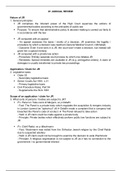
01 JUDICIAL REVIEW
Nature of JR
1. General principles
JR comprises the inherent power of the High Court supervise the actions of
governmental bodies according to the principles of public law
Purpose: To ensure that administrative policy & decision-making is carried out fairly &
in accordance with the law
JR compared with an appeal
- An appeal assesses the basis / merits of a decision; JR examines the legality /
procedure by which a decision was reached (General Medical Council v Michalak)
- Outcome: Even if one wins in a JR, the court won’t make a decision, but instead will
grant him a special remedy
JR compared with a private law action
- Procedure: Entirely separate court process by which one initiates JR
- Remedies: Special remedies are available in JR (e.g. prerogative orders); A claim of
damages is usually transferred to private law proceedings
Application / Claim for JR
2. Legislative basis
Order 53
- Secondary legislative basis
Senior Courts Act 1981, s 31
- Primary legislative basis
Civil Procedure Rules, Part 54
- Supplements the SCA 1981
Scope of an application / claim for JR
3. What sorts of persons / bodies are subject to JR?
R v Panel on Take-overs & Mergers, ex p Datafin
- Fact: The Panel is a private body which regulates the acquisition & mergers industry
in London (cannot be “opted-out” of) Datafin made a complaint that a company had
breached the Panel’s code of conduct The Panel refused to take action
- Held: A JR claim could be made against a private body
- Principle: Private bodies which effectively perform public law functions are subject to
JR
R v Chief Rabbi, ex p Wachmann
- Fact: Wachmann was exiled from the Orthodox Jewish religion by the Chief Rabbi
due to suspected adultery
- Held: A JR claim could not be brought to examine the decision to exile Wachmann
- Principle: A religious organisation is not subject to JR as it has no connection to the
government / no governmental interest
, R v Disciplinary Committee of the Jockey Club, ex p Aga Khan
- Fact: Aga Khan’s horse was disqualified for suspected cheating
- Held: A JR claim could not be brought to challenge the disqualification
- Principle: A claim can only be made in private law where it concerns contractual
relationships (the court didn’t want to intervene in a sporting event through JR)
Obtaining leave / permission
4. Procedure
Part 54.4, CPR
- “The court’s permission to proceed is required in a claim for JR whether started
under this Section / transferred to the Administrative Court”
Part 54.12, CPR
- (1) Permission decision without a hearing (written procedure)
- (7) If “totally without merit” No hearing allowed
Part 54.11A, CPR
- Permission decision where court requires a hearing
s 31(3), SCA 1981
- No application for JR shall be made unless the leave of the High Court has been
obtained in accordance with rules of court; & the court shall not grant leave unless the
applicant has a sufficient interest in the relevant matter
1st stage: Permission stage
- Paperwork: Written procedure
- Only about 20% cases obtain permission to proceed
- Acts as a filter stage to protect public bodies from undeserving claims (by only
allowing robust claims to proceed)
2nd stage: Merit stage
- Where a claim is found to be “totally without merit” = Bound to fail (R (Grace) v SoS
for the Home Department)
Exclusivity of an application / claim for JR
5. General principles
A person who is seeking private law remedies may use JR procedures to bring a claim
(Part 54.3, CPR)
The Exclusive Principle: One cannot assert a public law right against a public body
with a private law action; The JR process exists to ensure that public bodies are
protected from a flood of litigation Exclusive procedure (O’Reilly v Mackman)
- The Principle was expressly endorsed in Trim v North Dorset District Council
6. When the Exclusive Principle doesn’t apply
Where one is asserting private law rights
- Tort rights
Davy v Spelthorne BC: It was held that a negligent misstatement is a private
law right under tort Not governed by the Principle
- Contractual rights
Clark v University of Humberside: It was held that claim was made on a
contractual basis Not governed by the Principle
, - Certain statutory rights
Roy v Kensington & Chelsea FPC: It was held that some statutory rights are
treated as private law rights Not governed by the Principle
Steed v SoS for the Home Department: A private law claim may be made
although a public law right was being asserted against a public authority,
because the right specifically affected C No exclusivity issue
Where one uses a public law right to defend a legal proceeding being brought against
him (only the express words of a statute may limit / remove such a right)
- Civil proceedings
Wandsworth LBC v Winder: A public law right may be asserted in the defence
of a private law claim
- Criminal proceedings
Boddington v British Transport Police: A public law right may be asserted in the
defence of a criminal proceeding
Standing (the right / capacity to bring an action / to appear in a court)
7. R v IRC, ex p National Federation of Self-Employed
Fact: Fleet Street Newspapers avoided paying income tax for temporary workers by
paying the workers in cash & giving them false names on accounts HMRC
negotiated that if the Newspapers stopped this unlawful practice, they would only
request the previous 2 years’ income tax to be paid, rather than the 6 years which
statute required Agreement leaked to the public The Federation claimed JR on
the lawfulness of the decision not to act in accordance with the law
Held: No sufficient interest
Principle:
- Lord Wilberforce (majority): Relevant factors in considering whether an applicant has
sufficient interest:
(1) The powers of the respondent
(2) The position of the applicant in relation to those powers
(3) The substance of the breach
- Lord Diplock (dissent): No test, just use discretion; Clear words of statute
8. R v SoS for the Environment, ex p Rose Theatre Trust
Fact: A campaign group wished the SoS to prevent building works on the historic
Shakespearian Rose Theatre site SoS refused the group’s request to designate the
site, pursuant to statutory powers, a site of historic significance, which would prevent
building works The group incorporated & brought a JR claim against the decision
not to designate the site
Held: No sufficient interest
Principle:
- Not every person can seek to enforce every public duty
- Sufficient interest is not purely a matter of discretion
- A direct financial / legal interest is not required
- Incorporation does not per se create standing (if no individual member has standing,
the group will not have standing)
Nature of JR
1. General principles
JR comprises the inherent power of the High Court supervise the actions of
governmental bodies according to the principles of public law
Purpose: To ensure that administrative policy & decision-making is carried out fairly &
in accordance with the law
JR compared with an appeal
- An appeal assesses the basis / merits of a decision; JR examines the legality /
procedure by which a decision was reached (General Medical Council v Michalak)
- Outcome: Even if one wins in a JR, the court won’t make a decision, but instead will
grant him a special remedy
JR compared with a private law action
- Procedure: Entirely separate court process by which one initiates JR
- Remedies: Special remedies are available in JR (e.g. prerogative orders); A claim of
damages is usually transferred to private law proceedings
Application / Claim for JR
2. Legislative basis
Order 53
- Secondary legislative basis
Senior Courts Act 1981, s 31
- Primary legislative basis
Civil Procedure Rules, Part 54
- Supplements the SCA 1981
Scope of an application / claim for JR
3. What sorts of persons / bodies are subject to JR?
R v Panel on Take-overs & Mergers, ex p Datafin
- Fact: The Panel is a private body which regulates the acquisition & mergers industry
in London (cannot be “opted-out” of) Datafin made a complaint that a company had
breached the Panel’s code of conduct The Panel refused to take action
- Held: A JR claim could be made against a private body
- Principle: Private bodies which effectively perform public law functions are subject to
JR
R v Chief Rabbi, ex p Wachmann
- Fact: Wachmann was exiled from the Orthodox Jewish religion by the Chief Rabbi
due to suspected adultery
- Held: A JR claim could not be brought to examine the decision to exile Wachmann
- Principle: A religious organisation is not subject to JR as it has no connection to the
government / no governmental interest
, R v Disciplinary Committee of the Jockey Club, ex p Aga Khan
- Fact: Aga Khan’s horse was disqualified for suspected cheating
- Held: A JR claim could not be brought to challenge the disqualification
- Principle: A claim can only be made in private law where it concerns contractual
relationships (the court didn’t want to intervene in a sporting event through JR)
Obtaining leave / permission
4. Procedure
Part 54.4, CPR
- “The court’s permission to proceed is required in a claim for JR whether started
under this Section / transferred to the Administrative Court”
Part 54.12, CPR
- (1) Permission decision without a hearing (written procedure)
- (7) If “totally without merit” No hearing allowed
Part 54.11A, CPR
- Permission decision where court requires a hearing
s 31(3), SCA 1981
- No application for JR shall be made unless the leave of the High Court has been
obtained in accordance with rules of court; & the court shall not grant leave unless the
applicant has a sufficient interest in the relevant matter
1st stage: Permission stage
- Paperwork: Written procedure
- Only about 20% cases obtain permission to proceed
- Acts as a filter stage to protect public bodies from undeserving claims (by only
allowing robust claims to proceed)
2nd stage: Merit stage
- Where a claim is found to be “totally without merit” = Bound to fail (R (Grace) v SoS
for the Home Department)
Exclusivity of an application / claim for JR
5. General principles
A person who is seeking private law remedies may use JR procedures to bring a claim
(Part 54.3, CPR)
The Exclusive Principle: One cannot assert a public law right against a public body
with a private law action; The JR process exists to ensure that public bodies are
protected from a flood of litigation Exclusive procedure (O’Reilly v Mackman)
- The Principle was expressly endorsed in Trim v North Dorset District Council
6. When the Exclusive Principle doesn’t apply
Where one is asserting private law rights
- Tort rights
Davy v Spelthorne BC: It was held that a negligent misstatement is a private
law right under tort Not governed by the Principle
- Contractual rights
Clark v University of Humberside: It was held that claim was made on a
contractual basis Not governed by the Principle
, - Certain statutory rights
Roy v Kensington & Chelsea FPC: It was held that some statutory rights are
treated as private law rights Not governed by the Principle
Steed v SoS for the Home Department: A private law claim may be made
although a public law right was being asserted against a public authority,
because the right specifically affected C No exclusivity issue
Where one uses a public law right to defend a legal proceeding being brought against
him (only the express words of a statute may limit / remove such a right)
- Civil proceedings
Wandsworth LBC v Winder: A public law right may be asserted in the defence
of a private law claim
- Criminal proceedings
Boddington v British Transport Police: A public law right may be asserted in the
defence of a criminal proceeding
Standing (the right / capacity to bring an action / to appear in a court)
7. R v IRC, ex p National Federation of Self-Employed
Fact: Fleet Street Newspapers avoided paying income tax for temporary workers by
paying the workers in cash & giving them false names on accounts HMRC
negotiated that if the Newspapers stopped this unlawful practice, they would only
request the previous 2 years’ income tax to be paid, rather than the 6 years which
statute required Agreement leaked to the public The Federation claimed JR on
the lawfulness of the decision not to act in accordance with the law
Held: No sufficient interest
Principle:
- Lord Wilberforce (majority): Relevant factors in considering whether an applicant has
sufficient interest:
(1) The powers of the respondent
(2) The position of the applicant in relation to those powers
(3) The substance of the breach
- Lord Diplock (dissent): No test, just use discretion; Clear words of statute
8. R v SoS for the Environment, ex p Rose Theatre Trust
Fact: A campaign group wished the SoS to prevent building works on the historic
Shakespearian Rose Theatre site SoS refused the group’s request to designate the
site, pursuant to statutory powers, a site of historic significance, which would prevent
building works The group incorporated & brought a JR claim against the decision
not to designate the site
Held: No sufficient interest
Principle:
- Not every person can seek to enforce every public duty
- Sufficient interest is not purely a matter of discretion
- A direct financial / legal interest is not required
- Incorporation does not per se create standing (if no individual member has standing,
the group will not have standing)