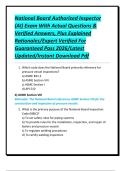
National Board Authorized Inspector
(AI) Practice Exam Questions And
Correct Answers (Verified Answers) Plus
Rationales 2026 Q&A | Instant
Download Pdf
1. Which of the following is the primary responsibility of an Authorized
Inspector?
A. Design new pressure vessels
B. Fabricate pressure vessels
C. Inspect and verify compliance with National Board and ASME codes
D. Operate pressure equipment
Rationale: Authorized Inspectors are tasked with inspecting pressure-
retaining equipment to ensure compliance with applicable codes, not
designing or operating them.
,2. What does the National Board “R” Stamp signify?
A. Original construction
B. Repairs on boilers and pressure vessels
C. Inspection only
D. Repairs and alterations in accordance with the National Board
Inspection Code
Rationale: The “R” Stamp authorizes repair and alteration of pressure-
retaining equipment according to NBIC rules.
3. Which of the following is the minimum required thickness for a shell of a
code-stamped pressure vessel subjected to internal pressure?
A. 0.05 inches
B. Determined by ASME Section VIII formulas
C. 0.25 inches
D. 1 inch
Rationale: Minimum thickness is calculated based on design formulas in
ASME Section VIII considering material, pressure, and diameter.
4. Which type of welding requires a prequalified procedure for National
Board inspection approval?
A. Gas welding
B. Shielded metal arc welding (SMAW) and other ASME code-required
,welding processes
C. Soldering
D. Brazing
Rationale: Code-stamped vessels require ASME-qualified welding
procedures, and prequalification may apply depending on process and
thickness.
5. Which of the following inspections is typically required before a new
pressure vessel is put into service?
A. Daily operational inspection
B. Hydrostatic or pneumatic pressure test
C. Visual inspection only after 5 years
D. Annual leak test
Rationale: ASME and NBIC codes require proof testing under hydrostatic or
pneumatic pressure to ensure vessel integrity before service.
6. What is the purpose of a “nameplate” on a pressure vessel?
A. Decorative only
B. Indicates the manufacturer’s name only
C. Provides essential design, material, and code compliance information
D. Used for tracking maintenance history only
, Rationale: Nameplates indicate key information including design pressure,
temperature, code, material, and manufacturer, which is critical for
inspection.
7. When inspecting a pressure relief valve, which factor is most important?
A. Color of the valve
B. Set pressure and proper operation
C. Manufacturer logo
D. Valve location
Rationale: Inspectors must ensure the relief valve operates at its designed
set pressure to protect equipment from overpressure.
8. In a boiler inspection, which defect is considered most critical?
A. Minor paint chips
B. Loose handrails
C. Rust on non-pressure surfaces
D. Cracks or thinning in pressure-retaining components
Rationale: Cracks or thinning could lead to catastrophic failure under
pressure, making them critical to address.
9. Which part of the NBIC covers installation, inspection, and repair of
boilers?
(AI) Practice Exam Questions And
Correct Answers (Verified Answers) Plus
Rationales 2026 Q&A | Instant
Download Pdf
1. Which of the following is the primary responsibility of an Authorized
Inspector?
A. Design new pressure vessels
B. Fabricate pressure vessels
C. Inspect and verify compliance with National Board and ASME codes
D. Operate pressure equipment
Rationale: Authorized Inspectors are tasked with inspecting pressure-
retaining equipment to ensure compliance with applicable codes, not
designing or operating them.
,2. What does the National Board “R” Stamp signify?
A. Original construction
B. Repairs on boilers and pressure vessels
C. Inspection only
D. Repairs and alterations in accordance with the National Board
Inspection Code
Rationale: The “R” Stamp authorizes repair and alteration of pressure-
retaining equipment according to NBIC rules.
3. Which of the following is the minimum required thickness for a shell of a
code-stamped pressure vessel subjected to internal pressure?
A. 0.05 inches
B. Determined by ASME Section VIII formulas
C. 0.25 inches
D. 1 inch
Rationale: Minimum thickness is calculated based on design formulas in
ASME Section VIII considering material, pressure, and diameter.
4. Which type of welding requires a prequalified procedure for National
Board inspection approval?
A. Gas welding
B. Shielded metal arc welding (SMAW) and other ASME code-required
,welding processes
C. Soldering
D. Brazing
Rationale: Code-stamped vessels require ASME-qualified welding
procedures, and prequalification may apply depending on process and
thickness.
5. Which of the following inspections is typically required before a new
pressure vessel is put into service?
A. Daily operational inspection
B. Hydrostatic or pneumatic pressure test
C. Visual inspection only after 5 years
D. Annual leak test
Rationale: ASME and NBIC codes require proof testing under hydrostatic or
pneumatic pressure to ensure vessel integrity before service.
6. What is the purpose of a “nameplate” on a pressure vessel?
A. Decorative only
B. Indicates the manufacturer’s name only
C. Provides essential design, material, and code compliance information
D. Used for tracking maintenance history only
, Rationale: Nameplates indicate key information including design pressure,
temperature, code, material, and manufacturer, which is critical for
inspection.
7. When inspecting a pressure relief valve, which factor is most important?
A. Color of the valve
B. Set pressure and proper operation
C. Manufacturer logo
D. Valve location
Rationale: Inspectors must ensure the relief valve operates at its designed
set pressure to protect equipment from overpressure.
8. In a boiler inspection, which defect is considered most critical?
A. Minor paint chips
B. Loose handrails
C. Rust on non-pressure surfaces
D. Cracks or thinning in pressure-retaining components
Rationale: Cracks or thinning could lead to catastrophic failure under
pressure, making them critical to address.
9. Which part of the NBIC covers installation, inspection, and repair of
boilers?