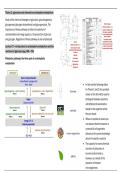
Theme C: glycolysis and alternative carbohydrate metabolism
Study of the chemical strategies of glycolysis, gluconeogenesis,
glycogenesis (glycogen biosynthesis) and glycogenolysis. The
importance of these pathways in either the oxidation of
carbohydrates and energy supply or, the production of glucose
and glycogen. Regulation of these pathways is also emphasized
Lecture C1 – introduction to carbohydrate metabolism and the
reactions of glycolysis (pg. 409 – 418)
Metabolic pathways that form part of carbohydrate
metabolism
• In this and the following slides
for Theme C and D, the symbols
shown on the left will be used to
distinguish between reactions
with di:erent characteristics
based on the organism where
they are found
• Where no symbol is shown you
can assume that the reaction is
universal for all organisms
(based on the current knowledge
about the specific reaction)
• The capacity for some chemical
reactions to take place in
humans and animals is,
however, as a result of the
presence of relevant
microorganisms
,Glycolysis The reactions of glycolysis: energy investment
Functions of glycolysis
• Supplies energy (ATP)
• Supplies reducing equivalents (NADH)
• Prepares sugars for complete oxidation
• Supplies key metabolites for anabolism
Figure 1 (maps documents)
,Metabolic map Metabolic map
The reactions of glycolysis: energy generation
, Types of reactions in glycolysis What is a phosphate group transfer?
• Phosphate group transfer - phosphate group is transferred (A phosphate group is transferred from ATP to a glycolytic
from one molecule to another. Conducted by the transfer of intermediate, or vice versa)
energy (ATP). Helps activate molecules, making them more
reactive
• Isomerization- rearrangement of atoms within a molecule
to form another isomer. Convert one molecule into another
with di:erent properties/functions.
• Aldol fission - important for the generation of smaller
molecules or the initiation of further chemical Kinases – require Mg2+ or Mn2+ ions
transformations
Examples:
• Redox reactions - Involves the transfer of electrons
between molecules • ATP-dependent phosphorylation:
• Rearrangement of phosphate groups - refers to the - phosphorylation of a glycolytic substrate coupled to
movement or rearrangement of a phosphate group within a hydrolysis of ATP
molecule o Enzyme No. 1A – hexokinase
• Dehydration- water molecules are removed from a o Enzyme No. 3A – phosphofructokinase-1
molecule or a reaction system • Substrate-level phosphorylation:
- production of an energy-rich phosphate compound (e.g.
Reaction 1A: the first ATP investment (phosphate group
ATP) by the transfer of a phosphate group from a
transfer)
compound with a higher phosphate-group-transfer
potential (PTP)
o Enzyme No. 7 – phosphoglycerate kinase
o Enzyme No. 10A – pyruvate kinase
Study of the chemical strategies of glycolysis, gluconeogenesis,
glycogenesis (glycogen biosynthesis) and glycogenolysis. The
importance of these pathways in either the oxidation of
carbohydrates and energy supply or, the production of glucose
and glycogen. Regulation of these pathways is also emphasized
Lecture C1 – introduction to carbohydrate metabolism and the
reactions of glycolysis (pg. 409 – 418)
Metabolic pathways that form part of carbohydrate
metabolism
• In this and the following slides
for Theme C and D, the symbols
shown on the left will be used to
distinguish between reactions
with di:erent characteristics
based on the organism where
they are found
• Where no symbol is shown you
can assume that the reaction is
universal for all organisms
(based on the current knowledge
about the specific reaction)
• The capacity for some chemical
reactions to take place in
humans and animals is,
however, as a result of the
presence of relevant
microorganisms
,Glycolysis The reactions of glycolysis: energy investment
Functions of glycolysis
• Supplies energy (ATP)
• Supplies reducing equivalents (NADH)
• Prepares sugars for complete oxidation
• Supplies key metabolites for anabolism
Figure 1 (maps documents)
,Metabolic map Metabolic map
The reactions of glycolysis: energy generation
, Types of reactions in glycolysis What is a phosphate group transfer?
• Phosphate group transfer - phosphate group is transferred (A phosphate group is transferred from ATP to a glycolytic
from one molecule to another. Conducted by the transfer of intermediate, or vice versa)
energy (ATP). Helps activate molecules, making them more
reactive
• Isomerization- rearrangement of atoms within a molecule
to form another isomer. Convert one molecule into another
with di:erent properties/functions.
• Aldol fission - important for the generation of smaller
molecules or the initiation of further chemical Kinases – require Mg2+ or Mn2+ ions
transformations
Examples:
• Redox reactions - Involves the transfer of electrons
between molecules • ATP-dependent phosphorylation:
• Rearrangement of phosphate groups - refers to the - phosphorylation of a glycolytic substrate coupled to
movement or rearrangement of a phosphate group within a hydrolysis of ATP
molecule o Enzyme No. 1A – hexokinase
• Dehydration- water molecules are removed from a o Enzyme No. 3A – phosphofructokinase-1
molecule or a reaction system • Substrate-level phosphorylation:
- production of an energy-rich phosphate compound (e.g.
Reaction 1A: the first ATP investment (phosphate group
ATP) by the transfer of a phosphate group from a
transfer)
compound with a higher phosphate-group-transfer
potential (PTP)
o Enzyme No. 7 – phosphoglycerate kinase
o Enzyme No. 10A – pyruvate kinase