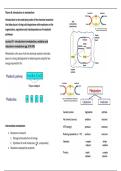
Theme B: introduction to metabolism
Introduction to the underlying order of the chemical reactions
that take place in living cells/organisms with emphasis on the
organization, regulation and interdependence of metabolic
pathways
Lecture B1 – introduction to metabolism, oxidation and
reduction in metabolism (pg. 374-379)
Metabolism is the sum of all the chemical reactions that take
place in a living cell/organism for obtaining and using the free
energy required for life
Intermediate metabolism
• Reactions involved in
1. Storage and production of energy
2. Synthesis of small molecules ( M! compounds)
• Reactions catalyzed by enzymes
, Redox reactions Catabolism and anabolism
NADH and NADPH
• Metabolic exchange: none
• [reduced coenzyme] / [oxidized enzyme] in cell:
5. [NADPH] / [NAD" ] < 1 promotes metabolite oxidation
6. [NADPH] / [NADP " ] > 1 promotes metabolite reduction
• Use of DG from metabolite oxidation:
7. NADH oxidative phosphorylation ATP
8. NADPH reductive biosynthesis (anabolism)
• Coenzyme specificity:
9. NAD" - enzymes of catabolism (dehydrogenases)
10. NADPH – enzymes of anabolism (reductases)
Exercise
Consider the redox reaction below:
• Does reduction or oxidation of the substrate metabolite
take place? Reduction
• Identify the:
3. Reducing agent/reductant
4. Oxidizing agent/oxidant
• Write out the redox reaction as 2 separate reactions: an
oxidation reaction and a reduction reaction
Introduction to the underlying order of the chemical reactions
that take place in living cells/organisms with emphasis on the
organization, regulation and interdependence of metabolic
pathways
Lecture B1 – introduction to metabolism, oxidation and
reduction in metabolism (pg. 374-379)
Metabolism is the sum of all the chemical reactions that take
place in a living cell/organism for obtaining and using the free
energy required for life
Intermediate metabolism
• Reactions involved in
1. Storage and production of energy
2. Synthesis of small molecules ( M! compounds)
• Reactions catalyzed by enzymes
, Redox reactions Catabolism and anabolism
NADH and NADPH
• Metabolic exchange: none
• [reduced coenzyme] / [oxidized enzyme] in cell:
5. [NADPH] / [NAD" ] < 1 promotes metabolite oxidation
6. [NADPH] / [NADP " ] > 1 promotes metabolite reduction
• Use of DG from metabolite oxidation:
7. NADH oxidative phosphorylation ATP
8. NADPH reductive biosynthesis (anabolism)
• Coenzyme specificity:
9. NAD" - enzymes of catabolism (dehydrogenases)
10. NADPH – enzymes of anabolism (reductases)
Exercise
Consider the redox reaction below:
• Does reduction or oxidation of the substrate metabolite
take place? Reduction
• Identify the:
3. Reducing agent/reductant
4. Oxidizing agent/oxidant
• Write out the redox reaction as 2 separate reactions: an
oxidation reaction and a reduction reaction