Lecture 6
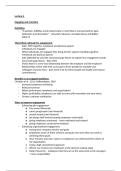
Engaging and retention
Definition
- “A positive, fulfilling, work related state or mind that is characterised by vigor,
dedication and absorption” – Schaufeli, Salanova, Gonzalez-Roma and Bakker
2002:74
Theoretical rationale for engagement
- Kahn 1990 cognitive, emotional and physical aspects
- Individuals are engaged
- When individuals are engaged, they bring all their aspects including cognitive,
emotional and physical aspects
- Saks 2006:603 he used the social exchange theory to explain how engagement works
- Social exchange theory – Blau 1964
- Shows that It is a two-way relationship between the employer and the employee
- Relationships evolve with time as you get to know people for example your
colleagues and your boss – gain more trust for these people and loyalty and mutual
commitments.
Benefits or an engaged workforce
Christian et al., 2011; Halbeseleben, 2010
- Increased employee well being
- Reduced turnover
- Better performance (employee and organisation)
- Higher profitability (employees are able to come with innovation and new ideas)
- Greater customer satisfaction
Ways to improve engagement
- Enhancing job engagement
o Pay reward (financial)
o career progression (non-financial)
o annual awards (non-financial)
o job design (skill variety keeping employees motivated)
o giving employees autonomy – more motivated and relaxed
o giving employees constructive feedback
- Enhancing organisational engagement
o Having clear company mission and goals
o Employees aware of these missions and goals, the more they can work to
achieving these goals
o Clear missions and clear values so employees can understand the culture of
the organisation
o Using a high commitment approach
o Where you involve your employees at the decision-making stage
o Flatter hierarchy – employees feel they are at the same level as the managers
= more responsibility
, The dark side of engagement
- Employee engagement is on the decline today
- 3 out of 5 employees feel disengaged in the UK
- Only Half of the American work force is fully engaged
- Disengagement cost company’s billions of dollars per year per loss of productivity
What is disengagement?
- You take yourself away
- You dint have a sense of belonging
- You remove/withdraw yourself from the specific job
- Don’t find meaning or interest in the job
- Low morale in the employees
Define employee turnover and retention
- Employees turnover
o Employees leave the organisation and have to be replaced
- Employee retention
o Keeping employees
o The act of keeping employees once they have been hired
o Steps to gain human capital advantage
Voluntary turnover
- when employees initiate leaving themselves against the wish of the company
- deliberately leave
Involuntary turnover
- turnover initiated by the organisation
functional turnover
- happens when person not performing very well
- Company finds person is not contributing much
- Both company and employee decide that they should leave – both parties agree
- Poor performers leave the company
dysfunctional turnover
- When high performers leave the company
- Detrimental to the company
- Company can make big losses
Perspectives on staff retention
- Tracking turnover rates generally and developing organisational policy aimed at
improving retention as a whole
- Retention practices should match organisational strategy
- High human capital needs consider-aggressive retention policies- retention bonuses
AIG banking sector
- Retaining high-performing key players ‘wait for talent’ – aimed specifically at those
whose talents are scarce
Engaging and retention
Definition
- “A positive, fulfilling, work related state or mind that is characterised by vigor,
dedication and absorption” – Schaufeli, Salanova, Gonzalez-Roma and Bakker
2002:74
Theoretical rationale for engagement
- Kahn 1990 cognitive, emotional and physical aspects
- Individuals are engaged
- When individuals are engaged, they bring all their aspects including cognitive,
emotional and physical aspects
- Saks 2006:603 he used the social exchange theory to explain how engagement works
- Social exchange theory – Blau 1964
- Shows that It is a two-way relationship between the employer and the employee
- Relationships evolve with time as you get to know people for example your
colleagues and your boss – gain more trust for these people and loyalty and mutual
commitments.
Benefits or an engaged workforce
Christian et al., 2011; Halbeseleben, 2010
- Increased employee well being
- Reduced turnover
- Better performance (employee and organisation)
- Higher profitability (employees are able to come with innovation and new ideas)
- Greater customer satisfaction
Ways to improve engagement
- Enhancing job engagement
o Pay reward (financial)
o career progression (non-financial)
o annual awards (non-financial)
o job design (skill variety keeping employees motivated)
o giving employees autonomy – more motivated and relaxed
o giving employees constructive feedback
- Enhancing organisational engagement
o Having clear company mission and goals
o Employees aware of these missions and goals, the more they can work to
achieving these goals
o Clear missions and clear values so employees can understand the culture of
the organisation
o Using a high commitment approach
o Where you involve your employees at the decision-making stage
o Flatter hierarchy – employees feel they are at the same level as the managers
= more responsibility
, The dark side of engagement
- Employee engagement is on the decline today
- 3 out of 5 employees feel disengaged in the UK
- Only Half of the American work force is fully engaged
- Disengagement cost company’s billions of dollars per year per loss of productivity
What is disengagement?
- You take yourself away
- You dint have a sense of belonging
- You remove/withdraw yourself from the specific job
- Don’t find meaning or interest in the job
- Low morale in the employees
Define employee turnover and retention
- Employees turnover
o Employees leave the organisation and have to be replaced
- Employee retention
o Keeping employees
o The act of keeping employees once they have been hired
o Steps to gain human capital advantage
Voluntary turnover
- when employees initiate leaving themselves against the wish of the company
- deliberately leave
Involuntary turnover
- turnover initiated by the organisation
functional turnover
- happens when person not performing very well
- Company finds person is not contributing much
- Both company and employee decide that they should leave – both parties agree
- Poor performers leave the company
dysfunctional turnover
- When high performers leave the company
- Detrimental to the company
- Company can make big losses
Perspectives on staff retention
- Tracking turnover rates generally and developing organisational policy aimed at
improving retention as a whole
- Retention practices should match organisational strategy
- High human capital needs consider-aggressive retention policies- retention bonuses
AIG banking sector
- Retaining high-performing key players ‘wait for talent’ – aimed specifically at those
whose talents are scarce