1|Page
–
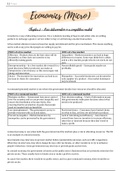
A market is a way of allocating resources. It is a voluntary meeting of buyers and sellers who are willing
partners to exchange a good or service either to buy or sell forming a market transaction.
A free market allocates resources based on supply and demand and the price mechanism. This means anything
can be sold at any price that people are willing to pay for.
PRO’s of a free market CON’s of a free market
Efficiency - Products that are the best value will be Inequalities – Market economies can lead to huge
demanded, so firms have an incentive to try differences in income. Some may think this is unfair,
efficiently making goods. and in a free market, people who do not work, do not
earn.
Entrepreneurship – In a free market, the reward for a Non-profitable goods – Some goods maybe not
good idea (new/better products) can make an profitable.
entrepreneur a lot of money, so this encourages risk-
taking and innovation.
Choice – The incentive for innovation can lead to an Monopolies – Successful businesses can become the
increase in choice for consumers. only supplier of a product – this market dominance
may be abused.
A command (planned) market is one where the government decides how resources should be allocated.
PRO’s of a command market CON’s of a command market
Maximise welfare – Government have more control Poor decision making – A lack of information means
over the economy and so can prevent inequality and that governments make poor decisions about what
ensure the distribution of income fairly. Also needs to be produced.
ensuring that the production of goods that people
need are needed and are beneficial.
Low unemployment – The government can try to Restricted choice – Consumers have limited choice
provide everyone with a job and salary. on what to buy, as firms are told what to produce.
Prevent monopolies – Market dominance by Lack of risk-taking and efficiency – Government-
monopolies can be prevented by the government. owned firms have no incentive to increase efficiency,
take risks or innovate because they don’t need to
make a profit.
A mixed economy is one when both the government and the markets play a role in allocating resources. The UK
is an example of a mixed economy.
Governments may intervene to prevent market failure (undesirable outcomes, such as traffic congestion).
When they do intervene, they often change the law, offer tax breaks, or other incentives to try to influence
people’s behaviour. Some governments may also buy or provide goods and services.
In a mixed economy, the government is known as the public sector. Businesses that are privately owned are the
private sector. These usually have to break even or make a profit to survive.
In a pure free market, there would be no public sector, and in a pure command economy, there would be no
private sector.
,2|Page
Demand is the quantity of a good/service that consumers are willing and able to buy at a given price, at a
particular time.
The demand curve shows the relationship between price and the quantity demanded. The demand curve is
usually downward sloping (inverse relationship), this is because of the law of demand – as a good price falls,
more is demanded. This is because consumers wish to pay the lowest price possible. This relationship between
price and quantity demanded can also be explained by the law of diminishing marginal utility.
A movement along a demand curve takes place only when the good’s price changes. The two different
movements along the demand curve is a contraction or an extension. An extension will occur when there is a
fall in the price, resulting in more of the good being demanded. Likewise, a contraction will occur when there is
a rise in the price, leading to less of the good being demanded.
The values which change planned demand are called the conditions of demand - a change in the condition of
demand shifts the demand curve to a new position.
A demand curve moves to the left when there is a decrease in the amount demanded at every price. A demand
curve shifts to the right when there is an increase in the amount demanded at every price.
, 3|Page
We should also be aware that some decisions may also be influenced by social and emotional factors.
➔ Increase in the price of substitute goods = increase in demand = outward shift
➔ Fall in the price of complementary goods = increase in demand = outward shift
➔ Increase in income (disposable income after tax) = more money to spend = increase in demand =
outward shift.
➔ Tastes and preferences
➔ Increase in population size (influences total market size) = increase in demand = outward shift
➔ Successful advertising campaign -> people think more favourable of the good = increase in demand =
outward shift.
Condition of demand – a determinant of demand, other than the good’s own price, that fixes the position of the
demand curve.
Increase in demand – a rightward shift of the demand curve
Decrease in demand – a leftward shift of the demand curve
Sometimes the demand curve doesn’t slope downwards, in which it may slope upwards, showing that more is
demanded as the prices of the goods increase. This happens when:
–
A market is a way of allocating resources. It is a voluntary meeting of buyers and sellers who are willing
partners to exchange a good or service either to buy or sell forming a market transaction.
A free market allocates resources based on supply and demand and the price mechanism. This means anything
can be sold at any price that people are willing to pay for.
PRO’s of a free market CON’s of a free market
Efficiency - Products that are the best value will be Inequalities – Market economies can lead to huge
demanded, so firms have an incentive to try differences in income. Some may think this is unfair,
efficiently making goods. and in a free market, people who do not work, do not
earn.
Entrepreneurship – In a free market, the reward for a Non-profitable goods – Some goods maybe not
good idea (new/better products) can make an profitable.
entrepreneur a lot of money, so this encourages risk-
taking and innovation.
Choice – The incentive for innovation can lead to an Monopolies – Successful businesses can become the
increase in choice for consumers. only supplier of a product – this market dominance
may be abused.
A command (planned) market is one where the government decides how resources should be allocated.
PRO’s of a command market CON’s of a command market
Maximise welfare – Government have more control Poor decision making – A lack of information means
over the economy and so can prevent inequality and that governments make poor decisions about what
ensure the distribution of income fairly. Also needs to be produced.
ensuring that the production of goods that people
need are needed and are beneficial.
Low unemployment – The government can try to Restricted choice – Consumers have limited choice
provide everyone with a job and salary. on what to buy, as firms are told what to produce.
Prevent monopolies – Market dominance by Lack of risk-taking and efficiency – Government-
monopolies can be prevented by the government. owned firms have no incentive to increase efficiency,
take risks or innovate because they don’t need to
make a profit.
A mixed economy is one when both the government and the markets play a role in allocating resources. The UK
is an example of a mixed economy.
Governments may intervene to prevent market failure (undesirable outcomes, such as traffic congestion).
When they do intervene, they often change the law, offer tax breaks, or other incentives to try to influence
people’s behaviour. Some governments may also buy or provide goods and services.
In a mixed economy, the government is known as the public sector. Businesses that are privately owned are the
private sector. These usually have to break even or make a profit to survive.
In a pure free market, there would be no public sector, and in a pure command economy, there would be no
private sector.
,2|Page
Demand is the quantity of a good/service that consumers are willing and able to buy at a given price, at a
particular time.
The demand curve shows the relationship between price and the quantity demanded. The demand curve is
usually downward sloping (inverse relationship), this is because of the law of demand – as a good price falls,
more is demanded. This is because consumers wish to pay the lowest price possible. This relationship between
price and quantity demanded can also be explained by the law of diminishing marginal utility.
A movement along a demand curve takes place only when the good’s price changes. The two different
movements along the demand curve is a contraction or an extension. An extension will occur when there is a
fall in the price, resulting in more of the good being demanded. Likewise, a contraction will occur when there is
a rise in the price, leading to less of the good being demanded.
The values which change planned demand are called the conditions of demand - a change in the condition of
demand shifts the demand curve to a new position.
A demand curve moves to the left when there is a decrease in the amount demanded at every price. A demand
curve shifts to the right when there is an increase in the amount demanded at every price.
, 3|Page
We should also be aware that some decisions may also be influenced by social and emotional factors.
➔ Increase in the price of substitute goods = increase in demand = outward shift
➔ Fall in the price of complementary goods = increase in demand = outward shift
➔ Increase in income (disposable income after tax) = more money to spend = increase in demand =
outward shift.
➔ Tastes and preferences
➔ Increase in population size (influences total market size) = increase in demand = outward shift
➔ Successful advertising campaign -> people think more favourable of the good = increase in demand =
outward shift.
Condition of demand – a determinant of demand, other than the good’s own price, that fixes the position of the
demand curve.
Increase in demand – a rightward shift of the demand curve
Decrease in demand – a leftward shift of the demand curve
Sometimes the demand curve doesn’t slope downwards, in which it may slope upwards, showing that more is
demanded as the prices of the goods increase. This happens when: