Chapter 9: Milk and dairy products
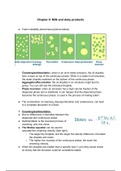
● Foam instability phenomena (picture below).
- Creaming/sedimentation: when in an oil-in-water emulsion, the oil droplets
form a layer on top of the continuous phase. When in a water-in-oil emulsion,
the water droplets sediment on the bottom of the continuous phase.
- Aggregation/flocculation: the oil droplets in an emulsion might tend to
group. You can still see the individual droplets.
- Phase inversion: when an emulsion has a high volume fraction of the
dispersed phase and is stabilized, it can happen that the dispersed phase
becomes the continuous phase. Is used in the process of making butter.
● The combination of creaming, disproportionation and coalescence, can lead
to a complete disruption of a foam.
1. Creaming/sedimentation.
● Due to differences in densities between the
dispersed and continuous phase.
● Sedimentation is the reversed process of
creaming, and vice versa.
● The Stokes equation can be used to
calculate the creaming velocity (See right).
○ The larger the droplets, and the larger the density difference, the faster
the droplets will cream.
○ The higher the viscosity of the continuous phase, the lower the
creaming velocity.
● When the droplets are smaller than a specific size (1 μm) they would cream
so slowly that the emulsion could be considered stable.
● Foam instability phenomena (picture below).
- Creaming/sedimentation: when in an oil-in-water emulsion, the oil droplets
form a layer on top of the continuous phase. When in a water-in-oil emulsion,
the water droplets sediment on the bottom of the continuous phase.
- Aggregation/flocculation: the oil droplets in an emulsion might tend to
group. You can still see the individual droplets.
- Phase inversion: when an emulsion has a high volume fraction of the
dispersed phase and is stabilized, it can happen that the dispersed phase
becomes the continuous phase. Is used in the process of making butter.
● The combination of creaming, disproportionation and coalescence, can lead
to a complete disruption of a foam.
1. Creaming/sedimentation.
● Due to differences in densities between the
dispersed and continuous phase.
● Sedimentation is the reversed process of
creaming, and vice versa.
● The Stokes equation can be used to
calculate the creaming velocity (See right).
○ The larger the droplets, and the larger the density difference, the faster
the droplets will cream.
○ The higher the viscosity of the continuous phase, the lower the
creaming velocity.
● When the droplets are smaller than a specific size (1 μm) they would cream
so slowly that the emulsion could be considered stable.