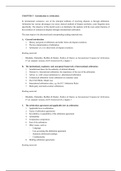
CHAPTER 5 – Introduction to Arbitration
In international commerce, one of the principal methods of resolving disputes is through arbitration.
Arbitration has various advantages over more classical methods of dispute resolution, court litigation more
specifically. The objective of this fourth week is to familiarize the students with the most salient features of
the resolution of commercial disputes through (international) arbitration.
The main topics to be discussed (and corresponding reading materials) are:
A. General introduction
1. History and goals of arbitration and (other forms of) dispute resolution
2. The key characteristics of arbitration
3. Arbitration vis-a-vis other forms of dispute resolution:
Reading materials
- Blackaby, Partasides, Redfern & Hunter, Redfern & Hunter on International Commercial Arbitration,
6th ed. (student version), OUP: Oxford (2015), Chapter 1
B. The institutional, regulatory and conceptual framework of international arbitration
1. Jurisdictional bases for the authority of arbitral tribunals
2. National vs. International arbitration: the importance of the seat of the arbitration
3. Ad hoc i.e. wild versus institutional i.e. administered arbitration
4. Commercial arbitration versus arbitration in consumer cases
5. The UNCITRAL Model Law
6. International arbitration rules, e.g. the ICC Arbitration Rules
7. Multi-party and multi-contract arbitrations
Reading materials
- Blackaby, Partasides, Redfern & Hunter, Redfern & Hunter on International Commercial Arbitration,
6th ed. (student version), OUP: Oxford (2015), Chapter 3
C. The arbitration agreement and applicable laws in arbitration
1. Applicable laws in arbitration
2. Types of arbitration agreements
3. Severability or separability of the arbitration agreement
4. Arbitrability
5. Competence-competence
6. Seat of the arbitration
7. Other issues, such as:
- Language
- Law governing the arbitration agreement
- Summary arbitral proceedings
- Confidentiality
8. Drafting arbitration agreements
Reading materials
, - Blackaby, Partasides, Redfern & Hunter, Redfern & Hunter on International Commercial Arbitration,
6th ed. (student version), OUP: Oxford (2015), Chapter 3.
ICDR Tutorial 5 (26.11.20)
- Separability-doctrine: Some argue that the validity of the arbitration agreement should
depend on the validity of the main contract. This would lead to following situation: If the
arbitral agreement at issue were void just because there is no valid main agreement, the
tribunal would have no competence to hear the case. So, every time a party succeeds in
challenging the main contract the tribunal would act ultra petitia or the award could be set
aside
- Attention when it comes to challenges of the choice of arbitrator: Often lex arbitri
provides a non-mandatory norm which determines before which court and under which
conditions the choice of arbitrator may be challenged. Parties may deviate from such
norms by choosing for example a set of rules (e.g. ICC Rules). Such rules may provide
the parties the right to challenge the choice of arbitrator before the institution (e.g.
International Chamber of Commerce). But: always check, whether lex arbitri is
dispositive in that regard!
Readings:
Blackaby CH 1-An overview of international arbitration
- A Introduction
(a) Dispute resolution—worldwide
(b) What is arbitration?
(c) Conduct of an arbitration
(d) A brief historical note
(e) International rules, treaties, and conventions
1.18 The most important ‘landmarks’ are:
the Geneva Protocol of 1923 (the ‘1923 Geneva Protocol’); (14)
the Geneva Convention of 1927 (the ‘1927 Geneva Convention’); (15)
In international commerce, one of the principal methods of resolving disputes is through arbitration.
Arbitration has various advantages over more classical methods of dispute resolution, court litigation more
specifically. The objective of this fourth week is to familiarize the students with the most salient features of
the resolution of commercial disputes through (international) arbitration.
The main topics to be discussed (and corresponding reading materials) are:
A. General introduction
1. History and goals of arbitration and (other forms of) dispute resolution
2. The key characteristics of arbitration
3. Arbitration vis-a-vis other forms of dispute resolution:
Reading materials
- Blackaby, Partasides, Redfern & Hunter, Redfern & Hunter on International Commercial Arbitration,
6th ed. (student version), OUP: Oxford (2015), Chapter 1
B. The institutional, regulatory and conceptual framework of international arbitration
1. Jurisdictional bases for the authority of arbitral tribunals
2. National vs. International arbitration: the importance of the seat of the arbitration
3. Ad hoc i.e. wild versus institutional i.e. administered arbitration
4. Commercial arbitration versus arbitration in consumer cases
5. The UNCITRAL Model Law
6. International arbitration rules, e.g. the ICC Arbitration Rules
7. Multi-party and multi-contract arbitrations
Reading materials
- Blackaby, Partasides, Redfern & Hunter, Redfern & Hunter on International Commercial Arbitration,
6th ed. (student version), OUP: Oxford (2015), Chapter 3
C. The arbitration agreement and applicable laws in arbitration
1. Applicable laws in arbitration
2. Types of arbitration agreements
3. Severability or separability of the arbitration agreement
4. Arbitrability
5. Competence-competence
6. Seat of the arbitration
7. Other issues, such as:
- Language
- Law governing the arbitration agreement
- Summary arbitral proceedings
- Confidentiality
8. Drafting arbitration agreements
Reading materials
, - Blackaby, Partasides, Redfern & Hunter, Redfern & Hunter on International Commercial Arbitration,
6th ed. (student version), OUP: Oxford (2015), Chapter 3.
ICDR Tutorial 5 (26.11.20)
- Separability-doctrine: Some argue that the validity of the arbitration agreement should
depend on the validity of the main contract. This would lead to following situation: If the
arbitral agreement at issue were void just because there is no valid main agreement, the
tribunal would have no competence to hear the case. So, every time a party succeeds in
challenging the main contract the tribunal would act ultra petitia or the award could be set
aside
- Attention when it comes to challenges of the choice of arbitrator: Often lex arbitri
provides a non-mandatory norm which determines before which court and under which
conditions the choice of arbitrator may be challenged. Parties may deviate from such
norms by choosing for example a set of rules (e.g. ICC Rules). Such rules may provide
the parties the right to challenge the choice of arbitrator before the institution (e.g.
International Chamber of Commerce). But: always check, whether lex arbitri is
dispositive in that regard!
Readings:
Blackaby CH 1-An overview of international arbitration
- A Introduction
(a) Dispute resolution—worldwide
(b) What is arbitration?
(c) Conduct of an arbitration
(d) A brief historical note
(e) International rules, treaties, and conventions
1.18 The most important ‘landmarks’ are:
the Geneva Protocol of 1923 (the ‘1923 Geneva Protocol’); (14)
the Geneva Convention of 1927 (the ‘1927 Geneva Convention’); (15)