100% satisfaction guarantee Immediately available after payment Both online and in PDF No strings attached 4.2 TrustPilot
logo-home
Summary

Risk management summary part 2

Rating
5.0
(4)
Sold
4
Pages
46
Uploaded on
19-01-2021
Written in
2020/2021

Summary of the lectures before the midterm. It contains lecture 6-8 and all relevant live sessions. This is all the relevant stuff after the midterm. I got a 9 with this summary.

Institution
Course


Whoops! We can’t load your doc right now. Try again or contact support.

Written for

Institution
Study
Course

Document information

Uploaded on
January 19, 2021
Number of pages
46
Written in
2020/2021
Type
Summary

Subjects

Content preview

Live session 5
Hedging with Forwards and Futures
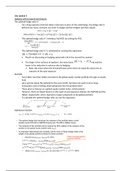
The optimal hedge ratio h*
- For a long exposure (worried about a decrease in price of the underlying), the hedge ratio h
defines how many contracts you short to hedge and the hedged cash flow equals:


- The optimal hedge ratio h* minimizes Var(HCF) by solving the FOC:


- The optimal hedge ratio h* is estimated by running the regression:

 Recall our discussing on hedging systematic risk in the second live session!

 The larger is the variance of epsilon t, the more basis risk and the
lower is the reduction in variance due to hedging
 Basis risk arises when the forward/futures price does not equal the spot price at
maturity of the spot exposure
Example
- Your father has US$1 million invested in the global equity market portfolio through an equity
fund
- He is worries about the outlook for the next month, but does not want to incur large
transaction costs of selling (and buying back into the position later)
- There exist no futures on a global equity market index, unfortunately!
- However, there are liquid futures on the main US and Japanese indexes, the S&P500 and the
Nikkei, respectively, which represent a large component of the global portfolio.
- To calculate the optimal hedge ratio, we run the regression


Additional intuition:

,Setting the stage
- Suppose you invest 1 unit of foreign currency and to hedge you short a futures contract to
sell H unit of foreign currency
 Your hedged return in dollar will be:


- Full or naïve hedge H=1: for each unit of foreign currency invested in an index, you also short
a futures contract to sell 1 unit of foreign currency

 H=1 gives you only approximately the local return
 Optimal hedge ratio H* found by regression
 Univariate regression
 Multivariate regression
Example
- Suppose you want to get exposure to stocks in the FTSE100, but are worried about the Brexit
and the state of the British economy in general. Consequently, you want to hedge your
exchange rate risk when you invest in British stocks.
- Today, the dollar-pound exchange rate = 2. You invest 2000$ in the FTSE100 stocks. The US
and UK (simple) risk-free interest rates are 3% and 2%, respectively.
- By the end of the year, the stocks have increased by 15%, as you expected, but the pound
has depreciated, as you feared to 1.8. 1.8 dollars to pound, the pound has depreciated.
1. What is the return of your investment in dollar in case you did not hedge?
Poll answer: less than 15%. Because you need to convert back pounds into dollars and
the pound has depreciated.
 2000/2=1000, 1000*1.15=1150 pounds -> 1150*1.8=2070 -> 2070/2000-1=3.5%
2. What is the no-arbitrage forward (or futures) price?
Poll answer: larger than 2.


3. What is the return of your investment in dollar in case you hedged shorting forward
worth 1000 pounds?
 2070-1000*(1.8-0.2)=2289.61
 In %, your return was 2289.61/2000-1=14.5%
 This return is close to the return for local British investors (15%), but not exactly the
same, because, among other things, you should have sold short 1150 pounds.
 Unconditional volatility is much more convenient when you use it for the future

Videocollege 6, Risk management 29-10-2020
Interest Rate Risk Management
Interest Rate Risk
- Two dimensions:
 Cash-flow-based: extent to which unexpected changes in interest rates affect the cash
flows of the firm
 Value-based: extent to which unexpected changes in interest rates affect the value of the
assets and liabilities of the firm

,  Remember: ease of access to financing determines whether firm is most worried about
cash-flow or value-based interest rate risk!
- Source of variation in interest rates: changes in


 Term premium is when it is hard to sell your bond, this causes extra risk
Some formalization


 Default risk-free bond yields are time-varying
 As are default spreads


 Strongly varying over time!
 Interest rates risk are very substantial
Interest Rate Risk and Cash Flows
- Interest rate risk: extent to which unexpected changes in interest rates affect the cash flows
of the firm
- Examples:

,  Real estate firm: cash flow fall when interest rate increases, because clients pay a higher
price to borrow funds
 Prime lender: cash flow covary positively with level of interest rate
 Firms primarily financed by short-term debt face risk whenever debt is rolled over
- Main tools for interest rate risk management in cash flows
1. Choice of debt level
2. Choice of type of debt: fixed versus floating (floating is changing)
3. Choice of maturity
Interest Rate Risk and Types of Corporate Debt
- Different types of corporate debt carry different types of uncertainty for future cash flows:
 Long term floating rate debt (LIBOT + x%, 10y): uncertainty about interest rate levels but
not about default spread
 Long term fixed rate debt (z%): no uncertainty about interest rate levels nor default
spread
 Short term fixed rate debt (LIBOR + y%, 1y): uncertainty about interest rate levels and
about default spreads, because in one year you will need to roll over the debt.
- Note, having a long term fixed rate debt (z%) implies that the cash flow is fixed, but this does
not mean that the value of the firm is unaffected by changes in interest rates.
 You might end up paying too much or too little relative to market interest rates!
Interest Rate Risk and Asset Values
- Interest rate risk: extent to which unexpected changes in interest rate affect asset values
- Examples:
 Bond values: bond prices covary negatively with level of interest rate
 Real Estate values: covary negatively with level of interest rate
 Banks: major liabilities are deposits on which they pay interest rate
- Major tools for interest rate risk management of asset values:
 Matching interest rate risk in assets and liabilities
 Using duration and convexity
The price of a bond


Example


Interest Rate Risk from cash flow perspective
$3.58
Get access to the full document:
Purchased by 4 students

100% satisfaction guarantee
Immediately available after payment
Both online and in PDF
No strings attached


Also available in package deal

Reviews from verified buyers

Showing all 4 reviews
2 year ago

4 year ago

4 year ago

4 year ago

5.0

4 reviews

5
4
4
0
3
0
2
0
1
0
Trustworthy reviews on Stuvia

All reviews are made by real Stuvia users after verified purchases.

Get to know the seller

Seller avatar
Reputation scores are based on the amount of documents a seller has sold for a fee and the reviews they have received for those documents. There are three levels: Bronze, Silver and Gold. The better the reputation, the more your can rely on the quality of the sellers work.
bascrypto Tilburg University
Follow You need to be logged in order to follow users or courses
Sold
323
Member since
4 year
Number of followers
208
Documents
18
Last sold
3 days ago

4.2

49 reviews

5
25
4
13
3
7
2
2
1
2

Recently viewed by you

Why students choose Stuvia

Created by fellow students, verified by reviews

Quality you can trust: written by students who passed their tests and reviewed by others who've used these notes.

Didn't get what you expected? Choose another document

No worries! You can instantly pick a different document that better fits what you're looking for.

Pay as you like, start learning right away

No subscription, no commitments. Pay the way you're used to via credit card and download your PDF document instantly.

Student with book image

“Bought, downloaded, and aced it. It really can be that simple.”

Alisha Student

Frequently asked questions