The Role of Ventilation in Acid-Base Balance
Concepts covered in this lecture include:
Acids, bases and pH
The effects of acidosis and alkalosis on the body
Buffers and the three main buffering systems in the body
The Henderson-Hasselbalch equation
Respiratory compensation for metabolic acid-base disturbances
Pure water ionises a bit—
H2O --------- --> H+ + OH-
Water has an [H+] of 0.0000001M, also written as 1x10⁻⁷ M
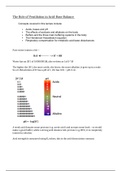
The higher the [H+], the more acidic, the lower, the more alkaline, it goes up in a scale.
So a 0.1M solution of H+ has a pH of 1, if it has 0.01 = pH 2 etc.
pH = - log[H+]
A weak acid donates some protons (e.g. acetic acid) and accepts some back – so would
make a good buffer, while a strong acid donates ALL protons (e.g. HCl), it is completely
ionised in solution.
Acid strength is measured using Ka values, this is the acid dissociation constant.
, [A-] = Anion concentration
[HA] = The acid (undissociated) concentration
The Henderson-Hasselbach Equation shows us that, for example, 1.0M of HCL and
1.0M acetic acid have different pH because they have different Ka.
pKa = the –log of Ka
Metabolism makes acid e.g. in respiration, the CO 2 produced then reacts with water to
form carbonic acid.
So if we did the Henderson-Hasselbach Equation for carbonic acid it would be written
as below
However, the [H2CO3] is hard to measure, so we substitute it for CO2 instead, to
simplify it
Concepts covered in this lecture include:
Acids, bases and pH
The effects of acidosis and alkalosis on the body
Buffers and the three main buffering systems in the body
The Henderson-Hasselbalch equation
Respiratory compensation for metabolic acid-base disturbances
Pure water ionises a bit—
H2O --------- --> H+ + OH-
Water has an [H+] of 0.0000001M, also written as 1x10⁻⁷ M
The higher the [H+], the more acidic, the lower, the more alkaline, it goes up in a scale.
So a 0.1M solution of H+ has a pH of 1, if it has 0.01 = pH 2 etc.
pH = - log[H+]
A weak acid donates some protons (e.g. acetic acid) and accepts some back – so would
make a good buffer, while a strong acid donates ALL protons (e.g. HCl), it is completely
ionised in solution.
Acid strength is measured using Ka values, this is the acid dissociation constant.
, [A-] = Anion concentration
[HA] = The acid (undissociated) concentration
The Henderson-Hasselbach Equation shows us that, for example, 1.0M of HCL and
1.0M acetic acid have different pH because they have different Ka.
pKa = the –log of Ka
Metabolism makes acid e.g. in respiration, the CO 2 produced then reacts with water to
form carbonic acid.
So if we did the Henderson-Hasselbach Equation for carbonic acid it would be written
as below
However, the [H2CO3] is hard to measure, so we substitute it for CO2 instead, to
simplify it