

Signalling in Metabolic Regulation
Signal Transduction
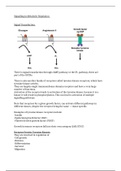
There is signal transduction through cAMP pathway or the IP3 pathway, these are
part of the GPCRs.
There is also another family of receptors called tyrosine kinase receptors, which have
tyrosine kinase activity.
They are largely single transmembrane domain receptors and have a very large
number of functions.
Activation of the receptor leads to activation of the tyrosine kinase, because it is a
kinase it will result in phosphorylation. This can lead to activation of multiple
signalling pathways.
Note that receptors for a given growth factor, can activate different pathways in
different tissues, despite the receptor being the same -> tissue specific.
Examples of tyrosine kinase receptors include
-Insulin
-Epidermal growth factor (EGF)
-Platelet derived growth factor (PDGF)
Growth hormone receptors fall into their own category (JAK/STAT)
Receptor Protein Tyrosine Kinases
They are involved in regulation of
-Cell growth
-Division
-Differentiation
-Survival
-Migration
, Inappropriate activation is associated with disease, particularly cancer (so focus of a
lot of pharmaceutical activity).
The appearance of a typical tyrosine kinase receptor molecule is shown below ->
Generally they are single transmembrane domain proteins (with an exception of
insulin). They have a binding site on the extracellular domain and then enzyme
activity on the cytosolic part of the molecule.
Binding of an agonist to the receptor result in changes in the intracellular domain
enabling it to activate a range of different pathways.
Process –
A very important step after the binding of the agonist is that the two receptor
molecules dimerise (come together). This is so they can activate each other.
There are two ways in which this can be done; ligand mediated or receptor mediated.
Signal Transduction
There is signal transduction through cAMP pathway or the IP3 pathway, these are
part of the GPCRs.
There is also another family of receptors called tyrosine kinase receptors, which have
tyrosine kinase activity.
They are largely single transmembrane domain receptors and have a very large
number of functions.
Activation of the receptor leads to activation of the tyrosine kinase, because it is a
kinase it will result in phosphorylation. This can lead to activation of multiple
signalling pathways.
Note that receptors for a given growth factor, can activate different pathways in
different tissues, despite the receptor being the same -> tissue specific.
Examples of tyrosine kinase receptors include
-Insulin
-Epidermal growth factor (EGF)
-Platelet derived growth factor (PDGF)
Growth hormone receptors fall into their own category (JAK/STAT)
Receptor Protein Tyrosine Kinases
They are involved in regulation of
-Cell growth
-Division
-Differentiation
-Survival
-Migration
, Inappropriate activation is associated with disease, particularly cancer (so focus of a
lot of pharmaceutical activity).
The appearance of a typical tyrosine kinase receptor molecule is shown below ->
Generally they are single transmembrane domain proteins (with an exception of
insulin). They have a binding site on the extracellular domain and then enzyme
activity on the cytosolic part of the molecule.
Binding of an agonist to the receptor result in changes in the intracellular domain
enabling it to activate a range of different pathways.
Process –
A very important step after the binding of the agonist is that the two receptor
molecules dimerise (come together). This is so they can activate each other.
There are two ways in which this can be done; ligand mediated or receptor mediated.


