
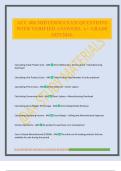
ACC 406 MIDTERM EXAM QUESTIONS
WITH VERIFIED ANSWERS. A+ GRADE
2025/2026.
Calculating Total Product Cost - ANS Direct Materials + Direct Labour + Manufacturing
Overhead
Calculating Unit Product Costs - ANS Total Product Cost/Number of units produced
Calculating Prime Costs - ANS Direct Materials + Direct Labour
Calculating Conversion Costs - ANS Direct Labour + Manufacturing Overhead
Calculating Gross Margin Percentage - ANS Gross Margin/Sales Revenue
Calculating Operating Income - ANS Gross Margin - Selling and Administrative Expenses
Service Operations - ANS No product to purchase or to manufacture
Cost of Goods Manufactured (COGM) - ANS The total cost of making products that are
available for sale during the period
1 @COPYRIGHT 2025/2026 ALLRIGHTS RESERVED
, Gross Margin - ANS Difference between sales revenue and cost of goods sold (COGS)
Cost Behaviour - ANS Describes whether a cost change when the level of activity changes. It
is the foundation upon which managerial accounting is built and is essential to planning,
controlling, and decision making.
Fixed Costs - ANS Cost that does not change in total as activity changes
Discretionary Fixed Costs - ANS Costs that can be changed or avoided relatively easily at
management's discretion
Committed Fixed Costs - ANS Costs that cannot be easily changed; these often involve a
long-term contract
Variable Costs - ANS Costs that vary in direct proportion to changes in output within the
relevant range
Total Variable Cost - ANS Variable Rate Per Unit x Units of Output
Mixed Costs - ANS Costs that have both a fixed and a variable component
High Low Method - ANS Method of separating mixed costs into fixed and variable
components by using just the high and low data points
Using the High Low Method - ANS 1. Find high point and low point for the activity or output
level
2. Using the high and low points, calculate the variable rate
3. Calculate the fixed cost using the variable rate (Use either high or low point)
4. Formulate the cost formula
2 @COPYRIGHT 2025/2026 ALLRIGHTS RESERVED
WITH VERIFIED ANSWERS. A+ GRADE
2025/2026.
Calculating Total Product Cost - ANS Direct Materials + Direct Labour + Manufacturing
Overhead
Calculating Unit Product Costs - ANS Total Product Cost/Number of units produced
Calculating Prime Costs - ANS Direct Materials + Direct Labour
Calculating Conversion Costs - ANS Direct Labour + Manufacturing Overhead
Calculating Gross Margin Percentage - ANS Gross Margin/Sales Revenue
Calculating Operating Income - ANS Gross Margin - Selling and Administrative Expenses
Service Operations - ANS No product to purchase or to manufacture
Cost of Goods Manufactured (COGM) - ANS The total cost of making products that are
available for sale during the period
1 @COPYRIGHT 2025/2026 ALLRIGHTS RESERVED
, Gross Margin - ANS Difference between sales revenue and cost of goods sold (COGS)
Cost Behaviour - ANS Describes whether a cost change when the level of activity changes. It
is the foundation upon which managerial accounting is built and is essential to planning,
controlling, and decision making.
Fixed Costs - ANS Cost that does not change in total as activity changes
Discretionary Fixed Costs - ANS Costs that can be changed or avoided relatively easily at
management's discretion
Committed Fixed Costs - ANS Costs that cannot be easily changed; these often involve a
long-term contract
Variable Costs - ANS Costs that vary in direct proportion to changes in output within the
relevant range
Total Variable Cost - ANS Variable Rate Per Unit x Units of Output
Mixed Costs - ANS Costs that have both a fixed and a variable component
High Low Method - ANS Method of separating mixed costs into fixed and variable
components by using just the high and low data points
Using the High Low Method - ANS 1. Find high point and low point for the activity or output
level
2. Using the high and low points, calculate the variable rate
3. Calculate the fixed cost using the variable rate (Use either high or low point)
4. Formulate the cost formula
2 @COPYRIGHT 2025/2026 ALLRIGHTS RESERVED


