

Light
Light is a form of energy that helps us to see objects around us. It travels in a straight path, it cannot
bend around corners. We could see the candle flame through a straight pipe, but not through a bent
pipe, this shows that light travels in straight lines.
Light travels very fast, about 3 lakh kilometres per second (or 3 × 10⁸ metres per second) in empty space.
It’s the fastest thing in the universe, and it moves a little slower in air, water, or glass. Light travels faster
than sound that’s why we see lightning before we hear thunder.
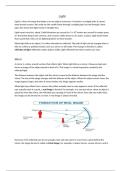
When light falls on an object, it is either absorbed or reflected. The path of light can be changed when it
falls on a shiny or polished surface such as a mirror or still water. This change in direction is called
reflection of light. Reflection makes objects visible, light reflected from them reaches our eyes.
Mirror
A mirror is a shiny, smooth surface that reflects light. When light falls on a mirror, it bounces back and
forms an image of the object placed in front of it. The image is a visual impression created by the
reflected light.
The distance between the object and the mirror is equal to the distance between the image and the
mirror. The size of the image changes with the distance of the object. When the object moves closer, the
image appears larger, and when it moves farther, the image appears smaller.
When light rays reflect from a mirror, they either actually meet or only appear to meet. If the reflected
rays actually meet at a point, a real image is formed. For example, in a concave mirror, when an object is
placed far from the mirror, the reflected rays converge in front of the mirror. Since the rays really meet,
the image can be formed on a screen. A real image is always inverted.
However, if the reflected rays do not actually meet and only seem to come from a point behind the
mirror, the image formed is called a virtual image. For example, in plane mirrors, convex mirrors, and in
, some cases of concave mirrors, the reflected rays spread out, but when we extend them backward, they
appear to meet behind the mirror. Since the rays do not actually meet there, no real light is present at
that point.
An image is called erect if it appears upright, and inverted if it appears upside down.
There are two main types of mirrors:
1. Plane Mirror: it has a flat and smooth surface.
Image properties:
The image is always virtual (cannot be formed on a screen).
It is always erect (upright).
It is of the same size as the object.
It shows laterally inverted image (left and right are reversed).
The word “AMBULANCE” is written in reverse on the front of ambulances so that drivers can read it
correctly in their rear-view mirrors.
2. Curved Mirrors (Spherical Mirrors): it has a surface shaped like a part of a sphere. The shiny
curved surface of a spoon acts as a mirror. When a sphere is cut, it has two parts —the inner surface acts
as a concave mirror, and the outer surface acts as a convex mirror.
a) Concave Mirror (Converging Mirror): The reflecting surface is curved inward, like the inner side of a
spoon. It converges (brings together) light rays to a single point.
Image properties:
The image can be real or virtual.
It can be inverted or erect.
The image size may be larger or smaller, depending on the distance of the object.
Light is a form of energy that helps us to see objects around us. It travels in a straight path, it cannot
bend around corners. We could see the candle flame through a straight pipe, but not through a bent
pipe, this shows that light travels in straight lines.
Light travels very fast, about 3 lakh kilometres per second (or 3 × 10⁸ metres per second) in empty space.
It’s the fastest thing in the universe, and it moves a little slower in air, water, or glass. Light travels faster
than sound that’s why we see lightning before we hear thunder.
When light falls on an object, it is either absorbed or reflected. The path of light can be changed when it
falls on a shiny or polished surface such as a mirror or still water. This change in direction is called
reflection of light. Reflection makes objects visible, light reflected from them reaches our eyes.
Mirror
A mirror is a shiny, smooth surface that reflects light. When light falls on a mirror, it bounces back and
forms an image of the object placed in front of it. The image is a visual impression created by the
reflected light.
The distance between the object and the mirror is equal to the distance between the image and the
mirror. The size of the image changes with the distance of the object. When the object moves closer, the
image appears larger, and when it moves farther, the image appears smaller.
When light rays reflect from a mirror, they either actually meet or only appear to meet. If the reflected
rays actually meet at a point, a real image is formed. For example, in a concave mirror, when an object is
placed far from the mirror, the reflected rays converge in front of the mirror. Since the rays really meet,
the image can be formed on a screen. A real image is always inverted.
However, if the reflected rays do not actually meet and only seem to come from a point behind the
mirror, the image formed is called a virtual image. For example, in plane mirrors, convex mirrors, and in
, some cases of concave mirrors, the reflected rays spread out, but when we extend them backward, they
appear to meet behind the mirror. Since the rays do not actually meet there, no real light is present at
that point.
An image is called erect if it appears upright, and inverted if it appears upside down.
There are two main types of mirrors:
1. Plane Mirror: it has a flat and smooth surface.
Image properties:
The image is always virtual (cannot be formed on a screen).
It is always erect (upright).
It is of the same size as the object.
It shows laterally inverted image (left and right are reversed).
The word “AMBULANCE” is written in reverse on the front of ambulances so that drivers can read it
correctly in their rear-view mirrors.
2. Curved Mirrors (Spherical Mirrors): it has a surface shaped like a part of a sphere. The shiny
curved surface of a spoon acts as a mirror. When a sphere is cut, it has two parts —the inner surface acts
as a concave mirror, and the outer surface acts as a convex mirror.
a) Concave Mirror (Converging Mirror): The reflecting surface is curved inward, like the inner side of a
spoon. It converges (brings together) light rays to a single point.
Image properties:
The image can be real or virtual.
It can be inverted or erect.
The image size may be larger or smaller, depending on the distance of the object.


