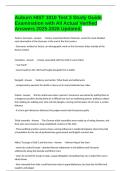
Auburn HIST 1010 Test 3 Study Guide
Examination with All Actual Verified
Answers 2025-2026 Updated.
Tacitus: Germania - Answer - Tacitus: important Roman historian, wrote the most detailed
early description of the Germans at the end of the first century
- Germania: written by Tacitus, an ethnographic work on the Germanic tribes outside of the
Roman empire
Comitatus - Answer - closely associated with the chief in some tribes
- "war band"
- swore loyally to the chief and fought alongside him in battle
Wergeld - Answer - Violence and Justice: Tribal feuds and settlements
- compensatory payment for death or injury set in many barbarian law codes
Ordeal - Answer -Trial by ordeal was when a person's innocence was tested by putting them in
a dangerous position having them do a difficult test such as swallowing poison, pulling an object
from boiling oil, walking over nine red-hot ploughs, carrying red-hot piece of iron over a certain
distance
- if a burn got infected or blistered, the judges would rule that person guilty
Tribal assembly - Answer -The German tribal assemblies were made up of voting freeman, and
their laws were based on long-established customs of the tribe
- These political practices were to have a strong influence in medieval England, where they laid
a foundation for the rise of parliamentary government and English common law
Attila ("Scourge of God") and the Huns - Answer - Warrior-king of the Huns
- went into central Europe - attacked Roman settlements in the Balkans and Germanic
settlements along the Danube and Rhine rivers
- when he turned his troops to Italy, a papal delegation (including Pope Leo I) asked him not to
attack Rome
- they retreated from Italy. could have been due to papal diplomacy, but also due to little food
supplies and plague
,Anglo-Saxons (southern Britain-England*) - Answer - Roman troops withdrew from Britain,
and Celtic-speaking peoples clashed with Germanic-speaking invaders
- the largest tribes were the Angles and the Saxons
- Some Celtic-speakers moved farther west, to Brittany (modern NW France), Wales, Scotland,
and Ireland
- Other remained and intermarried with Germanic peoples, their descendants forming a
number of small Anglo-Saxon kingdoms
Arianism (Christian heresy) - Answer - A theological belief, originating with Arius, a priest of
Alexandria, that denied that Christ was co-eternal with God the Father.
- Jesus was created by the will of God the Father and thus was not co-eternal with him
- Jesus the Son must be inferior to God the Father, because the Father was incapable of
suffering and did not die
- attracted many followers, including Greeks, Romans, and especially barbarian migrants to
Europe who were converted by Arian Christian missionaries
Franks (Gaul*) - Answer - not nomads
- their system of government, administration and laws are modeled more or less on the Roman
pattern, apart from which they uphold similar standards with regard to contracts, marriage, and
religious observance
Gregory of Tours: History of the Franks - Answer - a bishop in the Frankish kingdom
- described his father's faith in relics
Clovis, King of the Franks - Answer - through military campaigns, he acquired the central
provinces of Roman Gaul and began to conquer southern Gaul from other Germanic tribes
- his wife converted him to Roman Christian, which brought him the crucial support of the
bishops of Gaul
- went on the conquer the Visigoths, extending his domain to include much of what is now
France and southwestern Germany
- when he died, his kingdom was divided among his four sons
Charlemagne, Frankish King and Emperor - Answer - Charles the Great (generally known as
Charlemagne)
, - his kingdom included all of continental Europe except Spain, Scandinavia, southern Italy, and
the Slavic fringes of the East
- he divided his kingdom into countries
Holy Roman Empire* - Answer - included hundreds of largely independent states in which the
emperor had far less authority than did the monarchs of western Europe
- local rulers in the empire continued to exercise great power
Ostrogoths (Italy*) - Answer - members of a Germanic barbarian tribe
Visigoths (Spain*) - Answer - Clovis conquered the Visigoths, which extended his domain to
include much of what is now France and southwestern Germany
Jacquerie (French peasants revolt) - Answer - when French taxation for the Hundred Years'
War fell heavily on the poor, the frustrations of the French peasantry exploded in a massive
uprising (the Jacquerie) after a supposedly happy agricultural laborer, Jacques Bonhomme
Priests and the Sacraments - Answer The Sacraments: Baptism, Communion, and others
Baptism - Answer - the religious rite of sprinkling water onto a person's forehead or of
immersion in water, symbolizing purification or regeneration and admission to the Christian
Church.
Penance - Answer - ritual in which Christians asked a priest for forgiveness for sins, and the
priest set certain actions to atone for the sins
Excommunication - Answer - cut off from the sacraments and the Christian community
Purgatory - Answer - a place or state of suffering inhabited by the souls of sinners who are
expiating their sins before going to heaven
Interdict - Answer - an authoritative prohibition
The Pope/Bishop of Rome (according to the Petrine [St. Peter] Doctrine) - Answer - As
Examination with All Actual Verified
Answers 2025-2026 Updated.
Tacitus: Germania - Answer - Tacitus: important Roman historian, wrote the most detailed
early description of the Germans at the end of the first century
- Germania: written by Tacitus, an ethnographic work on the Germanic tribes outside of the
Roman empire
Comitatus - Answer - closely associated with the chief in some tribes
- "war band"
- swore loyally to the chief and fought alongside him in battle
Wergeld - Answer - Violence and Justice: Tribal feuds and settlements
- compensatory payment for death or injury set in many barbarian law codes
Ordeal - Answer -Trial by ordeal was when a person's innocence was tested by putting them in
a dangerous position having them do a difficult test such as swallowing poison, pulling an object
from boiling oil, walking over nine red-hot ploughs, carrying red-hot piece of iron over a certain
distance
- if a burn got infected or blistered, the judges would rule that person guilty
Tribal assembly - Answer -The German tribal assemblies were made up of voting freeman, and
their laws were based on long-established customs of the tribe
- These political practices were to have a strong influence in medieval England, where they laid
a foundation for the rise of parliamentary government and English common law
Attila ("Scourge of God") and the Huns - Answer - Warrior-king of the Huns
- went into central Europe - attacked Roman settlements in the Balkans and Germanic
settlements along the Danube and Rhine rivers
- when he turned his troops to Italy, a papal delegation (including Pope Leo I) asked him not to
attack Rome
- they retreated from Italy. could have been due to papal diplomacy, but also due to little food
supplies and plague
,Anglo-Saxons (southern Britain-England*) - Answer - Roman troops withdrew from Britain,
and Celtic-speaking peoples clashed with Germanic-speaking invaders
- the largest tribes were the Angles and the Saxons
- Some Celtic-speakers moved farther west, to Brittany (modern NW France), Wales, Scotland,
and Ireland
- Other remained and intermarried with Germanic peoples, their descendants forming a
number of small Anglo-Saxon kingdoms
Arianism (Christian heresy) - Answer - A theological belief, originating with Arius, a priest of
Alexandria, that denied that Christ was co-eternal with God the Father.
- Jesus was created by the will of God the Father and thus was not co-eternal with him
- Jesus the Son must be inferior to God the Father, because the Father was incapable of
suffering and did not die
- attracted many followers, including Greeks, Romans, and especially barbarian migrants to
Europe who were converted by Arian Christian missionaries
Franks (Gaul*) - Answer - not nomads
- their system of government, administration and laws are modeled more or less on the Roman
pattern, apart from which they uphold similar standards with regard to contracts, marriage, and
religious observance
Gregory of Tours: History of the Franks - Answer - a bishop in the Frankish kingdom
- described his father's faith in relics
Clovis, King of the Franks - Answer - through military campaigns, he acquired the central
provinces of Roman Gaul and began to conquer southern Gaul from other Germanic tribes
- his wife converted him to Roman Christian, which brought him the crucial support of the
bishops of Gaul
- went on the conquer the Visigoths, extending his domain to include much of what is now
France and southwestern Germany
- when he died, his kingdom was divided among his four sons
Charlemagne, Frankish King and Emperor - Answer - Charles the Great (generally known as
Charlemagne)
, - his kingdom included all of continental Europe except Spain, Scandinavia, southern Italy, and
the Slavic fringes of the East
- he divided his kingdom into countries
Holy Roman Empire* - Answer - included hundreds of largely independent states in which the
emperor had far less authority than did the monarchs of western Europe
- local rulers in the empire continued to exercise great power
Ostrogoths (Italy*) - Answer - members of a Germanic barbarian tribe
Visigoths (Spain*) - Answer - Clovis conquered the Visigoths, which extended his domain to
include much of what is now France and southwestern Germany
Jacquerie (French peasants revolt) - Answer - when French taxation for the Hundred Years'
War fell heavily on the poor, the frustrations of the French peasantry exploded in a massive
uprising (the Jacquerie) after a supposedly happy agricultural laborer, Jacques Bonhomme
Priests and the Sacraments - Answer The Sacraments: Baptism, Communion, and others
Baptism - Answer - the religious rite of sprinkling water onto a person's forehead or of
immersion in water, symbolizing purification or regeneration and admission to the Christian
Church.
Penance - Answer - ritual in which Christians asked a priest for forgiveness for sins, and the
priest set certain actions to atone for the sins
Excommunication - Answer - cut off from the sacraments and the Christian community
Purgatory - Answer - a place or state of suffering inhabited by the souls of sinners who are
expiating their sins before going to heaven
Interdict - Answer - an authoritative prohibition
The Pope/Bishop of Rome (according to the Petrine [St. Peter] Doctrine) - Answer - As