Physics Definitions:
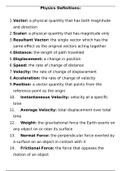
1.Vector: a physical quantity that has both magnitude
and direction
2.Scalar: a physical quantity that has magnitude only
3.Resultant Vector: the single vector which has the
same effect as the original vectors acting together
4.Distance: the length of path travelled
5.Displacement: a change in position
6.Speed: the rate of change of distance
7.Velocity: the rate of change of displacement
8.Acceleration: the rate of change of velocity
9.Position: a vector quantity that points from the
reference point as the origin
10. Instantaneous Velocity: velocity at a specific
time
11. Average Velocity: total displacement over total
time
12. Weight: the gravitational force the Earth exerts on
any object on or near its surface
13. Normal Force: the perpendicular force exerted by
a surface on an object in contact with it
14. Frictional Force: the force that opposes the
motion of an object
, 15. Newton’s First Law: An object continues in a
state of rest or uniform (moving with constant) velocity
unless it is acted upon by a net or resultant force
16. Inertia: the property of an object that causes it to
resist a change in its state of rest or uniform motion
17. Newton’s Second Law: When a net force, Fnet,
is applied to an object of mass, m, it accelerates in the
direction of the net force. The acceleration, a, is
directly proportional to the net force and inversely
proportional to the mass
18. Newton’s Third Law: When object A exerts a
force on object B, object B simultaneously exerts an
oppositely directed force of equal magnitude on object
A
19. Tension: Force in a rope or string
20. Static Force: frictional force that prevents an
object from moving
21. Kinetic Force: frictional force that opposes an
object in motion
22. Newton’s Law of Universal Gravity: every
particle with mass in the universe attracts every other
particle with a force that is directly proportional to the
product of their masses and inversely proportional to
the square of the distance between their centres
23. Free Fall: only force acting on the object is gravity
1.Vector: a physical quantity that has both magnitude
and direction
2.Scalar: a physical quantity that has magnitude only
3.Resultant Vector: the single vector which has the
same effect as the original vectors acting together
4.Distance: the length of path travelled
5.Displacement: a change in position
6.Speed: the rate of change of distance
7.Velocity: the rate of change of displacement
8.Acceleration: the rate of change of velocity
9.Position: a vector quantity that points from the
reference point as the origin
10. Instantaneous Velocity: velocity at a specific
time
11. Average Velocity: total displacement over total
time
12. Weight: the gravitational force the Earth exerts on
any object on or near its surface
13. Normal Force: the perpendicular force exerted by
a surface on an object in contact with it
14. Frictional Force: the force that opposes the
motion of an object
, 15. Newton’s First Law: An object continues in a
state of rest or uniform (moving with constant) velocity
unless it is acted upon by a net or resultant force
16. Inertia: the property of an object that causes it to
resist a change in its state of rest or uniform motion
17. Newton’s Second Law: When a net force, Fnet,
is applied to an object of mass, m, it accelerates in the
direction of the net force. The acceleration, a, is
directly proportional to the net force and inversely
proportional to the mass
18. Newton’s Third Law: When object A exerts a
force on object B, object B simultaneously exerts an
oppositely directed force of equal magnitude on object
A
19. Tension: Force in a rope or string
20. Static Force: frictional force that prevents an
object from moving
21. Kinetic Force: frictional force that opposes an
object in motion
22. Newton’s Law of Universal Gravity: every
particle with mass in the universe attracts every other
particle with a force that is directly proportional to the
product of their masses and inversely proportional to
the square of the distance between their centres
23. Free Fall: only force acting on the object is gravity