

100% satisfaction guarantee Immediately available after payment Both online and in PDF No strings attached 4.6 TrustPilot
logo-home
Exam (elaborations)

NR 446/NR446 Collaborative Healthcare Exam 1

Rating
-
Sold
-
Pages
10
Grade
A+
Uploaded on
26-10-2025
Written in
2025/2026

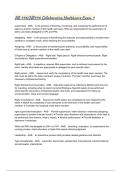
supervising - ANS- is the process of directing, monitoring, and evaluating the performance of tasks by another member of the health care team. RNs are responsible for the supervision of client care tasks delegated to APs and PNs. delegating - ANS- is the process of transferring the authority and responsibility to another team member to complete a task, while retaining the accountability Assigning - ANS- is the process of transferring the authority, accountability, and responsibility of client care to another member of the health care team. 5 Rights of Delegation - ANS- Right task, Right person, Right direction/communication, Right circumstance, Right supervision/evaluation Right task - ANS- is repetitive, requires little supervision, and is relatively noninvasive for the client. Identify what tasks are appropriate to delegate for each specific client Right person - ANS- Assess and verify the competency of the health care team member. The task must be within the team member's scope of practice. The team member must have the necessary competence/training. Right direction/communication - ANS- Data that needs to be collected ● Method and time line for reporting, including when to report concerns/findings ● Specific task(s) to be performed; client‑specific instructions ● Expected results, time lines, and expectations for follow‑up communication. Clear and concise language Right circumstance - ANS- Assess the health status and complexity of care required by the client. ● Match the complexity of care demands to the skill level of the health care team member. ● Consider the workload of the team member. right supervision/evaluation - ANS- Provide supervision, either directly or indirectly (assigning supervision to another licensed nurse). ● Provide clear directions and expectations of the task to be performed (time frames, what to report). ● Monitor performance. ● Provide feedback. ● Intervene if necessary What can RN's not delegate to UAP or LPN? - ANS- (teaching, evaluation, or assessment) the nursing process, client education or tasks that require clinical judgement Leadership - ANS- an interactive process that provides needed guidance and direction Type of leadership - ANS- autocratic, democratic, laissez-faire, transactional, transformational, servant-leader, interactional Autocratic/Authoritative leadership - ANS- Makes decisions for the group. ● Motivates by coercion. ● Communication occurs down the chain of command. ● Work output by staff is usually high: good for crisis situations and bureaucratic settings. ● Effective for employees with little or no formal education. Democratic leadership - ANS- Includes the group when decisions are made. ● Motivates by supporting staff achievements. ● Communication occurs up and down the chain of command. ● Work output by staff is usually of good quality: good when cooperation and collaboration are necessary. laissez-faire leadership - ANS- Makes very few decisions, and does little planning. ● Motivation is largely the responsibility of individual staff members. ● Communication occurs up and down the chain of command and between group members. ● Work output is low unless an informal leader evolves from the group. ● Effective with professional employees. transformational leader - ANS- empower followers to assume responsibility for a communal vision, and personal development is a secondary outcome. *focus on empowerment and vision transactional leader - ANS- focus on immediate problems, maintaining the status quo and using rewards to motivate followers. *Focus is mainly on tasks and getting the job done. interactional leadership - ANS- the leadership behavior is generally determined by the relationship between the leader's personality and the specific situation servant-leader - ANS- put serving others, such as employees, customers, and the community as number one priority over themselves leadership outcomes - ANS- increase job satisfaction, empowerment, and autonomy among nurses, and also increases pt. safety/satisfaction, fewer adverse events, and complications Management functions - ANS- planning, organizing, staffing, directing, controlling/coordinating Planning - ANS- The decisions regarding what needs to be done, how it will be done, and who is going to do it. *encompasses determining philosophy, goals, objectives, policies, procedures, and rules; carrying out long- and short-range projections; determining a fiscal course of action; and managing planned change. Organizing - ANS- The organizational structure that determines the lines of authority, channels of communication, and where decisions are made. *establishing the structure to carry out plans, determining the most appropriate type of patient care delivery, and grouping activities to meet unit goals. Staffing - ANS- The acquisition and management of adequate staff and staffing mix directing - ANS- The leadership role assumed by a manager that influences and motivates staff to perform assigned roles. *entail human resource management responsibilities, such as motivating, managing conflict, delegating, communicating, and facilitating collaboration controlling/coordinating - ANS- The evaluation of staff performance and evaluation of unit goals to ensure identified outcomes are being met. * the function that includes performance appraisals, fiscal accountability, quality control, legal and ethical control, and professional and collegial control. prioritization - ANS- decide who's needs or problems require immediate action vs. those who are not urgent Maslow's Hierarchy of needs - ANS- 1. self actualization, 2. self-esteem, 3. love/belonging, 4. safety, 5. physiological (ABC's) How do you determine who to see first? - ANS- chronic vs. acute, expected vs. unexpected, stable vs. unstable Autonomy - ANS- promotes self-determination and freedom of choice beneficence - ANS- actions are taken in an effort to do good non-maleficence - ANS- actions are taken in an effort to do no harm Paternalism - ANS- one individual assumes the right to make decisions for another Utility - ANS- the good of the many outweighs the wants or needs of the individual justice - ANS- seek fairness; treat 'equals' equally and treat 'unequals' according to their differences veracity - ANS- obligation to tell the truth fidelity - ANS- need to keep promises confidentiality - ANS- keep privileged information private social/societal ethics - ANS- Social ethics is applicable in a community and sometimes has a life of its own. Traits that appear depend on the culture and customs applicable in areas where a community or a community resides. organizational ethics - ANS- are the principals and standards by which businesses operate. They are best demonstrated through acts of fairness, compassion, integrity, honor and responsibility. clinical ethics - ANS- a practical discipline that provides a structured approach to assist physicians in identifying, analyzing and resolving ethical issues in clinical medicine. bioethics - ANS- the study of the typically controversial ethical issues emerging from new situations and possibilities brought about by advances in biology and medicine. professional ethics - ANS- defined as the personal and corporate rules that govern behavior within the context of a particular profession. personal ethics - ANS- refers to the ethics that a person identifies with in respect to people and situations that they deal with in everyday life. Ethical framework - ANS- Utilitarianism, duty-based, rights-based, intuitionist Utilitarianism - ANS- provide the greatest good for the greatest # of people rights-based - ANS- individuals have basic inherent rights that should not be interfered with duty-based - ANS- a duty to do something or to refrain from doing something intuitionist - ANS- each case weighed on a case-by-case basis to determine relative goals, duties and rights Traditional problem-solving process - ANS- 1. identify the problem, 2. discuss possible solutions, 3. analyze identified solutions, 4. select a solution, 5. implement the solution, 6. evaluate the solutions ability to resolve the original problem Nursing process - ANS- ADPIE- Assessment, diagnosis, planning, intervention, evaluation MORAL decision making model - ANS- M- massage the dilemma, O- outline options, R- review criteria and resolve, A- affirm position and act, L- look back/evaluate massage the dilemma - ANS- collect data about the ethical problem and who should be involved in the decision-making process outline options - ANS- identify alternatives, and analyze the causes and consequences of each review criteria and resolve - ANS- weigh the options against the values of those involved in the decision. This may be done through a weighting or grid affirm position and act - ANS- develop the implementation strategy look back - ANS- evaluate the decision making Emergency Medical Treatment and Active Labor Act (EMTALA) - ANS- It requires hospital Emergency Departments that accept payments from Medicare to provide an appropriate medical screening examination (MSE) to individuals seeking treatment for a medical condition, regardless of citizenship, legal status, or ability to pay. Institutional review boards (IRB) - ANS- to protect the rights and welfare of research subjects; managers are responsible is to make sure that there is a board in their organization and that any research has been approved by the board Nurse Practice Act - ANS- These acts govern nursing practice, and legal guidelines for practice are established and enforced through a state board of nursing or other government agency. criminal law - ANS- is a subsection of public law and relates to the relationship of an individual with the government. Violations of criminal law can be categorized as either a felony (a serious crime, such as homicide) or misdemeanor (a less serious crime, such as petty theft). civil law - ANS- protects the individual rights of people. One type of civil law that relates to the provision of nursing care is tort law. Torts can be classified as unintentional, quasi-intentional, or intentional. state law - ANS- The core of nursing practice is regulated by state law. Each state has enacted statutes that define the parameters of nursing practice and give the authority to regulate the practice of nursing to its state board of nursing Types of civil law/tort law - ANS- intentional, quasi-intentional, and unintentional intentional torts - ANS- assault, battery and false imprisonment unintentional torts - ANS- negligence and malpractice quasi-intentional torts - ANS- invasion of privacy and defamation (libel and slander) Assault - ANS- The conduct of one person makes another person fearful and apprehensive- verbal threat (threatening to place a NG tube in a client who is refusing to eat). Battery - ANS- Intentional and wrongful physical contact with a person that involves an injury or offensive contact (restraining a client and administering an injection against his wishes). False imprisonment - ANS- A person is confined or restrained against his will (using restraints on a competent client to prevent his leaving the health care facility) invasion of privacy - ANS- Intrusion into a client's private affairs or a breach of confidentiality (a nurse releases the medical diagnosis of a client to a member of the press). defamation - ANS- False communication or communication with careless disregard for the truth with the intent to injure an individual's reputation. libel - ANS- Defamation with the written word or photographs (a nurse documents in a client's health record that a provider is incompetent). slander - ANS- Defamation with the spoken word (a nurse tells a coworker that she believes a client has been unfaithful to the spouse). negligence - ANS- Practice or misconduct that does not meet expected standards of care and places the client at risk for injury (a nurse fails to implement safety measures for a client who has been identified as at risk for falls). malpractice (Professional negligence) - ANS- the failure of a person with professional training to act in a reasonable and prudent manner. The terms "reasonable and prudent" are generally used to describe a person who has the average judgment, foresight, intelligence, and skill that would be expected of a person with similar training and experience. (a nurse administers a large dose of medication due to a calculation error. The client has a cardiac arrest and dies). Good Samaritan law - ANS- by law medical personnel are NOT required to stop and provide emergency services. vary from state to state, protect nurses who provide emergency assistance outside of the employment location. The nurse must provide a standard of care that is reasonable and prudent and are not grossly negligent and are within the scope of practice advocacy - ANS- refers to nurses' role in supporting clients by ensuring that they are properly informed, that their rights are respected, and that they are receiving the proper level of care. informed consent - ANS- The nurse's role in the informed consent process is to witness the client's signature on the informed consent form and to ensure that informed consent has been appropriately obtained. components of advanced directive - ANS- living will, durable power of attorney purpose of advanced directives - ANS- The purpose of advance directives is to communicate a client's wishes regarding end-of-life care should the client become unable to do so. living will - ANS- a legal document that expresses the client's wishes regarding medical treatment in the event the client becomes incapacitated and is facing end-of-life issues durable power of attorney/ healthcare proxy - ANS- a legal document that designates a health care surrogate, who is an individual authorized to make health care decisions for a client who is unable. Organ donation - ANS- Organ and tissue donation is regulated by federal and state laws. Health care facilities have policies and procedures to guide health care workers involved with organ donation. ● Donations may be stipulated in a will or designated on an official card. Nurses role is to answer questions and provide family support Patient's bill of rights - ANS- 1. help pt. feel more confident in the healthcare system, 2. stress importance of relationship between patients and physicians, 3. stress the key role pt. have in staying healthy Great Man/Trait theory - ANS- some people were born to lead, while others were born to be led. And some people have characteristics or personality traits that make them better leaders than others Situational/contingency theory - ANS- leadership styles should vary dependent on the situation or individuals involved, because not every situation can be fixed by the same leadership style (Follett) Who was the creator of Management functions? - ANS- Fayol Participative management- Follett - ANS- she believed managers should have authority with, rather than over than employees Theory X- McGregor - ANS- managers believe that their employees are lazy, need constant supervision/direction, and are indifferent to organizational needs Theory Y- McGregor - ANS- managers believe that their workers enjoy their work, are self-motivated, and are willing to work hard to meet personal and organizational goals. Scientific Management- Taylor - ANS- if workers could identify the one best way to complete the task, productivity would increase 1. work should be scientifically designed to promote greatest efficiency of time and energy, 2. a scientific personnel system is implemented so workers can be hired, trained and promoted based on their competence and abilities, 3. workers should see how they fit into the organization and how they increase productivity, 4. relationship between managers and workers should be cooperative and interdependent and work should be shared equally critical thinking process - ANS- used when analyzing client issues and problems. Thinking skills include interpretation, analysis, evaluation, inference and explanation. These skills assist the nurse to determine the most appropriate action to take. American Nurses Association (ANA) Code of Ethics for Nurses - ANS- set of principles, values, duties and responsibilities established by the profession, to guide the health care team members International Council of Nurses (ICN) - ANS- goals are to bring nurses' organizations together in a worldwide body, to advance the socio-economic status of nurses and the profession of nursing worldwide, and to influence global and domestic health policy. components of malpractice - ANS- 1. duty to use due care (standard of care), 2. breach of duty (failure to meet standard of care), 3. foreseeability of harm, 4. a casual/direct relationship between breach and injury can be proved, 5. injury liability - ANS- liability is limited to the employee respondeat superior - ANS- the purpose is not the shift the burden of blame from employee to organization, but rather share the blame, increasing the possibility of larger financial compensation to the injured party doctrine of charitable immunity - ANS- a charitable non-profit hospital cannot be sued by a person that has been injured as a result of the hospital employees negligence governmental immunity - ANS- governments cannot be held liable for the negligent acts of their employees while carrying out government activities medical records - ANS- although the patient owns the information in the medical record, the actual record belongs to the facility that made it and is storing it. Patient Self-determination Act - ANS- stipulates that on admission to a health care facility, all clients must be informed of their right to accept or refuse care. Health Insurance Portability and Accountability Act of 1996(HIPAA) - ANS- privacy of healthcare information American With Disabilities Act(ADA) - ANS- to eliminate discrimination of people with mental and physical disabilities in the workplace and social life Accreditation - ANS- The Joint Commission's accreditation standards require institutions to show evidence of quality improvement in order to attain accreditation status. Standard of Care - ANS- Nurses base practice on established standards of care or legal guidelines for care. Found in each state in the Nurse Practice Act subordinate and workplace advocacy - ANS- nurse administrators should advocate for other health-care providers (including subordinates) as well as patients, especially when this is related to health and safety. and managers have a critical role to promote subordinate advocacy in the workplace whistle-blowing - ANS- internal- occurs within an organization; up the chain of command external- reporting outside of the organization such as the media or elected official professional advocacy - ANS- advocates for the nursing profession underdelegation - ANS- stems from the false assumption that delegation can be interpreted as a lack of ability on his/her part to do the job completely or correctly inappropriate delegation - ANS- delegating at the wrong time, wrong person or for the wrong reason. It can also be delegating responsibilities and tasks that are beyond the person's abilities/scope subordinate resistance - ANS- refusal of a task, and is most common when the delegator does not see the subordinates perspective. could be due to believing they are incapable to completing the task, inherent resistance to authority or they believe there is no room for creativity or independent thinking in the delegated tasks overdelegation - ANS- be mindful of the workload and constraints of the staff when delegating tasks. Do not give all delegations to exceptionally competent staff; it will cause them to burn out. futility of care - ANS- continued provision of medical care or treatment to a patient when there is no reasonable hope of a cure or benefit. Deontology - ANS- the study of the nature of duty and obligation. Teleology - ANS- the philosophical attempt to describe things in terms of their apparent purpose, directive principle, or goal. thought leadership - ANS- refers to any situation whereby one individual convinces another to consider a new idea, product, or way of looking at things. quantum leadership - ANS- suggests that the environment and context in which people work is complex and dynamic and that this has a direct impact on organizational productivity required by leader-managers in order to enhance their success authentic leadership - ANS- suggests that in order to lead, leaders must be true to themselves and their values and act accordingly. Principal agent theory - ANS- suggests that followers may have an informational (expertise or knowledge) advantage over the leader as well as their own preferences, which may deviate from that of the principal. human capital theory - ANS- suggests that individuals and organizations will invest in education and professional development if they believe such an investment will have a future payoff Hawthorne effect - ANS- indicates that people respond to the fact that they are being studied, attempting to increase whatever behavior they feel will continue to warrant their attention.

Show more Read less


Whoops! We can’t load your doc right now. Try again or contact support.

Document information

Uploaded on
October 26, 2025
Number of pages
10
Written in
2025/2026
Type
Exam (elaborations)
Contains
Questions & answers

Subjects

Content preview

NR 446/NR446 Collaborative Healthcare Exam 1
supervising - ANS- is the process of directing, monitoring, and evaluating the performance of
tasks by another member of the health care team. RNs are responsible for the supervision of
client care tasks delegated to APs and PNs.

delegating - ANS- is the process of transferring the authority and responsibility to another team
member to complete a task, while retaining the accountability

Assigning - ANS- is the process of transferring the authority, accountability, and responsibility
of client care to another member of the health care team.

5 Rights of Delegation - ANS- Right task, Right person, Right direction/communication, Right
circumstance, Right supervision/evaluation

Right task - ANS- is repetitive, requires little supervision, and is relatively noninvasive for the
client. Identify what tasks are appropriate to delegate for each specific client

Right person - ANS- Assess and verify the competency of the health care team member. The
task must be within the team member's scope of practice. The team member must have the
necessary competence/training.

Right direction/communication - ANS- Data that needs to be collected ● Method and time line
for reporting, including when to report concerns/findings ● Specific task(s) to be performed;
client‑specific instructions ● Expected results, time lines, and expectations for follow‑up
communication. Clear and concise language

Right circumstance - ANS- Assess the health status and complexity of care required by the
client. ● Match the complexity of care demands to the skill level of the health care team
member. ● Consider the workload of the team member.

right supervision/evaluation - ANS- Provide supervision, either directly or indirectly (assigning
supervision to another licensed nurse). ● Provide clear directions and expectations of the task to
be performed (time frames, what to report). ● Monitor performance. ● Provide feedback. ●
Intervene if necessary

What can RN's not delegate to UAP or LPN? - ANS- (teaching, evaluation, or assessment) the
nursing process, client education or tasks that require clinical judgement

Leadership - ANS- an interactive process that provides needed guidance and direction

Type of leadership - ANS- autocratic, democratic, laissez-faire, transactional, transformational,
servant-leader, interactional

, Autocratic/Authoritative leadership - ANS- Makes decisions for the group. ● Motivates by
coercion. ● Communication occurs down the chain of command. ● Work output by staff is
usually high: good for crisis situations and bureaucratic settings. ● Effective for employees with
little or no formal education.

Democratic leadership - ANS- Includes the group when decisions are made. ● Motivates by
supporting staff achievements. ● Communication occurs up and down the chain of command. ●
Work output by staff is usually of good quality: good when cooperation and collaboration are
necessary.

laissez-faire leadership - ANS- Makes very few decisions, and does little planning. ● Motivation
is largely the responsibility of individual staff members. ● Communication occurs up and down
the chain of command and between group members. ● Work output is low unless an informal
leader evolves from the group. ● Effective with professional employees.

transformational leader - ANS- empower followers to assume responsibility for a communal
vision, and personal development is a secondary outcome. *focus on empowerment and vision

transactional leader - ANS- focus on immediate problems, maintaining the status quo and
using rewards to motivate followers. *Focus is mainly on tasks and getting the job done.

interactional leadership - ANS- the leadership behavior is generally determined by the
relationship between the leader's personality and the specific situation

servant-leader - ANS- put serving others, such as employees, customers, and the community
as number one priority over themselves

leadership outcomes - ANS- increase job satisfaction, empowerment, and autonomy among
nurses, and also increases pt. safety/satisfaction, fewer adverse events, and complications

Management functions - ANS- planning, organizing, staffing, directing, controlling/coordinating

Planning - ANS- The decisions regarding what needs to be done, how it will be done, and who
is going to do it. *encompasses determining philosophy, goals, objectives, policies, procedures,
and rules; carrying out long- and short-range projections; determining a fiscal course of action;
and managing planned change.

Organizing - ANS- The organizational structure that determines the lines of authority, channels
of communication, and where decisions are made. *establishing the structure to carry out plans,
determining the most appropriate type of patient care delivery, and grouping activities to meet
unit goals.

Staffing - ANS- The acquisition and management of adequate staff and staffing mix

$12.49
Get access to the full document:

100% satisfaction guarantee
Immediately available after payment
Both online and in PDF
No strings attached

Get to know the seller
Seller avatar
CalebSTUVIA
3.0
(2)

Get to know the seller

Seller avatar
CalebSTUVIA Chamberlain College Of Nursing
View profile
Follow You need to be logged in order to follow users or courses
Sold
5
Member since
1 year
Number of followers
2
Documents
139
Last sold
1 week ago
Caleb's STUVIA

3.0

2 reviews

5
0
4
0
3
2
2
0
1
0

Recently viewed by you

Why students choose Stuvia

Created by fellow students, verified by reviews

Quality you can trust: written by students who passed their tests and reviewed by others who've used these notes.

Didn't get what you expected? Choose another document

No worries! You can instantly pick a different document that better fits what you're looking for.

Pay as you like, start learning right away

No subscription, no commitments. Pay the way you're used to via credit card and download your PDF document instantly.

Student with book image

“Bought, downloaded, and aced it. It really can be that simple.”

Alisha Student

Frequently asked questions
