HDEV Final Exam UPDATED ACTUAL Questions and CORRECT Answers
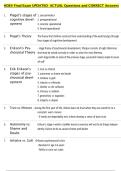
1. Piaget's stages of 1. sensorimotor
cognitive devel- 2. preoperational
opment 3. concrete operational
4. formal operational
2. Piaget's Theory The theory that children construct their understanding of the world and go through
four stages of cognitive development.
3. Erikson's Psy- - stage theory of psychosocial development, lifespan consists of eight dilemmas
chosocial Theory that must be solved correctly in order to solve the next dilemma
-each stage builds on tasks of the previous stage, successful mastery leads to sense
of self
4. Erik Erikson's 1. trust vs mistrust
stages of psy- 2. autonomy vs shame and doubt
chosocial devel- 3. initiative vs guilt
opment 4. industry vs inferiority
5. identity vs role confusion
6. intimacy vs isolation
7. generativity vs stagnation
8. integrity vs despair
5. Trust vs. Mistrust - during the first year of life, infants learn to trust when they are cared for in a
consistent warm manner
- If needs are dependably met, infants develop a sense of basic trust
6. Autonomy vs. Erikson's stage in which a toddler learns to exercise will and to do things indepen-
Shame and dently; failure to do so causes shame and doubt
Doubt
7. Initiative vs. Guilt -Erikson psychosocial crisis
-Resolved in age 3-6 years
-Ability to carry out a plan
,8. industry vs inferi- the period from age 6 to 12 characterized by a focus on ettorts to attain competence
ority stage in meeting the challenges presented by parents, peers, school, and the other
complexities of the modern world
9. identity vs. role -Erikson psychosocial crisis
confusion -Resolved in adolescence
-Ability to form a stable identity
- stage during which teenagers and young adults search for and become their true
selve
- During this stage, adolescents attempt to determine who they are in the present
while also imagining possible futures for themselves. It is at this stage when
individuals begin to pursue specific options for their lives, forgoing other options.
10. Intimacy vs. Iso- Erikson's stage in which individuals form deeply personal relationships, marry,
lation begin families
-(young adults) establish intimate bonds of love and friendship rather than isola-
tion and self-absorption. Must learn to trust others and trade some independence
for intimacy and love
11. Generativity vs. - middle-aged people begin to devote themselves more to fulfilling one's potential
Stagnation and doing public service
-(middle adulthood) consider family relations, partners, and intimate friendships
to be of greatest importance and people seek to enhance future generations
through child rearing; work production is important; negative outcomes reflect
feelings of meaninglessness in one's accomplishments
12. integrity vs de- -Erikson psychosocial crisis
spair -Resolved in mature adulthood
-Determining how well one has lived
- final stage in which those near the end of life look back and evaluate their lives
13. Ecological Theory
, Bronfenbrenner's theory that human development is shaped by five interrelated
systems in the social environment
14. BEHAV-
IORAL/LEARN-
ING:
15. Vygotsky's Theo- Zone of Proximal Development and Scattolding: Vygotsky stated that children
ry should be taught in the ZPD, which occurs when they can almost perform a task, but
not quite on their own without assistance. With the right kind of teaching, however,
they can accomplish it successfully.
- A good teacher identifies a child's ZPD and helps the child stretch beyond it.
- Then the adult (teacher) gradually withdraws support until the child can then
perform the task unaided. Researchers have applied the metaphor of scattolds (the
temporary platforms on which construction workers stand) to this way of teaching.
- Scattolding is the temporary support that parents or teachers give a child to do
a task. That little push the child needs
16. STAGES OF - Emerging adulthood
ADULTHOOD: - Early Adulthood
- middle adulthood
- Late Adulthood
17. emerging adult- Jettrey Arnett termed this stage
hood - occurs during the transition period from adolescence to adulthood.
- occurs in late teens/ early-to-mid 20s, when individuals typically dont have
enforced expectations or obligations.
- identity exploration- Many people age 18 or 20 to about 25 or 30 are on the path
to making vital choices in terms of their love lives and their career lives. They are
experimenting with romantic partners and career possibilities.
The Age of Instability- people at this age have had ditterent jobs
- frequently change their romantic partners (by choice, or not)
- frequently switch their living arrangements
1. Piaget's stages of 1. sensorimotor
cognitive devel- 2. preoperational
opment 3. concrete operational
4. formal operational
2. Piaget's Theory The theory that children construct their understanding of the world and go through
four stages of cognitive development.
3. Erikson's Psy- - stage theory of psychosocial development, lifespan consists of eight dilemmas
chosocial Theory that must be solved correctly in order to solve the next dilemma
-each stage builds on tasks of the previous stage, successful mastery leads to sense
of self
4. Erik Erikson's 1. trust vs mistrust
stages of psy- 2. autonomy vs shame and doubt
chosocial devel- 3. initiative vs guilt
opment 4. industry vs inferiority
5. identity vs role confusion
6. intimacy vs isolation
7. generativity vs stagnation
8. integrity vs despair
5. Trust vs. Mistrust - during the first year of life, infants learn to trust when they are cared for in a
consistent warm manner
- If needs are dependably met, infants develop a sense of basic trust
6. Autonomy vs. Erikson's stage in which a toddler learns to exercise will and to do things indepen-
Shame and dently; failure to do so causes shame and doubt
Doubt
7. Initiative vs. Guilt -Erikson psychosocial crisis
-Resolved in age 3-6 years
-Ability to carry out a plan
,8. industry vs inferi- the period from age 6 to 12 characterized by a focus on ettorts to attain competence
ority stage in meeting the challenges presented by parents, peers, school, and the other
complexities of the modern world
9. identity vs. role -Erikson psychosocial crisis
confusion -Resolved in adolescence
-Ability to form a stable identity
- stage during which teenagers and young adults search for and become their true
selve
- During this stage, adolescents attempt to determine who they are in the present
while also imagining possible futures for themselves. It is at this stage when
individuals begin to pursue specific options for their lives, forgoing other options.
10. Intimacy vs. Iso- Erikson's stage in which individuals form deeply personal relationships, marry,
lation begin families
-(young adults) establish intimate bonds of love and friendship rather than isola-
tion and self-absorption. Must learn to trust others and trade some independence
for intimacy and love
11. Generativity vs. - middle-aged people begin to devote themselves more to fulfilling one's potential
Stagnation and doing public service
-(middle adulthood) consider family relations, partners, and intimate friendships
to be of greatest importance and people seek to enhance future generations
through child rearing; work production is important; negative outcomes reflect
feelings of meaninglessness in one's accomplishments
12. integrity vs de- -Erikson psychosocial crisis
spair -Resolved in mature adulthood
-Determining how well one has lived
- final stage in which those near the end of life look back and evaluate their lives
13. Ecological Theory
, Bronfenbrenner's theory that human development is shaped by five interrelated
systems in the social environment
14. BEHAV-
IORAL/LEARN-
ING:
15. Vygotsky's Theo- Zone of Proximal Development and Scattolding: Vygotsky stated that children
ry should be taught in the ZPD, which occurs when they can almost perform a task, but
not quite on their own without assistance. With the right kind of teaching, however,
they can accomplish it successfully.
- A good teacher identifies a child's ZPD and helps the child stretch beyond it.
- Then the adult (teacher) gradually withdraws support until the child can then
perform the task unaided. Researchers have applied the metaphor of scattolds (the
temporary platforms on which construction workers stand) to this way of teaching.
- Scattolding is the temporary support that parents or teachers give a child to do
a task. That little push the child needs
16. STAGES OF - Emerging adulthood
ADULTHOOD: - Early Adulthood
- middle adulthood
- Late Adulthood
17. emerging adult- Jettrey Arnett termed this stage
hood - occurs during the transition period from adolescence to adulthood.
- occurs in late teens/ early-to-mid 20s, when individuals typically dont have
enforced expectations or obligations.
- identity exploration- Many people age 18 or 20 to about 25 or 30 are on the path
to making vital choices in terms of their love lives and their career lives. They are
experimenting with romantic partners and career possibilities.
The Age of Instability- people at this age have had ditterent jobs
- frequently change their romantic partners (by choice, or not)
- frequently switch their living arrangements