● 5 (inter-organizational information systems and service-oriented architectures)
● 6 (information systems complexity)
● 7 (information systems governance)
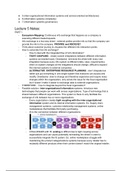
Lecture 5 Notes:
PART 1
- Ecosystem Mapping: Continuous info exchange that happens as a company is
executing different tasks/requests.
- Info exchange is a two-way street - external parties provide info so that the company can
provide the info to the company. PROVIDE and RECIEVE?
- Think about customer journey to visualize the different info interaction points
- How to automate this info exchange?
- How to deal with the integrated flow of rich information?
- TIGHT COUPLING - create custom integrations between different information
systems as-needed basis. Drawbacks- reinvents the wheel with every new
integration because every info system is different (data, rules, requirements),
when on system changes all the integrations should change, difficult to expand
the internal systems to external companies….
- ALTERNATIVE: ENTERPRISE RESOURCE PLANNING - don’t integrate but
rather just put everything in one single system that everyone can access and
modify. Drawbacks- slow to change and therefore expensive and require many
changes within the organization, only solves the issue for the focal organization
but it doesn’t make it easier to exchange data to external organizations.
- THEREFORE… how to integrate beyond the focal organization?
- Possible solution: inter-organizational information systems: Introduce new
technologies that people can work with across organizations. Type of technology that is
shared between different organizations. This system is there to only facilitate the
exchange of info between two or more organizations
- Every organization creates tight coupling with the inter-organizational
information system and its internal information systems. Ex: Supply chain
management systems, customer relationship management systems, online
marketplaces that facilitate third party purchasing.
- IS is the connection between different organizations
-
- CHALLENGES with IS: scaling is difficult due to tight coupling across
organizations and can cause potentially reinvesting the wheel in order to
successfully integrate the IS system. Ex: online marketplace struggle with
maintaining the product categorizations systems because every retailer has to
reclassify different products when their content doesn’t match the original retailer;
, IS adaptability becomes a key factor in successful IS because different
organizations do things in different ways; what organizations carry the
responsibility of the IS? Third-party? Or the collective? Collective ownership
causes difficulties with coordination of issues therefore either organizations carry
the main responsibility or a third party is hired ex: the travel industry.
PART2
- How to get from A to B? Bus tram metro train taxi rent a bike - All of these have different
boundary conditionals and we are aware of the requirements… We do not have the
responsibility for these but we are using the resources available to us. How to extend
this to SERVICE ORIENTED ARCHITECTURE?
- It is a paradigm for organizing and utilizing distributed services and capabilities
that may be under the control of different ownership domains. It provides an
uncovered means to offer, discover, and interact with different services to produce the
desired effects.
- Services are places between info systems that allow for the backend interaction of
information systems via the user simple interaction using the front end interface.
The services take care of this data exchange by corresponding data with the
completion of different tasks.
-
- The interaction between the client-side info system and service info system is done via
the service description in the back end. Abstract away from the information systems
and users interact with the interface services. Therefore users only need to know
how to interact with the services. This establishes LOOSE COUPLING between different
info systems. Ex: Log in using Facebook/google via a third organization. The
organization uses a validation process to check if this account is in fact a
Google/Facebook account.
● 6 (information systems complexity)
● 7 (information systems governance)
Lecture 5 Notes:
PART 1
- Ecosystem Mapping: Continuous info exchange that happens as a company is
executing different tasks/requests.
- Info exchange is a two-way street - external parties provide info so that the company can
provide the info to the company. PROVIDE and RECIEVE?
- Think about customer journey to visualize the different info interaction points
- How to automate this info exchange?
- How to deal with the integrated flow of rich information?
- TIGHT COUPLING - create custom integrations between different information
systems as-needed basis. Drawbacks- reinvents the wheel with every new
integration because every info system is different (data, rules, requirements),
when on system changes all the integrations should change, difficult to expand
the internal systems to external companies….
- ALTERNATIVE: ENTERPRISE RESOURCE PLANNING - don’t integrate but
rather just put everything in one single system that everyone can access and
modify. Drawbacks- slow to change and therefore expensive and require many
changes within the organization, only solves the issue for the focal organization
but it doesn’t make it easier to exchange data to external organizations.
- THEREFORE… how to integrate beyond the focal organization?
- Possible solution: inter-organizational information systems: Introduce new
technologies that people can work with across organizations. Type of technology that is
shared between different organizations. This system is there to only facilitate the
exchange of info between two or more organizations
- Every organization creates tight coupling with the inter-organizational
information system and its internal information systems. Ex: Supply chain
management systems, customer relationship management systems, online
marketplaces that facilitate third party purchasing.
- IS is the connection between different organizations
-
- CHALLENGES with IS: scaling is difficult due to tight coupling across
organizations and can cause potentially reinvesting the wheel in order to
successfully integrate the IS system. Ex: online marketplace struggle with
maintaining the product categorizations systems because every retailer has to
reclassify different products when their content doesn’t match the original retailer;
, IS adaptability becomes a key factor in successful IS because different
organizations do things in different ways; what organizations carry the
responsibility of the IS? Third-party? Or the collective? Collective ownership
causes difficulties with coordination of issues therefore either organizations carry
the main responsibility or a third party is hired ex: the travel industry.
PART2
- How to get from A to B? Bus tram metro train taxi rent a bike - All of these have different
boundary conditionals and we are aware of the requirements… We do not have the
responsibility for these but we are using the resources available to us. How to extend
this to SERVICE ORIENTED ARCHITECTURE?
- It is a paradigm for organizing and utilizing distributed services and capabilities
that may be under the control of different ownership domains. It provides an
uncovered means to offer, discover, and interact with different services to produce the
desired effects.
- Services are places between info systems that allow for the backend interaction of
information systems via the user simple interaction using the front end interface.
The services take care of this data exchange by corresponding data with the
completion of different tasks.
-
- The interaction between the client-side info system and service info system is done via
the service description in the back end. Abstract away from the information systems
and users interact with the interface services. Therefore users only need to know
how to interact with the services. This establishes LOOSE COUPLING between different
info systems. Ex: Log in using Facebook/google via a third organization. The
organization uses a validation process to check if this account is in fact a
Google/Facebook account.