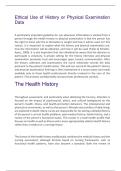
Ethical Use of History or Physical Examination
Data
A particularly important guideline for use whenever information is elicited from a
person through the health history or physical examination is that the person has
the right to know why the in-formation is sought and how it will be used. For this
reason, it is important to explain what the history and physical examination are,
how the information will be obtained, and how it will be used (Fuller & Schaller-
Ayers, 2000). It is also important that the individual be aware that the decision to
participate is voluntary. A private setting for the history interview and physical
examination promotes trust and encourages open, honest communication. After
the history collection and examination, the nurse selectively records the data
pertinent to the patient’s health status. This writ-ten record of the patient’s history
and physical examination find-ings is then maintained in a secure place and made
available only to those health professionals directly involved in the care of the
patient. This protects confidentiality and promotes professional conduct.
The Health History
Throughout assessment, and particularly when obtaining the his-tory, attention is
focused on the impact of psychosocial, ethnic, and cultural background on the
person’s health, illness, and health-promotion behaviors. The interpersonal and
physical en-vironments, as well as the person’s lifestyle and activities of daily living,
are explored in depth. Many nurses are responsible for ob-taining a detailed history
of the person’s current health problems, past medical history, family history, and a
review of the person’s functional status. This results in a total health profile that
focuses on health as well as illness and is more appropriately called a health history
rather than a medical or a nursing history.
The format of the health history traditionally combines the medical history and the
nursing assessment, although formats based on nursing frameworks, such as
functional health patterns, have also become a standard. Both the review of
,systems and pa-tient profile are expanded to include individual and family rela-
tionships, lifestyle patterns, health practices, and coping strategies. These
components of the health history are the basis of nursing as-sessment and can be
easily adapted to address the needs of any pa-tient population in any setting,
institution, or agency.
Combining the information obtained by the physician and the nurse in one health
history prevents duplication of informa-tion and minimizes efforts on the part of
the person to providethis information. This also encourages collaboration among
members of the health care team who share in the collection and interpretation of
the data (Butler, 1999).
THE INFORMANT
The informant, or the person providing the health history, may not always be the
patient, as in the case of a developmentally de-layed, mentally impaired,
disoriented, confused, unconscious, or comatose patient. The interviewer assesses
the reliability of the informant and the usefulness of the information provided. For
example, a disoriented patient is often unable to provide a reli-able database;
people who abuse drugs and alcohol often deny using these substances. The
interviewer must make a judgment about the reliability of the information (based
on the context of the entire interview), and he or she includes this evaluation in the
record.
CULTURAL CONSIDERATIONS
When obtaining the health history, the interviewer takes into ac-count the person’s
cultural background (Weber & Kelley, 2003). Cultural attitudes and beliefs about
health, illness, health care, hospitalization, the use of medications, and the use of
comple-mentary therapies are derived from each person’s experiences. They vary
according to the person’s ethnic and cultural back-ground. A person from another
, culture may have a different view of personal health practices than the health care
practitioner.
Similarly, people from some ethnic and cultural backgrounds will not complain of
pain, even when it is severe, because outward expressions of pain are considered
unacceptable. In some in-stances they may refuse to take analgesics. Other cultures
have their own folklore and beliefs about the treatment of illnesses. All such
differences in outlook must be taken into account and ac-cepted when caring for
members of other cultures. Attitudes and beliefs about family relationships and the
role of women and el-derly members of a family must be respected even if those
atti-tudes and beliefs conflict with those of the interviewer.
CONTENT OF THE HEALTH HISTORY
When the patient is seen for the first time by a member of the health care team,
the first requirement is a database (except in emergency situations). The sequence
and format of obtaining data about the patient vary, but the content, regardless of
format, usually addresses the same general topics. A traditional approach includes
the following:
• Biographical data
• Chief complaint
• Present health concern (or present illness)
• Past history
Data
A particularly important guideline for use whenever information is elicited from a
person through the health history or physical examination is that the person has
the right to know why the in-formation is sought and how it will be used. For this
reason, it is important to explain what the history and physical examination are,
how the information will be obtained, and how it will be used (Fuller & Schaller-
Ayers, 2000). It is also important that the individual be aware that the decision to
participate is voluntary. A private setting for the history interview and physical
examination promotes trust and encourages open, honest communication. After
the history collection and examination, the nurse selectively records the data
pertinent to the patient’s health status. This writ-ten record of the patient’s history
and physical examination find-ings is then maintained in a secure place and made
available only to those health professionals directly involved in the care of the
patient. This protects confidentiality and promotes professional conduct.
The Health History
Throughout assessment, and particularly when obtaining the his-tory, attention is
focused on the impact of psychosocial, ethnic, and cultural background on the
person’s health, illness, and health-promotion behaviors. The interpersonal and
physical en-vironments, as well as the person’s lifestyle and activities of daily living,
are explored in depth. Many nurses are responsible for ob-taining a detailed history
of the person’s current health problems, past medical history, family history, and a
review of the person’s functional status. This results in a total health profile that
focuses on health as well as illness and is more appropriately called a health history
rather than a medical or a nursing history.
The format of the health history traditionally combines the medical history and the
nursing assessment, although formats based on nursing frameworks, such as
functional health patterns, have also become a standard. Both the review of
,systems and pa-tient profile are expanded to include individual and family rela-
tionships, lifestyle patterns, health practices, and coping strategies. These
components of the health history are the basis of nursing as-sessment and can be
easily adapted to address the needs of any pa-tient population in any setting,
institution, or agency.
Combining the information obtained by the physician and the nurse in one health
history prevents duplication of informa-tion and minimizes efforts on the part of
the person to providethis information. This also encourages collaboration among
members of the health care team who share in the collection and interpretation of
the data (Butler, 1999).
THE INFORMANT
The informant, or the person providing the health history, may not always be the
patient, as in the case of a developmentally de-layed, mentally impaired,
disoriented, confused, unconscious, or comatose patient. The interviewer assesses
the reliability of the informant and the usefulness of the information provided. For
example, a disoriented patient is often unable to provide a reli-able database;
people who abuse drugs and alcohol often deny using these substances. The
interviewer must make a judgment about the reliability of the information (based
on the context of the entire interview), and he or she includes this evaluation in the
record.
CULTURAL CONSIDERATIONS
When obtaining the health history, the interviewer takes into ac-count the person’s
cultural background (Weber & Kelley, 2003). Cultural attitudes and beliefs about
health, illness, health care, hospitalization, the use of medications, and the use of
comple-mentary therapies are derived from each person’s experiences. They vary
according to the person’s ethnic and cultural back-ground. A person from another
, culture may have a different view of personal health practices than the health care
practitioner.
Similarly, people from some ethnic and cultural backgrounds will not complain of
pain, even when it is severe, because outward expressions of pain are considered
unacceptable. In some in-stances they may refuse to take analgesics. Other cultures
have their own folklore and beliefs about the treatment of illnesses. All such
differences in outlook must be taken into account and ac-cepted when caring for
members of other cultures. Attitudes and beliefs about family relationships and the
role of women and el-derly members of a family must be respected even if those
atti-tudes and beliefs conflict with those of the interviewer.
CONTENT OF THE HEALTH HISTORY
When the patient is seen for the first time by a member of the health care team,
the first requirement is a database (except in emergency situations). The sequence
and format of obtaining data about the patient vary, but the content, regardless of
format, usually addresses the same general topics. A traditional approach includes
the following:
• Biographical data
• Chief complaint
• Present health concern (or present illness)
• Past history