lOMoARcPSD|27612663
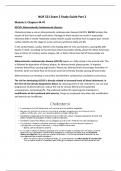
NR-565 FINAL STUDY GUIDE
, lOMoARcPSD|27612663
Final Exam Study Guide
W eek 5
· Th yr oid
o Diagn osis & Evalu ation
- W hat labs ar e used to diagn ose?
For diagnosis we check TSH, T3, and T4
TSH - normal 0.3-6
- in Hypothyroidism TSH would be elevated (>6) and T3 and T4 would be
decreased and the opposite would happen with hyperthyroidism.
- Hyperthyroidism - TSH low (<0.3) , T4 normal, and T3 High
· Etiology can be related to exogenous T4 ingestion, a concurrent
nonthyroidal illness, or amiodarone-induced thyroid dysfunction – Low
TSH, high T4, normal T3
· The possibility of a TSH producing pituitary tumor, which would
need to be evaluated further with magnetic resonance imaging. –
Normal/elevated TSH, elevated T4 and T3
· Primary hyperthyroidism. However, other reasons for this thyroid
function test abnormality could be exogenous T3 ingestion, or a
functioning adenoma. – Low TSH, normal T4, high T3
Baseline Data: Obtain serum levels of thyroid-stimulating hormone
(TSH), free triiodothyronine (T3), and free thyroxine (T4). Check baseline
CBC and LFTs prior to initiation.
Monitoring: Check CBC with differential if signs or symptoms of infection.
Check LFTs for signs or symptoms of liver dysfunction.
- Tim efr am e for r e-check of labs after star tin g levothyr oxin e
Downloaded by Brian kiarie ()
, lOMoARcPSD|27612663
· Measurement of serum TSH is an important means of
evaluation. Successful replacement therapy causes elevated TSH
levels to fall. However, TSH will not normalize quickly and often
lags normalization of serum T3 and T4. Hence evaluation should
not be done until 6 to 8 w eeks after starting treatment. - year ly
after stable.
- Sign s an d sym ptom s of hypo an d hyper thyr oidism
o Tr eatm ent
- Tr eatm en t of thyr o id stor m
· Propylthiouracil (PTU): Preferred treatment for thyroid storm. Thyrotoxic
crisis can occur in patients with severe thyrotoxicosis when they undergo major
surgery or develop a severe intercurrent illness (e.g., infection, sepsis). The
syndrome is characterized by profound hyperthermia (105°F or even higher),
severe tachycardia, restlessness, agitation, and tremor. Unconsciousness, coma,
Downloaded by Brian kiarie ()
NR-565 FINAL STUDY GUIDE
, lOMoARcPSD|27612663
Final Exam Study Guide
W eek 5
· Th yr oid
o Diagn osis & Evalu ation
- W hat labs ar e used to diagn ose?
For diagnosis we check TSH, T3, and T4
TSH - normal 0.3-6
- in Hypothyroidism TSH would be elevated (>6) and T3 and T4 would be
decreased and the opposite would happen with hyperthyroidism.
- Hyperthyroidism - TSH low (<0.3) , T4 normal, and T3 High
· Etiology can be related to exogenous T4 ingestion, a concurrent
nonthyroidal illness, or amiodarone-induced thyroid dysfunction – Low
TSH, high T4, normal T3
· The possibility of a TSH producing pituitary tumor, which would
need to be evaluated further with magnetic resonance imaging. –
Normal/elevated TSH, elevated T4 and T3
· Primary hyperthyroidism. However, other reasons for this thyroid
function test abnormality could be exogenous T3 ingestion, or a
functioning adenoma. – Low TSH, normal T4, high T3
Baseline Data: Obtain serum levels of thyroid-stimulating hormone
(TSH), free triiodothyronine (T3), and free thyroxine (T4). Check baseline
CBC and LFTs prior to initiation.
Monitoring: Check CBC with differential if signs or symptoms of infection.
Check LFTs for signs or symptoms of liver dysfunction.
- Tim efr am e for r e-check of labs after star tin g levothyr oxin e
Downloaded by Brian kiarie ()
, lOMoARcPSD|27612663
· Measurement of serum TSH is an important means of
evaluation. Successful replacement therapy causes elevated TSH
levels to fall. However, TSH will not normalize quickly and often
lags normalization of serum T3 and T4. Hence evaluation should
not be done until 6 to 8 w eeks after starting treatment. - year ly
after stable.
- Sign s an d sym ptom s of hypo an d hyper thyr oidism
o Tr eatm ent
- Tr eatm en t of thyr o id stor m
· Propylthiouracil (PTU): Preferred treatment for thyroid storm. Thyrotoxic
crisis can occur in patients with severe thyrotoxicosis when they undergo major
surgery or develop a severe intercurrent illness (e.g., infection, sepsis). The
syndrome is characterized by profound hyperthermia (105°F or even higher),
severe tachycardia, restlessness, agitation, and tremor. Unconsciousness, coma,
Downloaded by Brian kiarie ()