

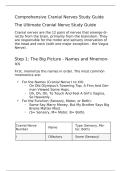
Comprehensive Cranial Nerves Study Guide
The Ultimate Cranial Nerve Study Guide
Cranial nerves are the 12 pairs of nerves that emerge di-
rectly from the brain, primarily from the brainstem. They
are responsible for the motor and sensory innervation of
the head and neck (with one major exception - the Vagus
Nerve).
Step 1: The Big Picture - Names and Mnemon-
ics
First, memorize the names in order. The most common
mnemonics are:
• For the Names (Cranial Nerve I to XII):
◦ On Old Olympus's Towering Top, A Finn And Ger-
man Viewed Some Hops.
◦ Oh, Oh, Oh, To Touch And Feel A Girl's Vagina,
So Heavenly.
• For the Function (Sensory, Motor, or Both):
◦ Some Say Marry Money, But My Brother Says Big
Brains Matter Most.
◦ (S= Sensory, M= Motor, B= Both).
Cranial Nerve Type (Sensory, Mo-
Name
Number tor, Both)
I Olfactory Some (Sensory)
,II Optic Say (Sensory)
III Oculomotor Marry (Motor)
IV Trochlear Money (Motor)
V Trigeminal But (Both)
VI Abducens My (Motor)
VII Facial Brother (Both)
Vestibulo-
VIII Says (Sensory)
cochlear
Glossopha-
IX Big (Both)
ryngeal
X Vagus Brains (Both)
XI Accessory Matter (Motor)
XII Hypoglossal Most (Motor)
Step 2: Detailed Breakdown of Each Cranial
Nerve
For each nerve, learn its Number, Name, Type, Foramen
(where it exits the skull), Key Functions, and how to Test
it.
CN I: Olfactory
, • Type: Sensory
• Function: Smell (Olfaction).
• Foramen: Cribriform plate of the ethmoid bone.
• How to Test: Ask patient to close their eyes and iden-
tify familiar, non-irritating smells (e.g., coffee,
vanilla) one nostril at a time.
• Study Tip: Think of a wine sommelier (I) sniffing a
glass.
CN II: Optic
• Type: Sensory
• Function: Vision.
• Foramen: Optic canal.
• How to Test: Visual acuity test (Snellen chart), visual
fields test, funduscopic exam.
• Study Tip: You have II (two) eyes.
CN III: Oculomotor
• Type: Motor
• Function:
◦ Motor to 4 of 6 extraocular muscles: Moves eye
up, down, inward (adduction).
◦ Lifts eyelid (levator palpebrae superioris).
◦ Constricts pupil (parasympathetic).
◦ Accommodation (lens shape change for near vi-
sion).
• Foramen: Superior orbital fissure.
• How to Test: "H-test" for eye movement, check for
ptosis (droopy eyelid), check pupil reactivity to light.
• Study Tip: CN III, IV, and VI work together to control
eye movement. Learn them as a group.
CN IV: Trochlear
• Type: Motor
The Ultimate Cranial Nerve Study Guide
Cranial nerves are the 12 pairs of nerves that emerge di-
rectly from the brain, primarily from the brainstem. They
are responsible for the motor and sensory innervation of
the head and neck (with one major exception - the Vagus
Nerve).
Step 1: The Big Picture - Names and Mnemon-
ics
First, memorize the names in order. The most common
mnemonics are:
• For the Names (Cranial Nerve I to XII):
◦ On Old Olympus's Towering Top, A Finn And Ger-
man Viewed Some Hops.
◦ Oh, Oh, Oh, To Touch And Feel A Girl's Vagina,
So Heavenly.
• For the Function (Sensory, Motor, or Both):
◦ Some Say Marry Money, But My Brother Says Big
Brains Matter Most.
◦ (S= Sensory, M= Motor, B= Both).
Cranial Nerve Type (Sensory, Mo-
Name
Number tor, Both)
I Olfactory Some (Sensory)
,II Optic Say (Sensory)
III Oculomotor Marry (Motor)
IV Trochlear Money (Motor)
V Trigeminal But (Both)
VI Abducens My (Motor)
VII Facial Brother (Both)
Vestibulo-
VIII Says (Sensory)
cochlear
Glossopha-
IX Big (Both)
ryngeal
X Vagus Brains (Both)
XI Accessory Matter (Motor)
XII Hypoglossal Most (Motor)
Step 2: Detailed Breakdown of Each Cranial
Nerve
For each nerve, learn its Number, Name, Type, Foramen
(where it exits the skull), Key Functions, and how to Test
it.
CN I: Olfactory
, • Type: Sensory
• Function: Smell (Olfaction).
• Foramen: Cribriform plate of the ethmoid bone.
• How to Test: Ask patient to close their eyes and iden-
tify familiar, non-irritating smells (e.g., coffee,
vanilla) one nostril at a time.
• Study Tip: Think of a wine sommelier (I) sniffing a
glass.
CN II: Optic
• Type: Sensory
• Function: Vision.
• Foramen: Optic canal.
• How to Test: Visual acuity test (Snellen chart), visual
fields test, funduscopic exam.
• Study Tip: You have II (two) eyes.
CN III: Oculomotor
• Type: Motor
• Function:
◦ Motor to 4 of 6 extraocular muscles: Moves eye
up, down, inward (adduction).
◦ Lifts eyelid (levator palpebrae superioris).
◦ Constricts pupil (parasympathetic).
◦ Accommodation (lens shape change for near vi-
sion).
• Foramen: Superior orbital fissure.
• How to Test: "H-test" for eye movement, check for
ptosis (droopy eyelid), check pupil reactivity to light.
• Study Tip: CN III, IV, and VI work together to control
eye movement. Learn them as a group.
CN IV: Trochlear
• Type: Motor


