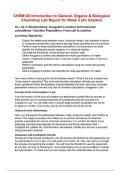
CHEM120 Introduction to General, Organic & Biological Chemistry | Lab Report for Week 3 (A+ Graded)
This document contains the Week 3 lab report for CHEM120: Introduction to General, Organic & Biological Chemistry. It features a full breakdown of the experimental procedure, data analysis, observations, and scientifically sound conclusions. Graded A+, the report exemplifies strong academic performance and is ideal for students seeking guidance on structure and content. CHEM120 Introduction to General, Organic & Biological Chemistry| Lab Report for Week 3 (A+ Graded) OL Lab 3: Stoichiometry: Avogadro’s number and molecular calculations / Solution Preparation: From salt to solution Learning Objectives: • Explain the relationship between mass, molecular weight, and numbers of atoms or molecules and perform calculations deriving these quantities from one another • Perform mass-to-mass stoichiometric calculations via conversions to moles • Identify the limiting and excess reagents in a chemical reaction • Calculate the theoretical, actual and percent reaction yield • Define Avogadro’s number and describe the mole quantification of matter • Explain relationship between mass, molecular weight, and numbers of atoms or molecules • Perform conversion and derivations calculations using key molecular quantity parameters • Define Avogadro’s number and describe the mole quantification of matter How many moles of sand grains has the Sahara desert? What is the only equation you ´ll ever need in chemistry? The short stoichiometry simulation will help you answer those questions! Follow the footsteps of great chemists and learn about key molecular parameters based on one and only star of chemistry calculations: Avogadro’s Law! Concept mole and Avogadro’s Law: Your first mission in this short simulation is to familiarize yourself with the concept of mole and the way of counting molecules of substances using the one and only Avogadro’s Law. You will learn how to convert huge numbers of particles into handy Avogadro’s number, extensively used by all chemists around the world! Chemical units relationship: Next, you will explore the relationship between mass, molecular weight, and number of atoms. This magical equation will enable you to perform derivations of molecular quantity parameters for various chemical substances. You will feel like Marie Curie analysing chemical dependencies of chemicals in her french laboratory! Part 1: Complete the Labster lab: Stoichiometric calculations: Identify an unknown compound using gravimetric analysis Glassware and quantitative transfer Moving on to the second workbench, you will explore and determine what glassware will be appropriate for you to use. Your lab guide and mentor, Dr. One, will walk you through the process of preparing the solution. You will have the freedom to use the equipment as you like, but only by following Dr. One’s instructions will you be successful in making the right solution. To make sure you can always redo the essential steps of the process, Dr. One will provide you with a fantastic reset button, so you can try again if you make a mistake. Solve the preparation In the end, only by carefully ensuring that the right amount of water and ammonium chloride is used can you make the correct solution. Are you prepared for solving how to perform a Solution Preparation? Part 1: Complete the Labster Lab: Stoichiometry: Avogadro’s number and molecular calculations Complete all activities and answer all questions within the lab and then complete the questions below: Purpose: Describe in complete sentences and in your own words, the purpose of this experiment. • The purpose of this experiment is to learn how to prepare the solution, the difference between molarity and mass concentration, and make sure we use the right glassware to mix it in. Observations: Record three observations from the simulation. I. How to weigh the ammonium chloride using a scale II. How to move material from the measuring disk to the flask using water III. Using more water to move, to ensure we have the entire substance 1. How do you convert between grams and moles of a specific molecule? Give a specific example to illustrate. • You divide the grams by the molar mass in order to convert to moles • Example: (20g Ca) (1 mol Ca / 40.08g/mol Ca) = 0.499 mol Ca 2. How do you convert between moles of one substance and moles another substance? • Steps: o Write the balanced chemical equation for the reaction o Determine the mole ratio between each substance o Use dimensional analysis to calculate the moles of the second substance to the corresponding moles of the first substance 3. Balance the following chemical equation: Na2CO3(aq) + CaCl2(aq) → CaCO3(s) + 2 NaCl(aq) 4. Use the balanced chemical equation from the last question to solve this situation: You combine 0.5 moles of Na2CO3 with enough CaCl2 that your compound reacts completely. How many moles of NaCl would you expect this reaction to produce? Show all work below. • nNa2CO3 = m/MM (m=mass 0.5g) (MM=molar mass 106g/mol) • nNa2CO3 = 0.5g / 106g/mol = (4.717 x 10^-3mol)(2mol NaCl / 1 molNa2CO3) = 9.434 x 10^-3 mol NaCl Part 2: Complete the Labster Lab: Solution Preparation: From salt to solution Complete all activities and answer all questions within the lab and then complete the questions below: 1. In this lab, you learned how to prepare solutions with a precise concentration. Where in your nursing career might this skill be needed? • There are going to be times as a nurse that a solute and a solvent are going to be mixed if they are not already. Knowing to mix properly will help to be able to mix a solute and solvent when needed. 2. Which piece of glassware did you use to prepare your solution in this lab and why? • I used a volumetric flask because it is precise, and it helps mix the solute and solvent 3. Calculate how many grams of NaCl are required to make 100 mL of a 1 M NaCl solution. Show your work in the space below. • M=CVM M=(0.1)(58.533)=5.853g Reflection: Consider what you learned from these simulations. Reflect on three to four key concepts that you learned in this lab exercise. How could the lessons learned in this virtual lab relate to a real world situation in the community/world or your future career? Be specific in your answer (this should require 5-10 sentences). • A chemical can be unknown in an experiment which is why an experiment is being conducted. An experiment can tell what kind of chemical is present, the weight, and how many moles is present. This experiment showed just that to determine how to decipher what chemical was present since the bottle’s label was worn. There are times that scientists need to do this because the bottles are worn so they need to conduct experiments to determine what it is. These simulations helped by showing how to conduct an experiment correctly and safely. Grading Rubric: Activity Deliverable Points Part I Complete Simulation Stoichiometry: Avogadro’s number and molecular calculations 10 Part II Complete Simulation Solution Preparation: From salt to solution 10 Part III Complete lab report and answer questions • Observation (3 points) 15
Written for
- Institution
- CHEM120
- Course
- CHEM120
Document information
- Uploaded on
- October 22, 2025
- Number of pages
- 4
- Written in
- 2025/2026
- Type
- Exam (elaborations)
- Contains
- Questions & answers
Subjects
- lab report
- week 3 chemistry lab
- general chemistry
- organic chemistry
- biological chemistry
- chem120 practical
- university lab report
-
chemistry analysis
-
introductory chemistry

Also available in package deal