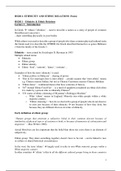
HS2011: ETHNICITY AND ETHNIC RELATIONS (Notes)
HS2011 – Ethnicity & Ethnic Relations
Lecture 1 – Introduction
In Greek ‘ethnos’/’ethnikos’ – used to describe a nation as a unity of people of common
blood/descent (ancestors)
- share something physically in your bodies
While ethnos was used to describe a group of people who share common physical/cultural traits,
the Greek used it to describe the OTHER; the Greek described themselves as genos Hellenon
(‘from the family of the Greeks’)
Ethnicity – term coined by Sociologist D. Riesman in 1953
Multiple related terms:
Ethnicity
Ethnic group
Ethnic identity
Ethnic ‘food’, ‘customs’, ‘dance’, ‘costume’…
Examples of how the term ‘ethnicity’ is used:
‘Ethnic politics in Malaysia’ – sharing of power
‘One in five marriages here is inter-ethnic’ – people assume that ‘inter-ethnic’ means
e.g. Chinese marries Indian, but not as Chinese Cantonese marries Chinese Hokkien
‘Ethnic dance’ – traditional dances that have centuries of history
‘36th Annual Ethnic Food Fair’ – is a meal of spaghetti considered an ethnic dish when
it is made by a person who is ethnically Chinese?
‘UN warns of ethnic cleansing of Myanmar’s Rohingya Muslims”
o What ‘ethnic’ means in England: Minority non-white people within a white
majority country
o ‘Ethnic cleansing’ = how do we deal with a group of people who do not deserve
to exist just because of their ethnicity not because of how they look, but
because they are different from us in terms of ethnicity
Early definition of ethnic group:
“Human groups that entertain a subjective belief in their common descent because of
similarities of physical type or of customs or both, or because of memories of colonization and
migration” – Max Weber (1968)
Actual blood ties are less important that the belief that those ties exist; there is an element of
subjectivity.
Ethnic group: They share something together, doesn’t have to be real – can be linked to race
or culture or shared historical circumstances
In the west: the term ‘ethnic’ largely used to refer to non-White minority groups within a
White-majority country
In other countries ‘ethnic’ refers to all the different cultural groups living in those countries
1
,Another definition of Ethnic Group:
“A collectivity within a larger society having real or putative common ancestry, memories of
a shared historical past, and a cultural focus on one or more symbolic elements defined as the
epitome of the peoplehood”
‘A collectivity within a larger society’ = All complex societies have multiple ethnic groups
in them (no longer homogenous)
An ethnic group frequently perceives itself and is perceived by others to be distinct in some
combination of the following traits: language, religion, culture, ancestral homeland etc.
‘Ethnic markers’ that separates one ethnic group from another:
(The Cauldron of Ethnicity in the Modern World – Manning Nash)
Kinship (i.e. how you are related to the family, and that plug into your entire ethnic
group)
o E.g. Peranakan, Singaporean Chinese, imagine that we have descended from the
Han dynasty
Commensality (i.e. eating together) – the way you eat the food would make you realise
your ethnic group
Common culture – e.g. in Singapore, we speak Singlish, kiasu-ness
Clothing, language, food, physical features, rituals to do with birth & death, weddings,
how we educate our children
RACE
Race and Ethnicity are NOT THE SAME
If ethnicity is about ‘culture’, then ‘race’ is different as it is ‘biological’ – i.e. ‘ethnicity’
and ‘race’ should not to used interchangeably
What you say someone is ‘ethnically’ an ‘Indian’, you are referring to his/her cultural
practices
What you say someone is ‘racially’ an ‘Indian’, you are referring to his/her physical looks
– e.g. Indians have a darker skin colour, bigger eyes etc.
Today, it more common to describe ‘ethnic group’ as a group that is sharing ‘culture’, but
not blood or physical traits (i.e. ‘race’)
The complications of Ethnicity and Race
What if you ‘look’ like you are from one ‘race’ (and also by extension its related ‘ethnic
practices’), but practice an ‘ethnicity’ (‘culture’) that is ‘different’?
2
,FREDRICK BARTH
He was a Norwegian anthropologist, who did his PhD fieldwork in Pakistan
Before his contributions to ‘ethnicity’, the term referred to a group’s cultural traits from
‘inside out’; that an ethnic group is defined by the stuff they do – language, food, religion
etc.
Barth’s researched changed the above: ‘ethnicity’ refers to a group’s cultural traits from
‘outside in’; that the stuff that you do does not define your ‘ethnic group’ “but rather it is
the social interaction with other groups that makes that difference possible, visible and
socially meaningful”
In a group of 10 people, assume they are all Singaporeans. The way they interact with one
another does not highlight their Singaporean-ness because to each of them, they are
practicing the ‘norm’
In a group of 10 people, only 3 are Singaporeans. The way they interact with the other 7
highlights their Singaporean-ness because to each of them, they are aware that their
Singaporean ‘norm’ is different from the norms of the other 7. Also, it is through these
interactions that their Singaporean-ness becomes ‘real’
So today, the study of ethnicity is not to focus on 1 ethnic group and see what they do with
one another, but to study how different groups interact.
Ethnicity is also not only about ‘minority groups’; if the interactions between groups are
important, then looking at majority-minority interactions is vital
3
, Reading #1: The Sociological Understanding of Ethnicity
The collapse of the colonial world in the 1950s and the 1960s has brought even more
confusion on questions of ‘race’, culture and ethnicity.
‘Ethnicity’ contains a multiplicity of meanings – such a plasticity and ambiguity of the
concept allows for deep misunderstandings and political misuses.
Frederick Barth (1969) defined and explained ethnicity from the outside in:
o It is not the ‘possession’ of cultural characteristics that makes social groups
distinct, but rather it is the social interaction with other groups that makes the
difference possible, visible, and socially meaningful.
Since culture and social groups emerge only through interaction with others, then
ethnicity cannot be confined to minority groups only – cannot study minority ethnic
groups without studying majority ethnic groups.
If ethnicity is understood in universalist terms as a question of social interaction, culture
and boundary maintenance, it means that there is no culturally and politically aware social
group which is able to create a believable narrative of common descent without drawing
upon some conception of ethnicity.
Cultural difference framed as ethnic difference is sociologically relevant only when it is
active, mobilized and dynamic, and not a mere difference.
‘Race’ is a social construct whereby phenotypic attributes are popularly used to denote
in-groups from out-groups.
o Since there is no sound biological or sociological foundation for its use in an
analytical sense, one should treat ‘race’ as no more than a special case of ethnicity.
Concepts such as nation, nationality and nationalism occasionally overlap with ethnicity,
but for the most part they refer to ideologies and political movements.
4
HS2011 – Ethnicity & Ethnic Relations
Lecture 1 – Introduction
In Greek ‘ethnos’/’ethnikos’ – used to describe a nation as a unity of people of common
blood/descent (ancestors)
- share something physically in your bodies
While ethnos was used to describe a group of people who share common physical/cultural traits,
the Greek used it to describe the OTHER; the Greek described themselves as genos Hellenon
(‘from the family of the Greeks’)
Ethnicity – term coined by Sociologist D. Riesman in 1953
Multiple related terms:
Ethnicity
Ethnic group
Ethnic identity
Ethnic ‘food’, ‘customs’, ‘dance’, ‘costume’…
Examples of how the term ‘ethnicity’ is used:
‘Ethnic politics in Malaysia’ – sharing of power
‘One in five marriages here is inter-ethnic’ – people assume that ‘inter-ethnic’ means
e.g. Chinese marries Indian, but not as Chinese Cantonese marries Chinese Hokkien
‘Ethnic dance’ – traditional dances that have centuries of history
‘36th Annual Ethnic Food Fair’ – is a meal of spaghetti considered an ethnic dish when
it is made by a person who is ethnically Chinese?
‘UN warns of ethnic cleansing of Myanmar’s Rohingya Muslims”
o What ‘ethnic’ means in England: Minority non-white people within a white
majority country
o ‘Ethnic cleansing’ = how do we deal with a group of people who do not deserve
to exist just because of their ethnicity not because of how they look, but
because they are different from us in terms of ethnicity
Early definition of ethnic group:
“Human groups that entertain a subjective belief in their common descent because of
similarities of physical type or of customs or both, or because of memories of colonization and
migration” – Max Weber (1968)
Actual blood ties are less important that the belief that those ties exist; there is an element of
subjectivity.
Ethnic group: They share something together, doesn’t have to be real – can be linked to race
or culture or shared historical circumstances
In the west: the term ‘ethnic’ largely used to refer to non-White minority groups within a
White-majority country
In other countries ‘ethnic’ refers to all the different cultural groups living in those countries
1
,Another definition of Ethnic Group:
“A collectivity within a larger society having real or putative common ancestry, memories of
a shared historical past, and a cultural focus on one or more symbolic elements defined as the
epitome of the peoplehood”
‘A collectivity within a larger society’ = All complex societies have multiple ethnic groups
in them (no longer homogenous)
An ethnic group frequently perceives itself and is perceived by others to be distinct in some
combination of the following traits: language, religion, culture, ancestral homeland etc.
‘Ethnic markers’ that separates one ethnic group from another:
(The Cauldron of Ethnicity in the Modern World – Manning Nash)
Kinship (i.e. how you are related to the family, and that plug into your entire ethnic
group)
o E.g. Peranakan, Singaporean Chinese, imagine that we have descended from the
Han dynasty
Commensality (i.e. eating together) – the way you eat the food would make you realise
your ethnic group
Common culture – e.g. in Singapore, we speak Singlish, kiasu-ness
Clothing, language, food, physical features, rituals to do with birth & death, weddings,
how we educate our children
RACE
Race and Ethnicity are NOT THE SAME
If ethnicity is about ‘culture’, then ‘race’ is different as it is ‘biological’ – i.e. ‘ethnicity’
and ‘race’ should not to used interchangeably
What you say someone is ‘ethnically’ an ‘Indian’, you are referring to his/her cultural
practices
What you say someone is ‘racially’ an ‘Indian’, you are referring to his/her physical looks
– e.g. Indians have a darker skin colour, bigger eyes etc.
Today, it more common to describe ‘ethnic group’ as a group that is sharing ‘culture’, but
not blood or physical traits (i.e. ‘race’)
The complications of Ethnicity and Race
What if you ‘look’ like you are from one ‘race’ (and also by extension its related ‘ethnic
practices’), but practice an ‘ethnicity’ (‘culture’) that is ‘different’?
2
,FREDRICK BARTH
He was a Norwegian anthropologist, who did his PhD fieldwork in Pakistan
Before his contributions to ‘ethnicity’, the term referred to a group’s cultural traits from
‘inside out’; that an ethnic group is defined by the stuff they do – language, food, religion
etc.
Barth’s researched changed the above: ‘ethnicity’ refers to a group’s cultural traits from
‘outside in’; that the stuff that you do does not define your ‘ethnic group’ “but rather it is
the social interaction with other groups that makes that difference possible, visible and
socially meaningful”
In a group of 10 people, assume they are all Singaporeans. The way they interact with one
another does not highlight their Singaporean-ness because to each of them, they are
practicing the ‘norm’
In a group of 10 people, only 3 are Singaporeans. The way they interact with the other 7
highlights their Singaporean-ness because to each of them, they are aware that their
Singaporean ‘norm’ is different from the norms of the other 7. Also, it is through these
interactions that their Singaporean-ness becomes ‘real’
So today, the study of ethnicity is not to focus on 1 ethnic group and see what they do with
one another, but to study how different groups interact.
Ethnicity is also not only about ‘minority groups’; if the interactions between groups are
important, then looking at majority-minority interactions is vital
3
, Reading #1: The Sociological Understanding of Ethnicity
The collapse of the colonial world in the 1950s and the 1960s has brought even more
confusion on questions of ‘race’, culture and ethnicity.
‘Ethnicity’ contains a multiplicity of meanings – such a plasticity and ambiguity of the
concept allows for deep misunderstandings and political misuses.
Frederick Barth (1969) defined and explained ethnicity from the outside in:
o It is not the ‘possession’ of cultural characteristics that makes social groups
distinct, but rather it is the social interaction with other groups that makes the
difference possible, visible, and socially meaningful.
Since culture and social groups emerge only through interaction with others, then
ethnicity cannot be confined to minority groups only – cannot study minority ethnic
groups without studying majority ethnic groups.
If ethnicity is understood in universalist terms as a question of social interaction, culture
and boundary maintenance, it means that there is no culturally and politically aware social
group which is able to create a believable narrative of common descent without drawing
upon some conception of ethnicity.
Cultural difference framed as ethnic difference is sociologically relevant only when it is
active, mobilized and dynamic, and not a mere difference.
‘Race’ is a social construct whereby phenotypic attributes are popularly used to denote
in-groups from out-groups.
o Since there is no sound biological or sociological foundation for its use in an
analytical sense, one should treat ‘race’ as no more than a special case of ethnicity.
Concepts such as nation, nationality and nationalism occasionally overlap with ethnicity,
but for the most part they refer to ideologies and political movements.
4