100% satisfaction guarantee Immediately available after payment Both online and in PDF No strings attached 4.2 TrustPilot
logo-home
Summary

Summary Gas Gangrene and Necrosis: Clinical Insights and Management

Rating
-
Sold
-
Pages
38
Uploaded on
21-10-2025
Written in
2024/2025

This Medical Training presentation explores gas gangrene (clostridial myonecrosis), a life-threatening infection primarily caused by Clostridium perfringens, often following trauma or surgery, characterized by rapid muscle necrosis, gas production (hydrogen, nitrogen, methane), and exotoxin-induced complications like hemolysis and shock. It covers necrosis types—coagulative, liquefactive, caseous, fat, fibrinoid, and gangrenous (dry and wet)—and details gas gangrene’s epidemiology, risk factors (e.g., car accidents, crush injuries, IV drug abuse, postoperative issues), and pathophysiology, noting a <24-hour incubation period. Clinical signs include severe pain, tachycardia, sweet-smelling discharge, crepitus, and “dishwater pus,” with diagnosis via radiographs showing gas streaks, elevated LDH/WBC, and Gram-positive bacilli. Treatment involves high-dose antibiotics (penicillin G, clindamycin), hyperbaric oxygen, and radical debridement, with complications like shock and renal failure driving a 25-100% mortality rate. Prevention focuses on early recognition and excision of necrotizing tissues, supported by images and an assignment on dry and wet gangrene, making this a key resource for medical education.

Show more Read less
Institution
Course


Whoops! We can’t load your doc right now. Try again or contact support.

Written for

Institution
Course

Document information

Uploaded on
October 21, 2025
Number of pages
38
Written in
2024/2025
Type
Summary

Subjects

Content preview

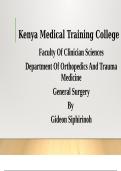
Kenya Medical Training College
Faculty Of Clinician Sciences
Department Of Orthopedics And Trauma
Medicine
General Surgery
By
Gideon Siphirinoh

,Necrosis
• Exogenous cell injury resulting in
uncontrolled cell degradation

,Key Principles

• Release of intracellular components
• Presence of inflammation

, Types of Necrosis
• Coagulative
Solid organs which allow preservation of
cell shape by coagulation of cell
proteins e.g.) heart, liver, kidney

$15.49
Get access to the full document:

100% satisfaction guarantee
Immediately available after payment
Both online and in PDF
No strings attached

Get to know the seller
Seller avatar
STUVIA4321

Also available in package deal

Get to know the seller

Seller avatar
STUVIA4321 Programming and medical institutions
Follow You need to be logged in order to follow users or courses
Sold
New on Stuvia
Member since
1 month
Number of followers
0
Documents
52
Last sold
-
Titotitus.

0.0

0 reviews

5
0
4
0
3
0
2
0
1
0

Recently viewed by you

Why students choose Stuvia

Created by fellow students, verified by reviews

Quality you can trust: written by students who passed their tests and reviewed by others who've used these notes.

Didn't get what you expected? Choose another document

No worries! You can instantly pick a different document that better fits what you're looking for.

Pay as you like, start learning right away

No subscription, no commitments. Pay the way you're used to via credit card and download your PDF document instantly.

Student with book image

“Bought, downloaded, and aced it. It really can be that simple.”

Alisha Student

Frequently asked questions