CHAPTER TWO SOLUTIONS
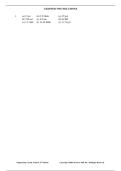
1. (a) 12 µs (d) 3.5 Gbits (g) 39 pA
(b) 750 mJ (e) 6.5 nm (h) 49 kΩ
(c) 1.13 kΩ (f) 13.56 MHz (i) 11.73 pA
Engineering Circuit Analysis, 6th Edition Copyright ©2002 McGraw-Hill, Inc. All Rights Reserved.
, CHAPTER TWO SOLUTIONS
2. (a) 1 MW (e) 33 µJ (i) 32 mm
(b) 12.35 mm (f) 5.33 nW
(c) 47. kW (g) 1 ns
(d) 5.46 mA (h) 5.555 MW
Engineering Circuit Analysis, 6th Edition Copyright ©2002 McGraw-Hill, Inc. All Rights Reserved.
, CHAPTER TWO SOLUTIONS
3. Motor power = 175 Hp
(a) With 100% efficient mechanical to electrical power conversion,
(175 Hp)[1 W/ (1/745.7 Hp)] = 130.5 kW
(b) Running for 3 hours,
Energy = (130.5×10³ W)(3 hr)(60 min/hr)(60 s/min) = 1.409 GJ
(c) A single battery has 430 kW-hr capacity. We require
(130.5 kW)(3 hr) = 391.5 kW-hr therefore one battery is sufficient.
Engineering Circuit Analysis, 6th Edition Copyright ©2002 McGraw-Hill, Inc. All Rights Reserved.
, CHAPTER TWO SOLUTIONS
4. The 400-mJ pulse lasts 20 ns.
(a) To compute the peak power, we assume the pulse shape is square:
Energy (mJ)
400
t (ns)
20
Then P = 400×10-3/20×10-9 = 20 MW.
(b) At 20 pulses per second, the average power is
Pavg = (20 pulses)(400 mJ/pulse)/(1 s) = 8 W.
Engineering Circuit Analysis, 6th Edition Copyright ©2002 McGraw-Hill, Inc. All Rights Reserved.
1. (a) 12 µs (d) 3.5 Gbits (g) 39 pA
(b) 750 mJ (e) 6.5 nm (h) 49 kΩ
(c) 1.13 kΩ (f) 13.56 MHz (i) 11.73 pA
Engineering Circuit Analysis, 6th Edition Copyright ©2002 McGraw-Hill, Inc. All Rights Reserved.
, CHAPTER TWO SOLUTIONS
2. (a) 1 MW (e) 33 µJ (i) 32 mm
(b) 12.35 mm (f) 5.33 nW
(c) 47. kW (g) 1 ns
(d) 5.46 mA (h) 5.555 MW
Engineering Circuit Analysis, 6th Edition Copyright ©2002 McGraw-Hill, Inc. All Rights Reserved.
, CHAPTER TWO SOLUTIONS
3. Motor power = 175 Hp
(a) With 100% efficient mechanical to electrical power conversion,
(175 Hp)[1 W/ (1/745.7 Hp)] = 130.5 kW
(b) Running for 3 hours,
Energy = (130.5×10³ W)(3 hr)(60 min/hr)(60 s/min) = 1.409 GJ
(c) A single battery has 430 kW-hr capacity. We require
(130.5 kW)(3 hr) = 391.5 kW-hr therefore one battery is sufficient.
Engineering Circuit Analysis, 6th Edition Copyright ©2002 McGraw-Hill, Inc. All Rights Reserved.
, CHAPTER TWO SOLUTIONS
4. The 400-mJ pulse lasts 20 ns.
(a) To compute the peak power, we assume the pulse shape is square:
Energy (mJ)
400
t (ns)
20
Then P = 400×10-3/20×10-9 = 20 MW.
(b) At 20 pulses per second, the average power is
Pavg = (20 pulses)(400 mJ/pulse)/(1 s) = 8 W.
Engineering Circuit Analysis, 6th Edition Copyright ©2002 McGraw-Hill, Inc. All Rights Reserved.