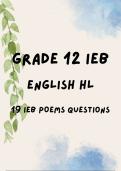
GRADE 12 IEB
english hl
19 IEB pOEMS questions
, To the Public Macneice
To me, fair friend, you never can be old Shakespeare
The Sun Rising Donne
The Discardment Paton
Namaqualand after Rain Plomer
Touch Lewin
For Oom Piet Dowling
The Tenant Ngulube
Cockroaches Yambo
Strangers forever Kassam
What is in a Name Plaatje
Ozymandias of Egypt Shelley
Moving through the silent crowd Spender
Mirror Plath
Go, lovely Rose Waller
Will it be so again? Lewis
Remember Rossetti
Growing Old Arnold
nobody loses all the time
,
, Cockroaches - Yambo Ouologuem
1. What is the central theme of the poem?
2. How does the poet describe the cockroaches’ movement?
3. What figure of speech is used in “helter-skelter they scuttle”?
4. What does the poet mean by “dark shelters”?
5. What is the effect of the imperative “Cut them off ” in the poem?
6. Identify the punctuation that creates a pause and emphasizes uncertainty in the poem.
7. What literary device is present in “hopeless flurry and helpless worry”?
8. How does the poet question authority in the line “who ordained the crash-fall of sandals”?
9. What is implied about cockroaches’ nature in “is it their love of darkness”?
10. How does the poem evoke sympathy for the cockroaches?
11. What role does alliteration play in “helter-skelter” and “hopeless flurry”?
12. How does enjambment affect the flow of the poem?
13. What contrast is highlighted between light and darkness?
14. How does the poet use rhetorical questions to engage the reader?
15. What mood is created by the description of the cockroaches’ panic?
Answers
1. The central theme is the tension between human control and the instinctive behavior of cockroaches,
reflecting a subtle commentary on vulnerability and survival.
2. The poet describes the cockroaches’ movement as frantic, chaotic, and scattered, emphasizing their
instinctive reaction to danger.
3. The figure of speech is alliteration combined with onomatopoeia, mimicking the frantic scuttling
sound of the cockroaches.
4. “Dark shelters” symbolize safety and secrecy, highlighting the creatures’ natural preference for
concealment and avoidance of human disturbance.
5. The imperative “Cut them off ” creates a commanding tone, showing human authority and
intervention, and heightens the sense of tension and pursuit.
6. The use of the question mark introduces hesitation and reflection, creating a pause that emphasizes
uncertainty and philosophical pondering.
7. The literary device is personification, attributing human emotions of worry and despair to the
cockroaches to evoke empathy.
8. The poet questions authority by implying that there is a higher power or order dictating the
cockroaches’ suffering, prompting reflection on fate and morality.
9. The phrase suggests that cockroaches are naturally drawn to darkness, emphasizing their instinctive
and habitual behavior rather than malevolence.
10. Sympathy is evoked by depicting the cockroaches as vulnerable, helpless, and frantically trying to
survive in a threatening environment.
11. Alliteration draws attention to the chaotic and fast-paced nature of the cockroaches’ movements,
enhancing the auditory imagery.
12. Enjambment creates a continuous flow that mirrors the movement and unpredictability of the
cockroaches, keeping the reader engaged in the scene.
13. The poem contrasts light as human intervention and danger with darkness as safety and instinct,
emphasizing the struggle between exposure and concealment.
14. Rhetorical questions encourage the reader to reflect on morality, fate, and human dominance over
other creatures, creating deeper philosophical engagement.
15. The mood is one of tension, anxiety, and urgency, reflecting both the panic of the cockroaches and
the looming human threat.
english hl
19 IEB pOEMS questions
, To the Public Macneice
To me, fair friend, you never can be old Shakespeare
The Sun Rising Donne
The Discardment Paton
Namaqualand after Rain Plomer
Touch Lewin
For Oom Piet Dowling
The Tenant Ngulube
Cockroaches Yambo
Strangers forever Kassam
What is in a Name Plaatje
Ozymandias of Egypt Shelley
Moving through the silent crowd Spender
Mirror Plath
Go, lovely Rose Waller
Will it be so again? Lewis
Remember Rossetti
Growing Old Arnold
nobody loses all the time
,
, Cockroaches - Yambo Ouologuem
1. What is the central theme of the poem?
2. How does the poet describe the cockroaches’ movement?
3. What figure of speech is used in “helter-skelter they scuttle”?
4. What does the poet mean by “dark shelters”?
5. What is the effect of the imperative “Cut them off ” in the poem?
6. Identify the punctuation that creates a pause and emphasizes uncertainty in the poem.
7. What literary device is present in “hopeless flurry and helpless worry”?
8. How does the poet question authority in the line “who ordained the crash-fall of sandals”?
9. What is implied about cockroaches’ nature in “is it their love of darkness”?
10. How does the poem evoke sympathy for the cockroaches?
11. What role does alliteration play in “helter-skelter” and “hopeless flurry”?
12. How does enjambment affect the flow of the poem?
13. What contrast is highlighted between light and darkness?
14. How does the poet use rhetorical questions to engage the reader?
15. What mood is created by the description of the cockroaches’ panic?
Answers
1. The central theme is the tension between human control and the instinctive behavior of cockroaches,
reflecting a subtle commentary on vulnerability and survival.
2. The poet describes the cockroaches’ movement as frantic, chaotic, and scattered, emphasizing their
instinctive reaction to danger.
3. The figure of speech is alliteration combined with onomatopoeia, mimicking the frantic scuttling
sound of the cockroaches.
4. “Dark shelters” symbolize safety and secrecy, highlighting the creatures’ natural preference for
concealment and avoidance of human disturbance.
5. The imperative “Cut them off ” creates a commanding tone, showing human authority and
intervention, and heightens the sense of tension and pursuit.
6. The use of the question mark introduces hesitation and reflection, creating a pause that emphasizes
uncertainty and philosophical pondering.
7. The literary device is personification, attributing human emotions of worry and despair to the
cockroaches to evoke empathy.
8. The poet questions authority by implying that there is a higher power or order dictating the
cockroaches’ suffering, prompting reflection on fate and morality.
9. The phrase suggests that cockroaches are naturally drawn to darkness, emphasizing their instinctive
and habitual behavior rather than malevolence.
10. Sympathy is evoked by depicting the cockroaches as vulnerable, helpless, and frantically trying to
survive in a threatening environment.
11. Alliteration draws attention to the chaotic and fast-paced nature of the cockroaches’ movements,
enhancing the auditory imagery.
12. Enjambment creates a continuous flow that mirrors the movement and unpredictability of the
cockroaches, keeping the reader engaged in the scene.
13. The poem contrasts light as human intervention and danger with darkness as safety and instinct,
emphasizing the struggle between exposure and concealment.
14. Rhetorical questions encourage the reader to reflect on morality, fate, and human dominance over
other creatures, creating deeper philosophical engagement.
15. The mood is one of tension, anxiety, and urgency, reflecting both the panic of the cockroaches and
the looming human threat.