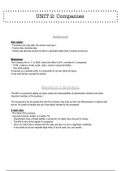
UNIT 2: Companies
Background:
Sole trader:
- If business can’t pay debt, the owners must pay it.
- If owner dies, business dies.
- Owners pay personal income tax which is generally higher than Company income tax.
Businesses:
The Company Act no. 71 of 2008, Came into effect in 2011, provides for 2 companies:
- Profit - making ( private, public, state - owned or personal liability )
- Non-profit making
A business is a separate entity, it’s responsible for its own debts and taxes.
It may exist forever, provided its solvent.
Memorandum of incorporation:
The MOI is a document setting out rights, duties and responsibilities of shareholders, directors and other
important members of the business.
The incoperators are the people that start the company, they draw up their own Memorandum in alliance with
the act, its content is flexible and can m=be easily mended by the companies.
It shall state:
- The name of the company
- Last word must be Limited, or if public, Pty.
- Shareholders have a limited liability, in actual fact not really, they only pay for shares.
- The MOI is sent to the register of companies.
- Once it is check that it complies with the rules and laws it is sent s registration certificate.
- It now exists as its own separate legal entity, it can be sued, sue, own assets…
, The capital of a Company:
The capital of a company is divided into shares.
Each representative holds an equal portion and entitles the holder to vote once at a general meeting.
Authorised Share Capital:
This is the number of shares the company is allowed to sell.
Issued Share Capital:
This is the number of shares the company actually issued to the public.
The business may have some unissued shares which can be sold at a later stage, if they want to expand their
business.
- The first thing the incoperators do, is raise the capital required to start up the business by issuing shares.
- In a public enterprise, the public will be invited to buy shares by means of a prospects.
(Private doesn’t have to do this.)
The Issue Price:
This is the price at which the shares are issued to the public at a particular time.
The unissued shares don’t have to be issued at the same price later.
A-Listed Public Companies:
A public Company, if shareholders and directors want, may apply to be ‘listed’ on the JOHANNESBURG
STOCK EXCHANGE (JSE).
They must comply with all requirements first.
Its name will then be placed on a list where shares can be bought in along with other companies.
These people willing to buy will contact a stock broker.
A shareholder, in a non - listed company will need to find buyers.
Background:
Sole trader:
- If business can’t pay debt, the owners must pay it.
- If owner dies, business dies.
- Owners pay personal income tax which is generally higher than Company income tax.
Businesses:
The Company Act no. 71 of 2008, Came into effect in 2011, provides for 2 companies:
- Profit - making ( private, public, state - owned or personal liability )
- Non-profit making
A business is a separate entity, it’s responsible for its own debts and taxes.
It may exist forever, provided its solvent.
Memorandum of incorporation:
The MOI is a document setting out rights, duties and responsibilities of shareholders, directors and other
important members of the business.
The incoperators are the people that start the company, they draw up their own Memorandum in alliance with
the act, its content is flexible and can m=be easily mended by the companies.
It shall state:
- The name of the company
- Last word must be Limited, or if public, Pty.
- Shareholders have a limited liability, in actual fact not really, they only pay for shares.
- The MOI is sent to the register of companies.
- Once it is check that it complies with the rules and laws it is sent s registration certificate.
- It now exists as its own separate legal entity, it can be sued, sue, own assets…
, The capital of a Company:
The capital of a company is divided into shares.
Each representative holds an equal portion and entitles the holder to vote once at a general meeting.
Authorised Share Capital:
This is the number of shares the company is allowed to sell.
Issued Share Capital:
This is the number of shares the company actually issued to the public.
The business may have some unissued shares which can be sold at a later stage, if they want to expand their
business.
- The first thing the incoperators do, is raise the capital required to start up the business by issuing shares.
- In a public enterprise, the public will be invited to buy shares by means of a prospects.
(Private doesn’t have to do this.)
The Issue Price:
This is the price at which the shares are issued to the public at a particular time.
The unissued shares don’t have to be issued at the same price later.
A-Listed Public Companies:
A public Company, if shareholders and directors want, may apply to be ‘listed’ on the JOHANNESBURG
STOCK EXCHANGE (JSE).
They must comply with all requirements first.
Its name will then be placed on a list where shares can be bought in along with other companies.
These people willing to buy will contact a stock broker.
A shareholder, in a non - listed company will need to find buyers.