

1
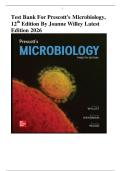
Test Bank For Prescott's Microbiology,
12th Edition By Joanne Willey Latest
Edition 2026
, 2
TABLE OF CONTENTS
1. Part one introduction to microbiology
chapter: 1. The evolution of microorganisms and microbiology
chapter: 2. Microscopy
chapter: 3. Bacterial cell structure
chapter: 4. Archaeal cell structure
chapter: 5. Eukaryotic cell structure
chapter: 6. Viruses and other acellular infectious agents
2. Part two microbial nutrition, growth, and control
chapter: 7. Bacterial and archaeal growth
chapter: 8. Control of microorganisms in the environment
chapter: 9. Antimicrobial chemotherapy
3. Part three microbial metabolism
chapter: 10. Introduction to metabolism
chapter: 11. Catabolism: energy release and conservation
chapter: 12. Anabolism: the use of energy in biosynthesis
4. Part four microbial molecular biology and genetics
chapter: 13. Bacterial genome replication and expression
chapter: 14. Regulation of cellular processes
chapter: 15. Eukaryotic and archaeal genome replication and expression
chapter: 16. Mechanisms of genetic variation
chapter: 17. Microbial dna technologies
chapter: 18. Microbial genomics
5. Part five the diversity of the microbial world
chapter: 19. Archaea
chapter: 20. Nonproteobacterial gram-negative bacteria
chapter: 21. Proteobacteria
chapter: 22. Gram-positive bacteria
chapter: 23. Protists
chapter: 24. Fungi
chapter: 25. Viruses
6. Part six ecology and symbiosis
chapter: 26. Exploring microbes in ecosystems
chapter: 27. Microbial interactions
chapter: 28. Biogeochemical cycling and global climate change
chapter: 29. Microorganisms in marine and freshwater ecosystems
chapter: 30. Microorganisms in terrestrial ecosystems
7. Part seven pathogenicity and host response
chapter: 31. Innate host resistance
chapter: 32. Adaptive immunity
chapter: 33. The microbe-human ecosystem
chapter: 34. Infection and pathogenicity
part eight microbial diseases, detection, and their control
chapter: 35. Epidemiology and public health microbiology
chapter: 36. Clinical microbiology and immunology
chapter: 37. Human diseases caused by viruses and prions
chapter: 38. Human diseases caused by bacteria
chapter: 39. Human diseases caused by fungi and protists
8. Part nine applied microbiology
chapter: 40. Microbiology of food
chapter: 41. Biotechnology and industrial microbiology
chapter: 42. Applied environmental microbiology
, 3
Prescott's microbiology, 12e (willey)
Chapter 1 the evolution of microorganisms and microbiology
1) Archaea are cellular organisms that have unique cell membrane .
ANSWER:
lipids topic:
archaea
Bloom's/accessibility: 1. Remember / keyboard navigation
asm topic: module 02 cell structure and function
Asm objective: 02.03 bacteria and archaea have specialized structures (e.g. flagella, endospores,
and pili) that often confer critical capabilities.
Learning outcome: 01.01c determine the type of microbe (e.g., bacterium, fungus, etc.) When
given a description of a newly discovered one
2) Extant microorganisms are organisms from the fossil record that are no longer present on earth
today.
ANSWER: false
Topic: taxonomy of microorganisms bloom's/accessibility:
2. Understand / keyboard navigation asm topic: module 01
evolution
Asm objective: 01.05 the evolutionary relatedness of organisms is best reflected in phylogenetic
trees.
Learning outcome: 01.02a propose a timeline of the origin and history of microbial life and
integrate supporting evidence into it
3) All cellular organisms can be placed into one of three , which include the bacteria,
archaea, and the eukarya.
ANSWER: domains
Topic: taxonomy of microorganisms bloom's/accessibility:
2. Understand / keyboard navigation asm topic: module 01
evolution
Asm objective: 01.05 the evolutionary relatedness of organisms is best reflected in phylogenetic
trees.
Learning outcome: 01.01b explain carl woeses contributions in establishing the three-domain
system for classifying cellular life
4) Viruses are not generally studied by microbiologists because they are not classified as living
organisms.
ANSWER: false
Topic: taxonomy of microorganisms
Bloom's/accessibility: 2. Understand / keyboard navigation
asm topic: module 05 microbial systems
Asm objective: 02.05 the replication cycles of viruses (lytic and lysogenic) differ among viruses
and are determined by their unique structures and genomes.
Learning outcome: 01.01a define the term microbiology
, 4
5) Microbiologists study a variety of organisms, but all are considered either bacteria or archaea.
ANSWER: false
Topic: taxonomy of microorganisms
Bloom's/accessibility: 2. Understand / keyboard navigation
asm topic: module 05 microbial systems
Asm objective: 05.04 microorganisms, cellular and viral, can interact with both human and
nonhuman hosts in beneficial, neutral or detrimental ways.
Learning outcome: 01.01a define the term microbiology
6) All eukaryotes have a membrane-delimited nucleus.
ANSWER: true
Topic: taxonomy of microorganisms bloom's/accessibility:
2. Understand / keyboard navigation asm topic: module 02
cell structure and function
Asm objective: 02.04 while microscopic eukaryotes (for example, fungi, protozoa and algae)
carry out some of the same processes as bacteria, many of the cellular properties are fundamentally
different.
Learning outcome: 01.01c determine the type of microbe (e.g., bacterium, fungus, etc.) When
given a description of a newly discovered one
7) Viruses constitute the fourth domain of life in current biological classification schemes.
ANSWER: false
Topic: taxonomy of microorganisms bloom's/accessibility:
2. Understand / keyboard navigation asm topic: module 01
evolution
Asm objective: 01.05 the evolutionary relatedness of organisms is best reflected in phylogenetic
trees.
Learning outcome: 01.01b explain carl woeses contributions in establishing the three-domain
system for classifying cellular life
8) Protists contain all of the following forms of life except .
A) Protozoa
B) Fungi
C) Slime molds
D) Algae
ANSWER: b
Topic: taxonomy of microorganisms bloom's/accessibility:
1. Remember / keyboard navigationasm
Topic: module 01 evolution
Asm objective: 01.05 the evolutionary relatedness of organisms is best reflected in phylogenetic
trees.
Learning outcome: 01.01b explain carl woeses contributions in establishing the three-domain
system for classifying cellular life
9) Cells with a relatively complex morphology that have a true membrane-delimited nucleus are
called .
Test Bank For Prescott's Microbiology,
12th Edition By Joanne Willey Latest
Edition 2026
, 2
TABLE OF CONTENTS
1. Part one introduction to microbiology
chapter: 1. The evolution of microorganisms and microbiology
chapter: 2. Microscopy
chapter: 3. Bacterial cell structure
chapter: 4. Archaeal cell structure
chapter: 5. Eukaryotic cell structure
chapter: 6. Viruses and other acellular infectious agents
2. Part two microbial nutrition, growth, and control
chapter: 7. Bacterial and archaeal growth
chapter: 8. Control of microorganisms in the environment
chapter: 9. Antimicrobial chemotherapy
3. Part three microbial metabolism
chapter: 10. Introduction to metabolism
chapter: 11. Catabolism: energy release and conservation
chapter: 12. Anabolism: the use of energy in biosynthesis
4. Part four microbial molecular biology and genetics
chapter: 13. Bacterial genome replication and expression
chapter: 14. Regulation of cellular processes
chapter: 15. Eukaryotic and archaeal genome replication and expression
chapter: 16. Mechanisms of genetic variation
chapter: 17. Microbial dna technologies
chapter: 18. Microbial genomics
5. Part five the diversity of the microbial world
chapter: 19. Archaea
chapter: 20. Nonproteobacterial gram-negative bacteria
chapter: 21. Proteobacteria
chapter: 22. Gram-positive bacteria
chapter: 23. Protists
chapter: 24. Fungi
chapter: 25. Viruses
6. Part six ecology and symbiosis
chapter: 26. Exploring microbes in ecosystems
chapter: 27. Microbial interactions
chapter: 28. Biogeochemical cycling and global climate change
chapter: 29. Microorganisms in marine and freshwater ecosystems
chapter: 30. Microorganisms in terrestrial ecosystems
7. Part seven pathogenicity and host response
chapter: 31. Innate host resistance
chapter: 32. Adaptive immunity
chapter: 33. The microbe-human ecosystem
chapter: 34. Infection and pathogenicity
part eight microbial diseases, detection, and their control
chapter: 35. Epidemiology and public health microbiology
chapter: 36. Clinical microbiology and immunology
chapter: 37. Human diseases caused by viruses and prions
chapter: 38. Human diseases caused by bacteria
chapter: 39. Human diseases caused by fungi and protists
8. Part nine applied microbiology
chapter: 40. Microbiology of food
chapter: 41. Biotechnology and industrial microbiology
chapter: 42. Applied environmental microbiology
, 3
Prescott's microbiology, 12e (willey)
Chapter 1 the evolution of microorganisms and microbiology
1) Archaea are cellular organisms that have unique cell membrane .
ANSWER:
lipids topic:
archaea
Bloom's/accessibility: 1. Remember / keyboard navigation
asm topic: module 02 cell structure and function
Asm objective: 02.03 bacteria and archaea have specialized structures (e.g. flagella, endospores,
and pili) that often confer critical capabilities.
Learning outcome: 01.01c determine the type of microbe (e.g., bacterium, fungus, etc.) When
given a description of a newly discovered one
2) Extant microorganisms are organisms from the fossil record that are no longer present on earth
today.
ANSWER: false
Topic: taxonomy of microorganisms bloom's/accessibility:
2. Understand / keyboard navigation asm topic: module 01
evolution
Asm objective: 01.05 the evolutionary relatedness of organisms is best reflected in phylogenetic
trees.
Learning outcome: 01.02a propose a timeline of the origin and history of microbial life and
integrate supporting evidence into it
3) All cellular organisms can be placed into one of three , which include the bacteria,
archaea, and the eukarya.
ANSWER: domains
Topic: taxonomy of microorganisms bloom's/accessibility:
2. Understand / keyboard navigation asm topic: module 01
evolution
Asm objective: 01.05 the evolutionary relatedness of organisms is best reflected in phylogenetic
trees.
Learning outcome: 01.01b explain carl woeses contributions in establishing the three-domain
system for classifying cellular life
4) Viruses are not generally studied by microbiologists because they are not classified as living
organisms.
ANSWER: false
Topic: taxonomy of microorganisms
Bloom's/accessibility: 2. Understand / keyboard navigation
asm topic: module 05 microbial systems
Asm objective: 02.05 the replication cycles of viruses (lytic and lysogenic) differ among viruses
and are determined by their unique structures and genomes.
Learning outcome: 01.01a define the term microbiology
, 4
5) Microbiologists study a variety of organisms, but all are considered either bacteria or archaea.
ANSWER: false
Topic: taxonomy of microorganisms
Bloom's/accessibility: 2. Understand / keyboard navigation
asm topic: module 05 microbial systems
Asm objective: 05.04 microorganisms, cellular and viral, can interact with both human and
nonhuman hosts in beneficial, neutral or detrimental ways.
Learning outcome: 01.01a define the term microbiology
6) All eukaryotes have a membrane-delimited nucleus.
ANSWER: true
Topic: taxonomy of microorganisms bloom's/accessibility:
2. Understand / keyboard navigation asm topic: module 02
cell structure and function
Asm objective: 02.04 while microscopic eukaryotes (for example, fungi, protozoa and algae)
carry out some of the same processes as bacteria, many of the cellular properties are fundamentally
different.
Learning outcome: 01.01c determine the type of microbe (e.g., bacterium, fungus, etc.) When
given a description of a newly discovered one
7) Viruses constitute the fourth domain of life in current biological classification schemes.
ANSWER: false
Topic: taxonomy of microorganisms bloom's/accessibility:
2. Understand / keyboard navigation asm topic: module 01
evolution
Asm objective: 01.05 the evolutionary relatedness of organisms is best reflected in phylogenetic
trees.
Learning outcome: 01.01b explain carl woeses contributions in establishing the three-domain
system for classifying cellular life
8) Protists contain all of the following forms of life except .
A) Protozoa
B) Fungi
C) Slime molds
D) Algae
ANSWER: b
Topic: taxonomy of microorganisms bloom's/accessibility:
1. Remember / keyboard navigationasm
Topic: module 01 evolution
Asm objective: 01.05 the evolutionary relatedness of organisms is best reflected in phylogenetic
trees.
Learning outcome: 01.01b explain carl woeses contributions in establishing the three-domain
system for classifying cellular life
9) Cells with a relatively complex morphology that have a true membrane-delimited nucleus are
called .


