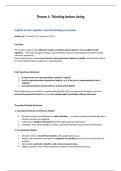
Theme 1: Thinking before doing
Implicit Social Cognition and Mental Representation
Authors: B. K. Payne & C.D. Cameron (2013)
Core Idea
This chapter explores how different models of mental representation explain implicit social
cognition — the ways thoughts, feelings, and evaluations operate automatically and often outside
conscious awareness.
Payne and Cameron analyse how mental content becomes implicit or explicit, and what this means
for understanding biases, judgments, and behaviours.
Main Questions Addressed
1. In what sense are representations implicit or explicit?
2. Are the representations themselves implicit, or is it the use of representations that is
implicit?
3. Are representations permanently or temporarily implicit?
These distinctions are crucial for understanding whether bias and automatic thought come from
unconscious mental structures or from how people apply knowledge without awareness.
Theoretical Models Reviewed
1. Associative Network and Schema Models
Describe memory and attitudes as nodes and links — activation spreads automatically when
related concepts are triggered.
Capture how implicit associations form through repeated experiences.
Limitation: treat all knowledge as similar, ignoring emotional and procedural distinctions.
2. Connectionist Models
View the mind as neural-like networks with parallel processing.
Implicit representations emerge from patterns of activation across units, not from discrete
symbols.
Best explain automatic, intuitive, and unconscious processes.
Explicit cognition arises when activation surpasses a threshold of awareness.
,3. Memory Systems Model (Amodio, 2008)
Proposes multiple memory systems:
o Semantic associative system (facts, meanings)
o Affective memory system (emotions, evaluations)
o Procedural system (skills, habits)
Helps explain why implicit evaluations (feelings) and stereotypes (beliefs) can operate
independently.
4. Embodied Cognition
Mental representations are grounded in bodily states and sensory experiences.
“Thinking is for doing” — cognition is inseparable from action and perception.
Emphasizes that implicit processes are context-sensitive and physical, not purely abstract.
5. Situated Cognition
Extends embodiment by including environmental and contextual factors.
Mental representations emerge from dynamic interactions between brain, body, and
surroundings.
Implies that implicitness is not fixed but depends on the situation and attention.
6. Multiple-Format Models
Suggest different forms of representation (visual, verbal, affective, motor) coexist and
interact.
Lower-level representations (affective, motor) are less accessible to consciousness, while
higher-level ones (verbal, visual) can more easily become explicit.
Emerging Themes
Implicitness as a property:
Some representations are inherently unconscious (e.g., motor habits).
Implicitness as a process:
The same knowledge can be used implicitly or explicitly depending on attention and control
(e.g., stereotypes influencing behavior automatically).
Temporary vs. permanent implicitness:
Some representations can shift into awareness (like noticing your breathing), while others
(like brainstem regulation) can never be conscious.
,Self-Inference and Attributional Models
People infer their own mental states from behavior and context, rather than directly
accessing them (Nisbett & Wilson, 1977).
Implicitness may result from how people interpret their own thoughts — they misattribute
influences as self-generated or external.
For example, in the Affect Misattribution Procedure (Payne et al., 2005), participants
unknowingly project emotional reactions from one stimulus onto another.
Key Takeaways
Implicit cognition arises not only from unconscious structures but also from how and when
representations are used without awareness.
Different systems (affective, semantic, procedural) explain different types of implicit thought
and behavior.
The distinction between implicit and explicit cognition is fluid, influenced by attention,
control, and context.
Understanding these distinctions helps clarify how biases and automatic responses operate
and how they might be changed.
Practical Implications
Implicit biases can be addressed either by making representations conscious (awareness
training) or by changing automatic use (habit and context modification).
Models of embodiment and situated cognition suggest that contextual cues, bodily states,
and attention can powerfully shape implicit processing.
Summary in One Sentence
Payne and Cameron (2013) argue that implicit social cognition is best understood as a dynamic,
multi-system process, where whether something is implicit or explicit depends on both the nature of
the representation and how it’s used — not a simple on/off state of consciousness.
, Reflective and Impulsive Determinants of Social Behaviour: A Theoretical
Model
Authors: F. Strack & R. Deutsch (2004)
Core Idea
Strack and Deutsch propose the Reflective–Impulsive Model (RIM), a dual-process theory explaining
how behavior results from the interaction between two systems:
1. a reflective system that is deliberate, analytical, and conscious, and
2. an impulsive system that is associative, automatic, and unconscious.
The model provides a unified framework for understanding why people often act against their
intentions, especially in areas like prejudice, dieting, or addiction.
Structure of the Model
System Characteristics Functions Basis of Operation
Reflective Slow, controlled, Symbolic representations
Plans, intentions, evaluations
System conscious (propositions, rules)
Impulsive Fast, automatic, Drives behavior through Associative links between
System unconscious associative activation concepts and affect
The Reflective System
Represents knowledge and goals symbolically (e.g., “Smoking is unhealthy”).
Engages in rule-based reasoning and if–then planning.
Requires working memory capacity and motivation to operate.
Central to intentional action and self-control.
Example: You consciously decide to eat healthy because you want to improve fitness.
The Impulsive System
Represents knowledge as associations between perceptual and affective features (e.g., “cake
= pleasure”).
Activation spreads automatically upon cue detection.
Behaviour follows the strength and accessibility of associations rather than conscious
reasoning.
Strongly influenced by situational cues, emotions, and learned habits.
Example: You see cake, automatically salivate, and take a bite before thinking.
Implicit Social Cognition and Mental Representation
Authors: B. K. Payne & C.D. Cameron (2013)
Core Idea
This chapter explores how different models of mental representation explain implicit social
cognition — the ways thoughts, feelings, and evaluations operate automatically and often outside
conscious awareness.
Payne and Cameron analyse how mental content becomes implicit or explicit, and what this means
for understanding biases, judgments, and behaviours.
Main Questions Addressed
1. In what sense are representations implicit or explicit?
2. Are the representations themselves implicit, or is it the use of representations that is
implicit?
3. Are representations permanently or temporarily implicit?
These distinctions are crucial for understanding whether bias and automatic thought come from
unconscious mental structures or from how people apply knowledge without awareness.
Theoretical Models Reviewed
1. Associative Network and Schema Models
Describe memory and attitudes as nodes and links — activation spreads automatically when
related concepts are triggered.
Capture how implicit associations form through repeated experiences.
Limitation: treat all knowledge as similar, ignoring emotional and procedural distinctions.
2. Connectionist Models
View the mind as neural-like networks with parallel processing.
Implicit representations emerge from patterns of activation across units, not from discrete
symbols.
Best explain automatic, intuitive, and unconscious processes.
Explicit cognition arises when activation surpasses a threshold of awareness.
,3. Memory Systems Model (Amodio, 2008)
Proposes multiple memory systems:
o Semantic associative system (facts, meanings)
o Affective memory system (emotions, evaluations)
o Procedural system (skills, habits)
Helps explain why implicit evaluations (feelings) and stereotypes (beliefs) can operate
independently.
4. Embodied Cognition
Mental representations are grounded in bodily states and sensory experiences.
“Thinking is for doing” — cognition is inseparable from action and perception.
Emphasizes that implicit processes are context-sensitive and physical, not purely abstract.
5. Situated Cognition
Extends embodiment by including environmental and contextual factors.
Mental representations emerge from dynamic interactions between brain, body, and
surroundings.
Implies that implicitness is not fixed but depends on the situation and attention.
6. Multiple-Format Models
Suggest different forms of representation (visual, verbal, affective, motor) coexist and
interact.
Lower-level representations (affective, motor) are less accessible to consciousness, while
higher-level ones (verbal, visual) can more easily become explicit.
Emerging Themes
Implicitness as a property:
Some representations are inherently unconscious (e.g., motor habits).
Implicitness as a process:
The same knowledge can be used implicitly or explicitly depending on attention and control
(e.g., stereotypes influencing behavior automatically).
Temporary vs. permanent implicitness:
Some representations can shift into awareness (like noticing your breathing), while others
(like brainstem regulation) can never be conscious.
,Self-Inference and Attributional Models
People infer their own mental states from behavior and context, rather than directly
accessing them (Nisbett & Wilson, 1977).
Implicitness may result from how people interpret their own thoughts — they misattribute
influences as self-generated or external.
For example, in the Affect Misattribution Procedure (Payne et al., 2005), participants
unknowingly project emotional reactions from one stimulus onto another.
Key Takeaways
Implicit cognition arises not only from unconscious structures but also from how and when
representations are used without awareness.
Different systems (affective, semantic, procedural) explain different types of implicit thought
and behavior.
The distinction between implicit and explicit cognition is fluid, influenced by attention,
control, and context.
Understanding these distinctions helps clarify how biases and automatic responses operate
and how they might be changed.
Practical Implications
Implicit biases can be addressed either by making representations conscious (awareness
training) or by changing automatic use (habit and context modification).
Models of embodiment and situated cognition suggest that contextual cues, bodily states,
and attention can powerfully shape implicit processing.
Summary in One Sentence
Payne and Cameron (2013) argue that implicit social cognition is best understood as a dynamic,
multi-system process, where whether something is implicit or explicit depends on both the nature of
the representation and how it’s used — not a simple on/off state of consciousness.
, Reflective and Impulsive Determinants of Social Behaviour: A Theoretical
Model
Authors: F. Strack & R. Deutsch (2004)
Core Idea
Strack and Deutsch propose the Reflective–Impulsive Model (RIM), a dual-process theory explaining
how behavior results from the interaction between two systems:
1. a reflective system that is deliberate, analytical, and conscious, and
2. an impulsive system that is associative, automatic, and unconscious.
The model provides a unified framework for understanding why people often act against their
intentions, especially in areas like prejudice, dieting, or addiction.
Structure of the Model
System Characteristics Functions Basis of Operation
Reflective Slow, controlled, Symbolic representations
Plans, intentions, evaluations
System conscious (propositions, rules)
Impulsive Fast, automatic, Drives behavior through Associative links between
System unconscious associative activation concepts and affect
The Reflective System
Represents knowledge and goals symbolically (e.g., “Smoking is unhealthy”).
Engages in rule-based reasoning and if–then planning.
Requires working memory capacity and motivation to operate.
Central to intentional action and self-control.
Example: You consciously decide to eat healthy because you want to improve fitness.
The Impulsive System
Represents knowledge as associations between perceptual and affective features (e.g., “cake
= pleasure”).
Activation spreads automatically upon cue detection.
Behaviour follows the strength and accessibility of associations rather than conscious
reasoning.
Strongly influenced by situational cues, emotions, and learned habits.
Example: You see cake, automatically salivate, and take a bite before thinking.