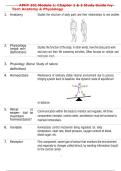
APHY 201 Module 1: Chapter 1 & 3 Study Guide Ivy
Tech Anatomy & Physiology
1. Anatomy Studies the structure of body parts and their relationships to one another.
2. Physiology
(mod- ern Studies the function of the body, in other words, how the body parts work
definition) and carry out their life sustaining activities. Often focuses on cellular and
molecular level.
3. Physiology (literal Study of nature
definition)
4. Homeostasis Maintenance of relatively stable internal environment due to process
bringing system back to baseline. Aka dynamic state of equilibrium
or balance.
5. What is
essen- tial to Communication within the body to monitor and regulate. All three
maintain components (receptor, control center, and ettector) must be functional to
homeostasis? maintain homeostasis.
6. Variable Homeostasis control mechanism being regulated. Ex: body
temperature, heart rate, blood pressure, oxygen content of blood,
blood sugar, etc.
7. Receptor First component: some type of sensor that monitors the environment
and responds to changes called stimuli, by sending information (input)
to the control center.
1/
17
, APHY 201 Module 1: Chapter 1 & 3 Study Guide Ivy
Tech Anatomy & Physiology
8. Control center Second component: receives information (input) from the receptor along
the
atterent pathway. Determines the set point, which is the level or range
at which a variable is to be maintained.
2/
17
, APHY 201 Module 1: Chapter 1 & 3 Study Guide Ivy
Tech Anatomy & Physiology
9. Effector Third component: receives information (output) from the control center
along the etterent pathway. Provides the means for the control centers
response (output) to the stimulus.
10. Afferent Approaches the control center (monitors)
11. Efferent Exits the control center (issues orders to muscles or glands)
12. Negative
feed- back The output shuts ott the original ettect of the stimulus or reduces its
intensity. Causes the variable to change in a direction opposite to that of
the initial change, returning to its ideal value. If too fast, then slows. If hot,
13. Body
tempera- ture then cools.
and blood
sugar are Negative feedback mechanism
regu- lated by
what?
14. Main goal for
negative
feed- back To prevent sudden severe changes within the body.
mecha-
nisms?
15. Positive
feedback
mechanisms
The response enhances or reinforces the original stimulus so that the
response is accelerated. The change that results proceeds in the same
direction as the initial change, causing the variable to deviate further
16. Positive and further from its original set point.
feedback
Infrequent events that do not require continuous adjustments. Often
referred to
mechanisms con- as cascades. Ex: labor contractions and blood clotting.
trol...
17. 3 major parts of a cell membrane, cytoplasm, nucleus
3/
17
Tech Anatomy & Physiology
1. Anatomy Studies the structure of body parts and their relationships to one another.
2. Physiology
(mod- ern Studies the function of the body, in other words, how the body parts work
definition) and carry out their life sustaining activities. Often focuses on cellular and
molecular level.
3. Physiology (literal Study of nature
definition)
4. Homeostasis Maintenance of relatively stable internal environment due to process
bringing system back to baseline. Aka dynamic state of equilibrium
or balance.
5. What is
essen- tial to Communication within the body to monitor and regulate. All three
maintain components (receptor, control center, and ettector) must be functional to
homeostasis? maintain homeostasis.
6. Variable Homeostasis control mechanism being regulated. Ex: body
temperature, heart rate, blood pressure, oxygen content of blood,
blood sugar, etc.
7. Receptor First component: some type of sensor that monitors the environment
and responds to changes called stimuli, by sending information (input)
to the control center.
1/
17
, APHY 201 Module 1: Chapter 1 & 3 Study Guide Ivy
Tech Anatomy & Physiology
8. Control center Second component: receives information (input) from the receptor along
the
atterent pathway. Determines the set point, which is the level or range
at which a variable is to be maintained.
2/
17
, APHY 201 Module 1: Chapter 1 & 3 Study Guide Ivy
Tech Anatomy & Physiology
9. Effector Third component: receives information (output) from the control center
along the etterent pathway. Provides the means for the control centers
response (output) to the stimulus.
10. Afferent Approaches the control center (monitors)
11. Efferent Exits the control center (issues orders to muscles or glands)
12. Negative
feed- back The output shuts ott the original ettect of the stimulus or reduces its
intensity. Causes the variable to change in a direction opposite to that of
the initial change, returning to its ideal value. If too fast, then slows. If hot,
13. Body
tempera- ture then cools.
and blood
sugar are Negative feedback mechanism
regu- lated by
what?
14. Main goal for
negative
feed- back To prevent sudden severe changes within the body.
mecha-
nisms?
15. Positive
feedback
mechanisms
The response enhances or reinforces the original stimulus so that the
response is accelerated. The change that results proceeds in the same
direction as the initial change, causing the variable to deviate further
16. Positive and further from its original set point.
feedback
Infrequent events that do not require continuous adjustments. Often
referred to
mechanisms con- as cascades. Ex: labor contractions and blood clotting.
trol...
17. 3 major parts of a cell membrane, cytoplasm, nucleus
3/
17