Psychology AO1 AO3 Essay Plan (eval)
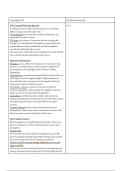
The Central Nervous System None
It collects processes and stores information. It coordinates
different organs and cells in the body.
The spinal cord is the tube-like extension of the brain, it is
responsible for reflex actions.
The brain is the source of conscious decision making and
thoughts. It is divided into 2 hemispheres connected by the
corpus callosum and is contralateral, the left hemisphere
controls the right side and vice versa.
The outer layer of the brain is the cerebral cortex and is divided
into cortical and subcortical (below the cortex)
Subcortical Structures
Thalamus acts as a filter of information, it’s the brain’s relay
station to send information to their respective higher level
processing areas. It is thought to have a factor on sleep,
wakefulness.
Hypothalamus controls motivational behaviours like thirst, sex
and hunger, as well as triggering fight or flight responses to
stress stimuli in the environment. It also regulates the body
temperature and the endocrine system.
The Limbic system is a series of structures involved in
emotional regulation. This includes the amygdala, that has a
ripple in memory and learning with aggression.
Cerebellum coordinates posture, balance and movement.
Integrates information from the spinal cord with other cortical
and subcortical structures. It contains 50% of the brain’s
neurons.
Corpus Callosum is the structure that connects the two
hemispheres, it has a major role in contralateral control of the
limbs, because it connects both sides of the brain.
The Cerebral Cortex
Both hemispheres are subdivided into four lobes. There are 8
lobes in total because of the 2 cerebral cortexes, one in each
hemisphere.
Frontal Lobe
The frontal lobe controls high level cognitive functions like
decision making, planning and problem solving. They contain
the motor cortex that controls voluntary movement.
Parietal Lobe (Pie! yummy tasting, smells delicious, hot and
crispy to touch)
This cortex controls sensory information. It manages input of
sensory information from other parts of the body like the skin
, and touch. It is the hub for touch, scent, taste, temperature,
pressure etc. It contains the somatosensory cortex, which
processes temperature pressure.
Temporal Lobe (tempora is crunchy → sound ah!)
It is an auditory cortex that controls auditory information and
has a role in understanding language.
Occipital lobe (looks and sounds like optical)
Visual cortex, visual information is processed here.
Language areas
Broca's area controls slow laborious speech
Wernicke's area controls understanding of language, patients
suffering from this damage produce fluent but meaningless
speech.
Neurotransmitters and synaptic transmission. None
Neurons are nerve cells that make up the nervous system. They
are made up of the axon, dendrites that stick out of both ends
of the neuron and assist cell to cell transmission. The myelin
sheath covers the axon, insulating it and speeding up the rate of
transmission across the nodes of Ranvier. There are three types
of neuron, 1 is motor neuron, 2 is relay neuron and 3 is sensory
neuron.
When a neuron is at resting potential, the inside of the cell is
negatively charged compared to the positive charge of the
extracellular environment, this polarisation. When a stimulus
arrives, this increases the charge inside the cell, causing
depolarisation where an action potential can be fired to be
transmitted to the next neuron.
Synaptic transmission
The synapse is a gap between the two neurons where
neurotransmitters diffuse through. When the action potential
reaches the end of the cell, it triggers the presynaptic vesicles to
release neurotransmitters that diffuse across the synaptic cleft.
These chemical messengers bind to their respective receptors on
the post synapse. These cause another action potential to fire in
the post neuron. These neurotransmitters are then broken
down and reuptaken to be reused.
Excitation and inhibition. Some neurotransmitters trigger
excitatory action which causes another action potential to be
fired. But some have inhibitory action, where they block the
action potential from firing. If there are more action potentials
targeting one post neuron, their effects are added up and the
excitatory or inhibitory effect becomes stronger.
The Central Nervous System None
It collects processes and stores information. It coordinates
different organs and cells in the body.
The spinal cord is the tube-like extension of the brain, it is
responsible for reflex actions.
The brain is the source of conscious decision making and
thoughts. It is divided into 2 hemispheres connected by the
corpus callosum and is contralateral, the left hemisphere
controls the right side and vice versa.
The outer layer of the brain is the cerebral cortex and is divided
into cortical and subcortical (below the cortex)
Subcortical Structures
Thalamus acts as a filter of information, it’s the brain’s relay
station to send information to their respective higher level
processing areas. It is thought to have a factor on sleep,
wakefulness.
Hypothalamus controls motivational behaviours like thirst, sex
and hunger, as well as triggering fight or flight responses to
stress stimuli in the environment. It also regulates the body
temperature and the endocrine system.
The Limbic system is a series of structures involved in
emotional regulation. This includes the amygdala, that has a
ripple in memory and learning with aggression.
Cerebellum coordinates posture, balance and movement.
Integrates information from the spinal cord with other cortical
and subcortical structures. It contains 50% of the brain’s
neurons.
Corpus Callosum is the structure that connects the two
hemispheres, it has a major role in contralateral control of the
limbs, because it connects both sides of the brain.
The Cerebral Cortex
Both hemispheres are subdivided into four lobes. There are 8
lobes in total because of the 2 cerebral cortexes, one in each
hemisphere.
Frontal Lobe
The frontal lobe controls high level cognitive functions like
decision making, planning and problem solving. They contain
the motor cortex that controls voluntary movement.
Parietal Lobe (Pie! yummy tasting, smells delicious, hot and
crispy to touch)
This cortex controls sensory information. It manages input of
sensory information from other parts of the body like the skin
, and touch. It is the hub for touch, scent, taste, temperature,
pressure etc. It contains the somatosensory cortex, which
processes temperature pressure.
Temporal Lobe (tempora is crunchy → sound ah!)
It is an auditory cortex that controls auditory information and
has a role in understanding language.
Occipital lobe (looks and sounds like optical)
Visual cortex, visual information is processed here.
Language areas
Broca's area controls slow laborious speech
Wernicke's area controls understanding of language, patients
suffering from this damage produce fluent but meaningless
speech.
Neurotransmitters and synaptic transmission. None
Neurons are nerve cells that make up the nervous system. They
are made up of the axon, dendrites that stick out of both ends
of the neuron and assist cell to cell transmission. The myelin
sheath covers the axon, insulating it and speeding up the rate of
transmission across the nodes of Ranvier. There are three types
of neuron, 1 is motor neuron, 2 is relay neuron and 3 is sensory
neuron.
When a neuron is at resting potential, the inside of the cell is
negatively charged compared to the positive charge of the
extracellular environment, this polarisation. When a stimulus
arrives, this increases the charge inside the cell, causing
depolarisation where an action potential can be fired to be
transmitted to the next neuron.
Synaptic transmission
The synapse is a gap between the two neurons where
neurotransmitters diffuse through. When the action potential
reaches the end of the cell, it triggers the presynaptic vesicles to
release neurotransmitters that diffuse across the synaptic cleft.
These chemical messengers bind to their respective receptors on
the post synapse. These cause another action potential to fire in
the post neuron. These neurotransmitters are then broken
down and reuptaken to be reused.
Excitation and inhibition. Some neurotransmitters trigger
excitatory action which causes another action potential to be
fired. But some have inhibitory action, where they block the
action potential from firing. If there are more action potentials
targeting one post neuron, their effects are added up and the
excitatory or inhibitory effect becomes stronger.