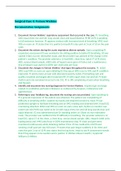
Master the ABO blood group system with this clear and exam-focused study guide! Learn
how Karl Landsteiner’s 1901 discovery shaped modern transfusion medicine, explore the
genetic basis of A, B, and H antigens, and understand key concepts like A1 vs. A2
subgroups, the Bombay phenotype, forward vs. reverse typing, ABO discrepancies, and
acquired B antigen.
This guide also explains the role of naturally occurring antibodies, clinical dangers of weak
subgroups, and the timeline of antibody development in infants.
Designed for medical laboratory, nursing, and medical students, this resource is written
in simple, student-friendly language with exam relevance in mind. Perfect for quick
revision, self-study, or clinical preparation!
Precursor
ubstance
stays the same
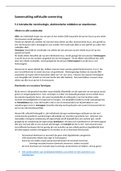
, Karl Landsteiner was a pioneer who truly opened the doors of blood banking. His primary
contribution in 1901 was the discovery of the first human blood group system, ABO. This
discovery explained the serious reactions that occur in humans because of incompatible
transfusions.
The H gene elicits the production of alpha-2-L-fucosyltransferase, which adds the
immunodominant sugar L-fucose to a precursor chain to create the H substance. The A
and B genes then code for specific transferase enzymes that attach their respective
immunodominant sugars to the H substance. These immunodominant sugars are N-
acetylgalactosamine for A specificity and D-galactose for B specificity.
Precursor
ubstance
stays the same
how Karl Landsteiner’s 1901 discovery shaped modern transfusion medicine, explore the
genetic basis of A, B, and H antigens, and understand key concepts like A1 vs. A2
subgroups, the Bombay phenotype, forward vs. reverse typing, ABO discrepancies, and
acquired B antigen.
This guide also explains the role of naturally occurring antibodies, clinical dangers of weak
subgroups, and the timeline of antibody development in infants.
Designed for medical laboratory, nursing, and medical students, this resource is written
in simple, student-friendly language with exam relevance in mind. Perfect for quick
revision, self-study, or clinical preparation!
Precursor
ubstance
stays the same
, Karl Landsteiner was a pioneer who truly opened the doors of blood banking. His primary
contribution in 1901 was the discovery of the first human blood group system, ABO. This
discovery explained the serious reactions that occur in humans because of incompatible
transfusions.
The H gene elicits the production of alpha-2-L-fucosyltransferase, which adds the
immunodominant sugar L-fucose to a precursor chain to create the H substance. The A
and B genes then code for specific transferase enzymes that attach their respective
immunodominant sugars to the H substance. These immunodominant sugars are N-
acetylgalactosamine for A specificity and D-galactose for B specificity.
Precursor
ubstance
stays the same