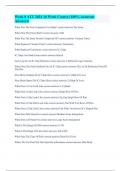
Nur 1060 exam 1 Ch. 1, 2, 3, 4 , 8, 9, 10, 11 ,13, 14, 44
With complete solu on RATED A+ 2025/2026 UPDATED
100% VERIFIED CORRECT
What is the difference between Subjec ve and Objec ve data?
Subjec ve Data- what the pt feels/ selfs report
Objec ve Data- what you can observe and measure
PAIN WILL ALWAYS BE SUBJECTIVE
PT COMPLAINT WILL ALWAYS BE SUBJECTIVE
What is Database?
A collec on of informa on such as health history and physical examina on of a pa ent
The ability to integrate mul ple data sources and thinkinh strage es during a pa ent encounter
to accurately iden fy diagnoses and implememnt appropriate management plans.
Dianos c Reasoning
What is. CUE?
A CUE is a peice of informa on, a sign, or symptom, or a peie of lab data
An indirect signal that a pa ent uses to try to alert the doctor to a ques on or concern
An uncertain explana on for a cue or a set of cues that can be used as a basis for further
inves ga on
Hypothesis
What is the Nursing Process?
The standrards of nursing prac ce that consists of ADOPIE
Who is considered a Novice Nurse?
The novice nurse needs rules to guide performance
3 mul ple choice op ons
,Whos is considered a Proficient nurse?
The proficient nurse understands a pa ent situa on as a whole rather than as a list of tasks.
3 mul ple choice op ons
Who is considered an Expert Nurse?
The expert nurse vaults over these steps and arrives at a clinical judgment in one leap.
3 mul ple choice op ons
Emergent, life-threatening, immediate illnesses (establishing an airway or suppor ng breathing)
are example of ________________ priority problems
First Priority Problems
Example: Emergency Room
Next in urgency; require prompt interven on to avoid further deteriora on (mental status
change, acute pain, acute urinary elimina on problems, untreated medical problems, abnormal
laboratory values, risks of infec on, risk to safety or security)
Secondary Priority Problems
Example: Urgent Care
Important to the pa ent's health but can be a6ended to a7er more urgent health problems are
addressed. Require long-term interven ons and response might take more me. These
problems might require collabora ve effort between the pa ent and healthcare professionals.
Third Priority Problems
Example: PCP
The nurse has a "hunch" that the pa ent's elevated blood pressure is due to pain level;
however, the pa ent received blood pressure and pain medica on 45 minutes ago. What should
the nurse consider in regard to this hunch?
1.Research supports that the pain and blood pressure medica ons will take 30 minutes to
become effec ve. The nurse should wait un l the next prescribed me and reevaluate pain
level.
2.The nurse should consider consul ng with the pain management team to evaluate the
effec veness of the pain medica on regimen.
3.The nurse should disregard the hunch because hunches are not effec ve at incorpora ng
, evidence-based prac ces.
4.The nurse should administer pain medica on based on the hunch.
1. The correct answer is 2. The nurse should trust the hunch; however, having another
member of the team substan ate the hunch would be a collabora ve approach and would
provide addi onal reinforcement for the hunch.
2. Op on 1 is incorrect because a pa ent’s clinical status is unique and may not fit a textbook
defini on.
3. Op on 3 is incorrect because to disregard a hunch would be to disregard an important
component of cri cal thinking and an opportunity to add to evidence-based prac ce.
4. Op on 4 is incorrect because the hunch is not enough to act on, and no informa on
regarding the next appropriate me is given in this scenario.
Holis c
Holis c health is an approach to wellness that simultaneously addresses the physical, mental,
emo onal, social, and spiritual components of health.
The five steps to EBP are:
1.Ask the clinical ques on
2.Acquire sources of evidence
3.Appraise and synthesize evidence
4.Apply relevant evidence in prac ce, and assess the outcomes.
5.Access the outcome (GI bowel sounds vs. flatus/bowel movement example)
Describes current and past health state and forms baseline to measure all future changes.
Complete Total Health Base
Status of all iden fied problems should be evaluated at regular and appropriate intervals.
Follow-up data base
Rapid collec on of data o7en compiled concurrently with lifesaving measures.
Emergency Data Base
A nurse working in the emergency department triage wants to apply principles of priority
seDng with regard to an organiza onal framework for delivery of care.
With complete solu on RATED A+ 2025/2026 UPDATED
100% VERIFIED CORRECT
What is the difference between Subjec ve and Objec ve data?
Subjec ve Data- what the pt feels/ selfs report
Objec ve Data- what you can observe and measure
PAIN WILL ALWAYS BE SUBJECTIVE
PT COMPLAINT WILL ALWAYS BE SUBJECTIVE
What is Database?
A collec on of informa on such as health history and physical examina on of a pa ent
The ability to integrate mul ple data sources and thinkinh strage es during a pa ent encounter
to accurately iden fy diagnoses and implememnt appropriate management plans.
Dianos c Reasoning
What is. CUE?
A CUE is a peice of informa on, a sign, or symptom, or a peie of lab data
An indirect signal that a pa ent uses to try to alert the doctor to a ques on or concern
An uncertain explana on for a cue or a set of cues that can be used as a basis for further
inves ga on
Hypothesis
What is the Nursing Process?
The standrards of nursing prac ce that consists of ADOPIE
Who is considered a Novice Nurse?
The novice nurse needs rules to guide performance
3 mul ple choice op ons
,Whos is considered a Proficient nurse?
The proficient nurse understands a pa ent situa on as a whole rather than as a list of tasks.
3 mul ple choice op ons
Who is considered an Expert Nurse?
The expert nurse vaults over these steps and arrives at a clinical judgment in one leap.
3 mul ple choice op ons
Emergent, life-threatening, immediate illnesses (establishing an airway or suppor ng breathing)
are example of ________________ priority problems
First Priority Problems
Example: Emergency Room
Next in urgency; require prompt interven on to avoid further deteriora on (mental status
change, acute pain, acute urinary elimina on problems, untreated medical problems, abnormal
laboratory values, risks of infec on, risk to safety or security)
Secondary Priority Problems
Example: Urgent Care
Important to the pa ent's health but can be a6ended to a7er more urgent health problems are
addressed. Require long-term interven ons and response might take more me. These
problems might require collabora ve effort between the pa ent and healthcare professionals.
Third Priority Problems
Example: PCP
The nurse has a "hunch" that the pa ent's elevated blood pressure is due to pain level;
however, the pa ent received blood pressure and pain medica on 45 minutes ago. What should
the nurse consider in regard to this hunch?
1.Research supports that the pain and blood pressure medica ons will take 30 minutes to
become effec ve. The nurse should wait un l the next prescribed me and reevaluate pain
level.
2.The nurse should consider consul ng with the pain management team to evaluate the
effec veness of the pain medica on regimen.
3.The nurse should disregard the hunch because hunches are not effec ve at incorpora ng
, evidence-based prac ces.
4.The nurse should administer pain medica on based on the hunch.
1. The correct answer is 2. The nurse should trust the hunch; however, having another
member of the team substan ate the hunch would be a collabora ve approach and would
provide addi onal reinforcement for the hunch.
2. Op on 1 is incorrect because a pa ent’s clinical status is unique and may not fit a textbook
defini on.
3. Op on 3 is incorrect because to disregard a hunch would be to disregard an important
component of cri cal thinking and an opportunity to add to evidence-based prac ce.
4. Op on 4 is incorrect because the hunch is not enough to act on, and no informa on
regarding the next appropriate me is given in this scenario.
Holis c
Holis c health is an approach to wellness that simultaneously addresses the physical, mental,
emo onal, social, and spiritual components of health.
The five steps to EBP are:
1.Ask the clinical ques on
2.Acquire sources of evidence
3.Appraise and synthesize evidence
4.Apply relevant evidence in prac ce, and assess the outcomes.
5.Access the outcome (GI bowel sounds vs. flatus/bowel movement example)
Describes current and past health state and forms baseline to measure all future changes.
Complete Total Health Base
Status of all iden fied problems should be evaluated at regular and appropriate intervals.
Follow-up data base
Rapid collec on of data o7en compiled concurrently with lifesaving measures.
Emergency Data Base
A nurse working in the emergency department triage wants to apply principles of priority
seDng with regard to an organiza onal framework for delivery of care.