Social Influence
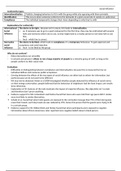
Conformity types:
Internationalisation Publicly changing behaviour to fit in with the group while also agreeing with them privately
identification This occurs when someone conforms to the demands of a given social role in society ex. policeman
Compliance The individual temporarily changes their views depending on who they’re with
Explanations for conformity:
Informational The desire to be right, because we’re unsure, this leads to internalisation.
Social o ex. if someone was to go to a posh restaurant for the first time, they may be confronted with several
Influence forks and not know which one to use, so they might look to a nearby person to see what fork to use
first.
o Asch - which line is correct
Normative The desire to be liked, which leads to compliance, it’s a temporary behaviour. To gain approval and
social acceptance and avoid rejection.
Influence o Asch - to be liked by the group
Why do we conform?
- Helps interactions run smoothly
- In schools and prisons it allows to run a large majority of people by a minority group of staff, as long as the
people conform to their social roles
Evaluation:
- Difficulties in distinguishing between compliance and internalisation, because this is measured by how an
individual defines and measures public acceptance.
- Overlap between the effects of the two types of social influence; we often look to others for information, but
partly because we do not want to be different
- NSI may not be detected: Nolan et al 2008 investigated whether people detected the influence of social norms
on their energy conservation, people believed that the behaviour of neighbours had the least impact, yet results
show otherwise.
- Explanation of ISI: features of the task moderate the impact of majority influence, like objectivity isn’t certain
and therefore don’t prove anything.
+ Evidence support for NSI: Linkenbach and Perkins found that teens who were told their age peers didn’t smoke
were less likely to smoke themselves.
+ Schultz et al. found that when hotel guests are exposed to the normative message that 75% of the hotel guests
reuse their towels, each day towel use was reduced by 25%, hence this proves that the guests were trying to fit
in a certain group.
+ Evidence support for ISI: Witten Brink and Henley found that when participants were exposed to negative
information about African Americans, later reported more negative beliefs about a black person.
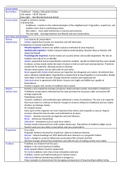
Conformity types:
Internationalisation Publicly changing behaviour to fit in with the group while also agreeing with them privately
identification This occurs when someone conforms to the demands of a given social role in society ex. policeman
Compliance The individual temporarily changes their views depending on who they’re with
Explanations for conformity:
Informational The desire to be right, because we’re unsure, this leads to internalisation.
Social o ex. if someone was to go to a posh restaurant for the first time, they may be confronted with several
Influence forks and not know which one to use, so they might look to a nearby person to see what fork to use
first.
o Asch - which line is correct
Normative The desire to be liked, which leads to compliance, it’s a temporary behaviour. To gain approval and
social acceptance and avoid rejection.
Influence o Asch - to be liked by the group
Why do we conform?
- Helps interactions run smoothly
- In schools and prisons it allows to run a large majority of people by a minority group of staff, as long as the
people conform to their social roles
Evaluation:
- Difficulties in distinguishing between compliance and internalisation, because this is measured by how an
individual defines and measures public acceptance.
- Overlap between the effects of the two types of social influence; we often look to others for information, but
partly because we do not want to be different
- NSI may not be detected: Nolan et al 2008 investigated whether people detected the influence of social norms
on their energy conservation, people believed that the behaviour of neighbours had the least impact, yet results
show otherwise.
- Explanation of ISI: features of the task moderate the impact of majority influence, like objectivity isn’t certain
and therefore don’t prove anything.
+ Evidence support for NSI: Linkenbach and Perkins found that teens who were told their age peers didn’t smoke
were less likely to smoke themselves.
+ Schultz et al. found that when hotel guests are exposed to the normative message that 75% of the hotel guests
reuse their towels, each day towel use was reduced by 25%, hence this proves that the guests were trying to fit
in a certain group.
+ Evidence support for ISI: Witten Brink and Henley found that when participants were exposed to negative
information about African Americans, later reported more negative beliefs about a black person.